
If you are eligible for both courses, BSc Nursing is usually the stronger long-term choice because it gives you a bachelor’s degree from the start and a more direct route to postgraduate study. GNM can still be the better fit if you want a three-year diploma route in India, do not meet the Physics, Chemistry, and Biology requirements for BSc Nursing, or plan to complete Post Basic BSc Nursing later.
Your country matters as much as your course. India currently has both GNM and BSc Nursing pathways. In Nepal, GNM is not the standard domestic program name, and the closest certificate route is PCL Nursing, which appears in phase-out curriculum materials. If India is part of your plan, review the wider Study in India options for nursing students alongside this comparison.
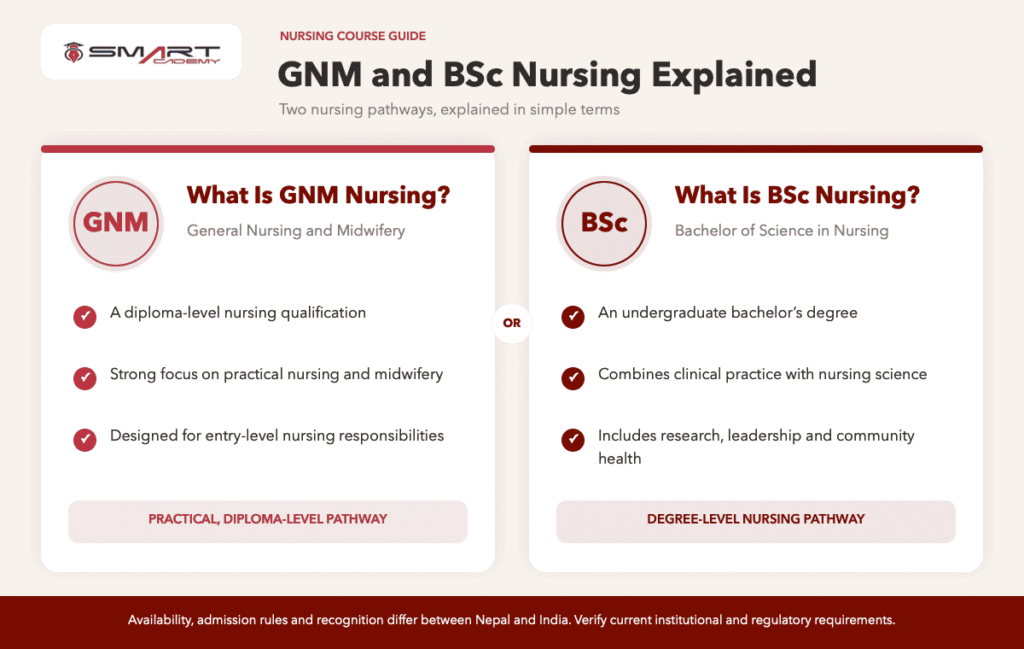
GNM vs BSc Nursing: The Short Answer
Choose BSc Nursing if you meet the science eligibility requirements, can commit to four years of study, and want a bachelor’s qualification with broader academic progression.
Choose GNM if you are considering India, want a three-year diploma route, or do not have the required PCB background for BSc Nursing but only after you confirm the institution’s current approval, your foreign-student eligibility, the complete cost, and the qualification’s future equivalence and licensing pathway in Nepal.
Neither course automatically gives you a particular job, salary, government level, or right to work abroad. Your professional registration, employer criteria, experience, and destination-country rules still matter.
GNM vs BSc Nursing Quick Comparison
| Factor | GNM | BSc Nursing |
| Full form | General Nursing and Midwifery | Bachelor of Science in Nursing |
| Qualification level | Diploma | Bachelor’s degree |
| Current INC-listed duration in India | 3 years | 4 years |
| India baseline entry | 10+2 with English and the required marks; science is preferable. A minimum GPA of 1.6 is required for Nepali students studying GNM nursing in India. | 10+2 with Physics, Chemistry, Biology, and English and the required marks. Nepali students studying BSc Nursing in India require a minimum 2.4 GPA. |
| Nepal availability | GNM is not the usual domestic program name; PCL Nursing is the closest comparison and is listed in phase-out curriculum materials. | Active four-year bachelor’s route through the current MEC admission system. |
| Academic emphasis | Foundational nursing and midwifery education with clinical preparation. | Nursing science, clinical learning, research, education, leadership, and management. |
| Further study | Post Basic BSc Nursing may be possible after the required registration and admission criteria. | Postgraduate nursing study may be possible under the relevant rules. |
| Time to first qualification | Shorter in India. | One year longer than GNM in India. |
| Long-term academic flexibility | Requires a later bachelor’s upgrade for goals that demand a degree. | Bachelor’s level from the start. |
| Nepal registration after study in India | Requires the applicable equivalence, documentation, and NNC licensure pathway. | Requires foreign-degree equivalence, required pre-study approvals, documentation, and the NNC licensure pathway. |
| Often suits | Students whose eligibility and career plans fit a diploma route. | Students eligible for a degree who want broader progression. |
The table gives the broad differences. Your binding rules come from the current regulator, state, university, examining authority, and institution for your intake.
What Is GNM Nursing?
GNM is a diploma-level nursing program that prepares students in general nursing, midwifery, community health, and supervised clinical care. The Indian Nursing Council program table currently lists GNM as a three-year program. Some older pages still show three and a half years because the structure changed from the 2015–16 academic year.
GNM is not a shorter version of the BSc degree. It is a different qualification level with its own admission, examination, registration, and progression route. It can support entry into nursing practice after the graduate completes the professional registration requirements that apply in the intended country of work.
The program may suit a student who wants to begin diploma-level nursing after Grade 12 and later consider Post Basic BSc Nursing. It can also create an option for some students who studied management, humanities, or another non-PCB stream because the INC baseline says science is preferable for GNM rather than universally compulsory. A state or institution may still apply a narrower rule.
What Is BSc Nursing?
BSc Nursing is a four-year undergraduate degree that combines nursing science with clinical education. The curriculum extends beyond foundational bedside care into subjects such as research, nursing education, leadership, management, community health, and evidence-informed practice.
The degree does not remove the practical side of nursing. BSc students also complete supervised clinical learning. The difference is the broader academic level and the way the course prepares graduates for further study and degree-specific opportunities.
In India, the INC baseline requires 10+2 Science with Physics, Chemistry, Biology, and English. In Nepal, BSc Nursing is also a science-entry program, and admission falls under the Medical Education Commission’s current common-entrance and matching process.
GNM vs BSc Nursing in Nepal
Is GNM available in Nepal?
Nepal does not offer General Nursing and Midwifery (GNM) as a standalone program, as diploma-level nursing education is traditionally structured under the Proficiency Certificate Level (PCL) Nursing or equivalent CTEVT pathways.
GNM and PCL Nursing should not be described as automatically identical. A GNM qualification earned in India may be considered through Nepal’s equivalence and licensing process, but the decision depends on the exact award, institution, examining authority, curriculum, documents, and current rules.
BSc Nursing in Nepal
BSc Nursing is an active four-year bachelor’s program in Nepal. The Medical Education Commission’s published guidance says bachelor-level applicants generally need Grade 12 Science or an equivalent qualification with Physics, Chemistry, and Biology and at least 50% aggregate or GPA 2.4.
The applicant must also meet the current MECEE-BL requirements and compete through the applicable merit and matching process. Tribhuvan University’s Institute of Medicine lists B.Sc. Nursing as a four-year program. Its nursing curriculum includes health sciences, nursing foundations, adult and geriatric nursing, psychiatric nursing, midwifery, child health, community health, research, education, management, and practical learning.
For a student who wants to study in Nepal and qualifies through +2 Science, BSc Nursing is therefore the clearer mainstream direct-entry choice.
That does not mean admission is certain or that every college is interchangeable. Check the current MEC notice, seat category, institution status, fees, and clinical-learning arrangements for the exact intake.
GNM vs BSc Nursing in India
India offers both pathways, but the eligibility rules differ.
Eligibility for GNM in India
The Indian Nursing Council’s published eligibility criteria state that a GNM applicant should have:
- passed 10+2 or an equivalent qualification from a recognized board;
- studied English;
- a minimum GPA of 1.6 (for Nepali students studying GNM nursing in India);
- obtained at least 40% in the qualifying examination and in English individually;
- met the applicable age and medical-fitness requirements; and
- followed any additional state, examining-board, or institution rule.
Science is preferred under the national baseline, but it is not the only qualifying stream. This is why a student from management or humanities may find GNM options that are not available for BSc Nursing.
As a Nepali applicant, you are also a foreign national for Indian admission purposes. Confirm the current entry-qualification equivalency process, applicant category, and documents required by the institution and relevant State Nursing Council.
Do not rely on a verbal statement that “Nepali students are eligible.” Ask the institution to identify the written rule it is applying to your profile.
Admission is not identical across India. A state may use an entrance examination and counseling, while another institution or examining system may use a different approved process. Obtain the current prospectus for your intake.
Eligibility for BSc Nursing in India
The INC baseline for BSc Nursing requires:
- 10+2 Science with Physics, Chemistry, and Biology;
- English Core or English Elective;
- Nepali students applying for BSc Nursing in India require a minimum 2.4 GPA.
- At least 45% aggregate from a recognized board; and
- the applicable age, medical-fitness, entrance, state, university, and institution requirements.
Foreign-student document and equivalency requirements also apply.
The BSc Nursing in India application guide explains broader planning questions for students applying from Nepal.
Meeting the national academic baseline does not itself secure a seat. The selected state, university, or institution may use an entrance test, counseling process, merit list, or additional documentary requirement.
Main Differences Between GNM and BSc Nursing
1. Qualification level
This is the most important difference.
- GNM is a diploma qualification.
- BSc Nursing is a bachelor’s degree.
A bachelor’s degree can make later academic progression more direct and may satisfy job or postgraduate criteria that specifically require a degree.
It does not automatically make a new graduate more clinically capable than every GNM graduate. Clinical competence develops through the quality of education, supervised practice, registration, and experience.
2. Duration
The INC currently lists:
- GNM: three years;
- BSc Nursing: four years; and
- Post Basic BSc Nursing: two years in the regular route.
GNM is one year shorter at the initial-qualification stage.
However, a student who completes three years of GNM and then two years of Post Basic BSc Nursing may spend five years in nursing education before reaching bachelor’s level. The direct BSc route takes four years.
Therefore, measure time against your final goal, not just your first graduation date.
3. Curriculum and clinical learning
Both programs include theory and practical learning. The comparison is not “GNM is practical while BSc is only theoretical.”
GNM focuses on the nursing and midwifery foundation required for diploma-level practice. BSc Nursing includes clinical preparation but adds broader bachelor-level work in research, education, leadership, management, and nursing science.
When you compare colleges, ask for more than the subject list. Request written information about:
- clinical rotation sites and departments;
- supervision during practical learning;
- skills-lab access;
- student attendance and assessment;
- patient exposure and rotation scheduling; and
- how students are supported when they have not yet demonstrated a required skill.
4. Admission and entrance process
In Nepal, BSc Nursing admission is controlled through the current MEC process. In India, GNM and BSc admission can vary by state, university, and institution.
A “direct admission” advertisement should never replace the current official prospectus.
Before paying, confirm:
- The program and institution are permitted for the relevant intake.
- The examining or degree-awarding authority.
- The selection method and foreign-student category.
- Your academic and equivalency eligibility.
- The official payment account.
- The refund terms if admission or documentation is not completed.
5. Fees and total cost
There is no responsible Nepal-wide or India-wide fee number that applies to every GNM or BSc student.
Public, private, and self-financing institutions use different structures. Hostel, food, clinical transport, examination fees, uniforms, books, deposits, documentation, and travel can materially change the total.
GNM is one year shorter than BSc Nursing in India, so it may reduce one year of tuition and living expenses. It is not automatically cheaper overall.
A low tuition quote may exclude hostel or compulsory institutional charges, and a later Post Basic BSc route adds more study costs.
Ask for a dated, itemized cost sheet and compare the full program:
| Cost category | What to include |
| Academic | Tuition, admission, university or board registration, examinations, laboratory, and clinical charges |
| Course materials | Uniforms, shoes, books, instruments, and required health or vaccination records |
| Accommodation | Hostel deposits, room fees, electricity, laundry, meals, and transport to clinical sites |
| Nepal–India process | Travel, identity documents, equivalency, NOC, courier, and document-verification costs |
| Family contingency | Fee changes, repeat examinations, emergency travel, health costs, and delayed deposits or refunds |
Parents should ask who receives each payment, what is refundable, and which condition controls a deduction. Keep the offer letter, fee sheet, approval evidence, bank receipt, and refund policy together.
6. Jobs and salary
Both GNM and BSc graduates can enter nursing career pathways after meeting the applicable professional registration and employer requirements.
Possible settings include hospitals, community health services, clinics, residential care, home care, and health projects.
BSc Nursing may create broader access to roles or progression routes that require a bachelor’s qualification. GNM can still support registered nursing work where a diploma and relevant registration satisfy the vacancy criteria.
Do not choose a course using a single online starting-salary figure.
Pay varies by employer, location, registration, experience, appointment level, shift pattern, and employment terms. A BSc degree does not automatically place a new graduate into a senior post, and a GNM diploma does not determine one fixed salary.
Compare actual vacancies and written offers. Ask whether the quoted amount is basic, gross, or take-home pay; what probation applies; how shifts are compensated; and what qualification is required for promotion.
BSc Nursing graduates earn a higher average salary in Nepal compared to GNM or PCL Nursing graduates.
Salary Comparison Breakdown in Nepal
In Nepal, nursing salaries vary by qualification, experience, employer, and sector. The table below provides estimated monthly salary ranges for comparison.
| Sector / Experience Level | GNM / PCL Nursing Salary (per month) | BSc Nursing Salary (per month) |
| Private Sector (Entry-Level / Freshers) | NPR 12,000 – NPR 20,000 | NPR 20,000 – NPR 35,000 |
| Private Sector (Experienced) | NPR 25,000 – NPR 40,000 | NPR 40,000 – NPR 80,000 |
| Government Service (Staff Nurse / 5th Level) | NPR 30,000 – NPR 55,000 | NPR 38,203 base + allowances (~NPR 42,000–55,000+) |
| NGO / INGO Projects | NPR 20,000 – NPR 35,000 | NPR 35,000 – NPR 60,000 |
Salary Comparison Breakdown in India
BSc Nursing graduates may qualify for a broader range of degree-specific roles and career-progression opportunities. However, starting salary and career growth depend on the employer, position, experience, professional registration, and recruitment criteria.
| Sector | GNM (General Nursing & Midwifery) | BSc Nursing (Bachelor of Science) |
| Course Type | 3-year diploma (+6 months internship) | 4-year undergraduate degree |
| Starting Salary (Private Sector) | ₹10,000 – ₹25,000 per month | ₹15,000 – ₹35,000 per month |
| Starting Salary (Government Sector) | ₹20,000 – ₹35,000 per month | ₹35,000 – ₹60,000+ per month (e.g., AIIMS, ESIC) |
| Experienced Salary | ₹25,000 – ₹45,000 per month | ₹50,000 – ₹75,000+ per month |
Salary disclaimer: These figures are indicative estimates based on publicly available job advertisements, salary schedules, and general market references at the time of review. Except where an official government base salary is specifically cited, they are not official pay scales or guaranteed earnings. Actual salaries may vary by employer, location, position, qualification, professional registration, experience, contract type, working hours, allowances, and deductions. Confirm current compensation through the employer’s official vacancy notice or written offer before making a career or financial decision.
7. Further study
GNM and BSc Nursing lead to different education sequences.
The usual GNM progression is:
- Complete a recognized GNM program.
- Obtain the professional registration required for the next course.
- Meet the university’s current admission requirements.
- Complete Post Basic BSc Nursing if that route fits your goal.
The usual BSc Nursing progression is:
- Complete the four-year bachelor’s degree.
- Complete the applicable professional licensing and registration process.
- Apply for MSc Nursing or another eligible postgraduate route under the relevant experience and admission rules.
If you already know that you want a master’s degree, research, teaching, or a career route that requires a bachelor’s qualification, the direct BSc route is usually more efficient.
8. International career planning
A nursing qualification does not travel automatically from one country to another.
The regulator in the country where you want to work decides whether your education, registration, clinical experience, language evidence, examinations, and other documents meet its standards.
A bachelor’s degree may align more directly with degree-level academic requirements in some destinations. That does not make overseas registration automatic.
A GNM graduate may need a bachelor’s upgrade or another assessment depending on the destination.
Plan backward from the regulator, not from a college advertisement:
- Choose the country where you may want to register.
- Read that regulator’s education and registration criteria.
- Compare those criteria with the exact GNM or BSc curriculum and award.
- Include possible language tests, licensing examinations, experience, and document assessment in your plan.
- Choose the course only after you understand the gaps.
Recognition in Nepal After Studying in India
For a Nepali student, India-side approval and Nepal-side registration are separate checks. The Indian institution and program must satisfy the relevant Indian authorities. After graduation, the Nepal Nursing Council will apply its own documentation, equivalence, and licensing requirements.
The Nepal Nursing Council application portal currently separates Nepal-trained and foreign-trained applicants.
For foreign PCL-level nursing, it asks for the relevant marksheets, transcript, character certificate, equivalence certificate, and evidence that the institution was recognized by the relevant council, health ministry, or government authority.
For foreign B.Sc. Nursing, it lists degree equivalence, institution-recognition evidence, and an MEC eligibility letter for students who went abroad after October 1, 2020.
The NNC’s PCL licensure guideline also says a Nepali citizen who completed a PCL nursing program in another country needs equivalence from the concerned government authority and must have graduated from an institution recognized by the relevant nursing council or authorized government body.
Before leaving Nepal, also check the current MEC eligibility-letter and Ministry of Education NOC process for your exact course.
The Ministry’s FAQ says an NOC is required for study in India and that medical-education NOC applications require an MEC eligibility letter.
Use this recognition-first checklist:
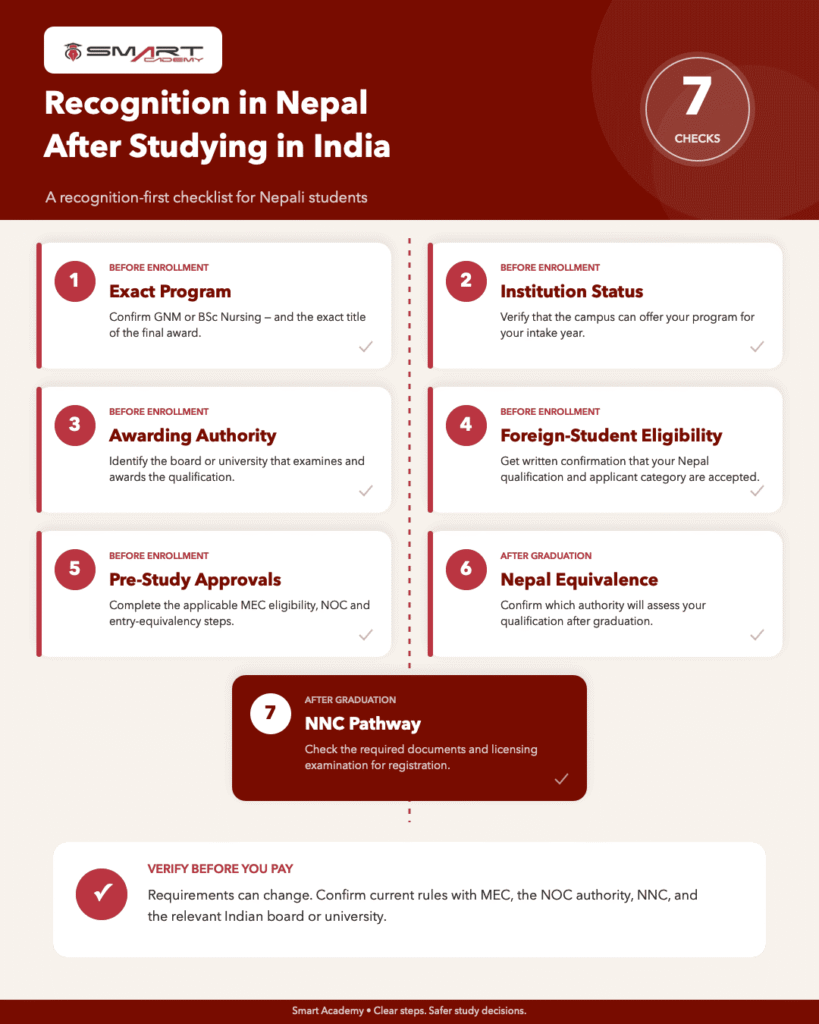
- Exact program: Is the course GNM or BSc Nursing, and what is the final award called?
- Current institution status: Is that campus permitted to offer the program for your intake year?
- Awarding authority: Which board or university conducts examinations and issues the qualification?
- Foreign-student eligibility: Which written rule confirms that your Nepal qualification and applicant category are accepted?
- Pre-study approvals: Which MEC eligibility letter, NOC, and entry-equivalency steps apply before enrollment?
- Nepal equivalence: Which authority will assess the completed qualification?
- NNC pathway: Which documents and licensing examination will apply after graduation?
Do not accept “recognized in Nepal” as a complete answer. Ask the person making that claim to identify the responsible authority, current rule, academic year, campus, and award in writing.
Who Should Choose GNM?
GNM may fit you if:
- you are considering nursing study in India;
- you completed Grade 12 with English but do not meet the PCB criteria for BSc Nursing;
- you want a three-year initial diploma route;
- you value an earlier first qualification and understand that a later bachelor’s upgrade may add time and cost;
- the exact program, institution, foreign-entry route, Nepal equivalence, and NNC pathway have been checked; and
- your family has a complete three-year budget and written refund terms.
Pause before choosing GNM if your plan depends on automatic Nepal recognition, certain employment, a fixed salary, or easy migration. Those outcomes require separate decisions by regulators and employers.
Who Should Choose BSc Nursing?
BSc Nursing may fit you if:
- you completed +2 Science with Physics, Chemistry, Biology, and English;
- you meet the current Nepal or India admission criteria;
- you can commit to four years of study and the full cost;
- you want a bachelor’s qualification without completing a later Post Basic degree;
- you expect to pursue postgraduate nursing, research, education, management, or degree-specific roles; and
- you want broader long-term academic flexibility.
Do not choose BSc Nursing only because someone promised a higher salary. Choose it because the degree structure fits your eligibility, learning goals, finances, and long-term registration plan.
Decision Checklist for Students and Parents
Answer these questions before you choose:
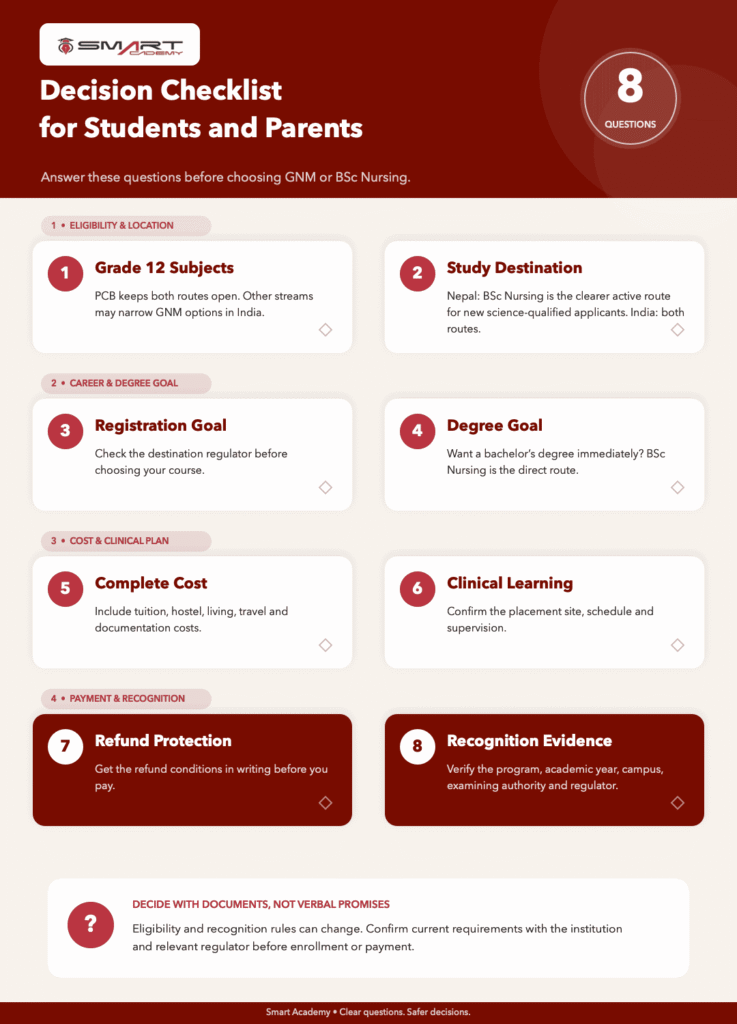
- What subjects did you study in Grade 12? PCB keeps both routes open under the baseline rules. Another stream may limit you to GNM options in India.
- Where do you want to study? In Nepal, BSc Nursing is the clearer active route for a new science-qualified applicant. India currently offers both pathways.
- Where do you want to register after graduation? Check that regulator before choosing the course.
- Do you want a bachelor’s degree immediately? If yes, BSc Nursing is the direct route.
- Is your family comparing the complete cost? Include every academic, hostel, living, travel, and documentation cost.
- What is the clinical-learning plan? Ask where, when, and under whose supervision practical learning takes place.
- What happens if documentation or admission is not approved? Obtain written refund conditions before payment.
- What evidence supports every recognition claim? Check the program, academic year, campus, examining authority, and regulator.
If you are also deciding between countries, read the GNM Nursing in Nepal versus India comparison.
If you are comparing institutions after confirming that GNM is the right course, use current approval evidence when reviewing GNM nursing colleges in Bangalore.
Frequently Asked Questions
Is GNM equal to BSc Nursing?
No. GNM is a diploma, while BSc Nursing is a bachelor’s degree. Both can form part of a nursing career after the applicable registration process, but they differ in academic level, duration, eligibility, curriculum breadth, and further-study route.
Which is better, GNM or BSc Nursing?
BSc Nursing is usually the stronger option if you are eligible for both and want a direct bachelor’s degree with broader academic progression. GNM may fit you better if you want a three-year diploma route in India or do not have the PCB subjects required for BSc Nursing.
Can I study GNM in Nepal?
GNM is not the usual domestic program name in Nepal. PCL Nursing is the closest certificate-level comparison, but CTEVT lists its PCL Nursing curriculum under phase-out materials. Do not assume a current seat exists; verify the intake with CTEVT, NNC, and the institution.
Can a management or humanities student study GNM?
Possibly in India. The INC baseline requires 10+2 with English and the stated minimum marks and says science is preferable. A state, board, or institution may use stricter rules, and foreign-student equivalency also applies. Check the current official prospectus before applying.
Can a management or humanities student study BSc Nursing?
Not under the standard India or Nepal eligibility routes described in the current official guidance. BSc Nursing normally requires 10+2 Science with Physics, Chemistry, Biology, and English, plus the applicable marks and entrance requirements.
Can I do BSc Nursing after GNM?
A GNM graduate may be eligible for Post Basic BSc Nursing after obtaining the required nursing registration and meeting the selected university’s current criteria. This is not the same as entering the four-year basic BSc Nursing program from the beginning.
Does BSc Nursing have a higher salary than GNM?
Not in every job. BSc Nursing may qualify you for more degree-specific roles and progression routes, but salary depends on the employer, post, registration, experience, location, shifts, and employment terms. Compare actual vacancies and written offers rather than a single online average.
Can I work in Nepal after completing GNM in India?
Not automatically. You need to meet the applicable Nepal equivalence, documentation, Nepal Nursing Council licensing, and registration requirements. Check the exact GNM award, institution, examining authority, and study pattern with the responsible authorities before enrollment.
Which course is more suitable for working abroad?
BSc Nursing may align more directly with degree-level education requirements, but neither course creates automatic overseas registration. The destination regulator may require qualification assessment, registration, language evidence, examinations, experience, or further study.
Final Verdict
For a student who qualifies for both, can fund four years, and wants the widest direct academic progression, BSc Nursing is generally the more flexible long-term choice.
It gives you a bachelor’s degree from the start and avoids the extra Post Basic step required to bring a GNM route to bachelor’s level.
GNM remains a valid course choice in India for the right student. It can provide a shorter initial route and may be open to some students without a PCB background.
Its value depends on whether the exact institution, award, clinical education, foreign-student admission, Nepal equivalence, and licensing plan withstand careful verification.
If you want to study in Nepal, do not treat GNM as a routine current domestic option. Check active programs and current authority notices.
If you want to study in India, put recognition before price and get every material claim in writing. Our counselors can help you compare your Grade 12 subjects, marks, budget, preferred country, and registration goal.
WhatsApp Smart Academy to review whether GNM or BSc Nursing fits your profile and which documents you should verify next.
Regulatory Note
This article provides general education-planning information based on official sources available on the review date. Admission, equivalence, licensing, and professional-registration rules can change, and each application is assessed under the applicable authority’s current requirements. Confirm the exact course, institution, intake, and documents with the responsible regulator before acting or paying a fee.