
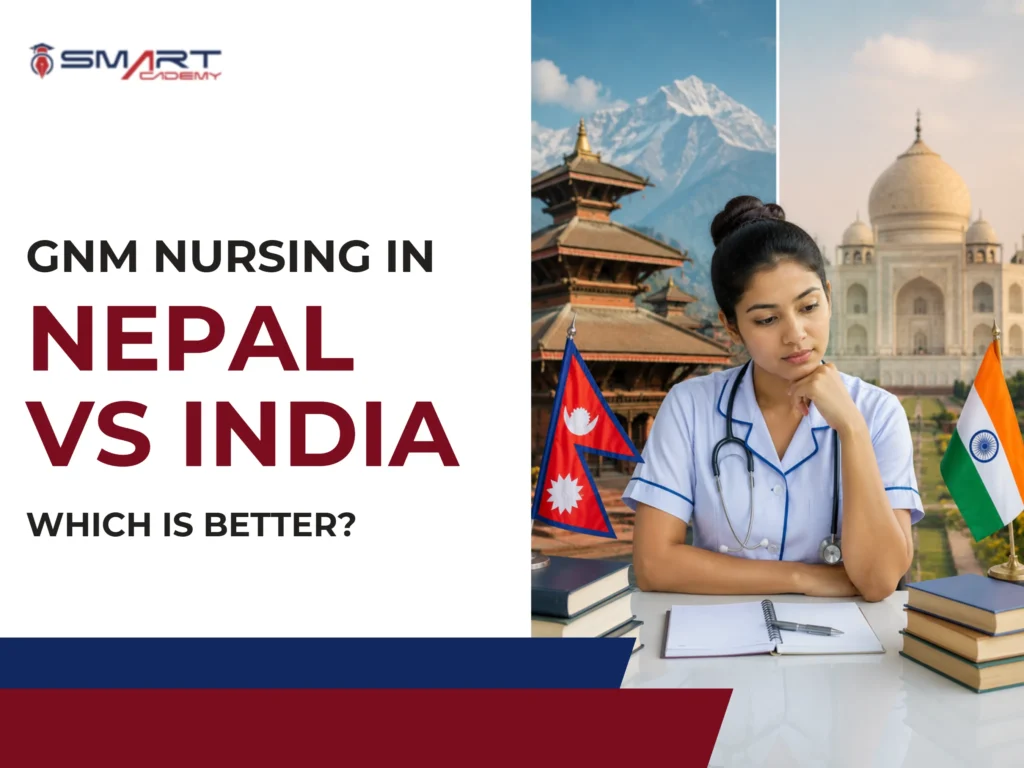
For most Nepali students, GNM Nursing in India is the better option for clinical exposure, specialization opportunities, and long-term career growth, whereas Nepal is often the better choice for affordability, convenience, and local employment. Both countries offer recognized nursing qualifications, but they differ in eligibility requirements, training structure, costs, and career pathways.
Nepal offers a 3-year PCL Nursing-equivalent program with lower living expenses, easier access to local employment, and a familiar learning environment. However, seat availability is limited, and opportunities for specialization are comparatively few.
India offers a 3- to 3.5-year GNM program with a mandatory internship, larger seat capacity, stronger hospital affiliations, broader clinical exposure, and more higher-education pathways, such as Post Basic BSc Nursing and specialized nursing programs. Indian GNM qualifications are also recognized in Nepal after completing the required registration and equivalency procedures. Ultimately, students seeking lower costs and convenience may prefer Nepal, while those aiming for stronger career growth, wider opportunities, and international mobility will often benefit more from pursuing GNM Nursing in India.
What Are the Key Differences Between GNM Nursing in Nepal and India?
The key differences between GNM Nursing in Nepal and India are course structure, program duration, internship requirements, and regulatory recognition. While both programs prepare students for nursing and patient care roles, Nepal offers a 3-year program equivalent to PCL Nursing, whereas India provides a 3 to 3.5-year General Nursing and Midwifery (GNM) course that includes a mandatory internship. The nursing councils that regulate education and professional registration also differ between the two countries, which can influence recognition and licensing requirements for graduates.
GNM Nursing Course Structure
The GNM (General Nursing and Midwifery) course in Nepal and India shares a diploma-level framework but differs in structural execution and mandatory internship protocols. In Nepal, the GNM program is considered equivalent to the PCL (Proficiency Certificate Level) Nursing qualification. The course blends core theoretical knowledge with clinical training through fundamental modules such as midwifery, psychiatric nursing, patient care, and community health.
In contrast, GNM in India similarly balances academic study with clinical mastery. However, it integrates a highly standardized, mandatory six-month rotation block across specialized departments (such as ICUs, Pediatric units, and OBG wards), ensuring deep practical application before graduation. Both countries deliberately engineer their GNM nursing course structures to build competent, entry-level professionals capable of stepping directly into staff nurse positions.
GNM Nursing Course Duration
GNM Nursing course in Nepal follows a 3-year diploma-level nursing framework that is considered equivalent to PCL Nursing, whereas in India, the program follows a 3 to 3.5-year structure that includes a mandatory internship component. Both nursing programs combine theoretical learning, clinical training, patient care education, and community health nursing. The main difference lies in how clinical exposure and internships are incorporated into the curriculum.
| Aspect | GNM Nursing in Nepal | GNM Nursing in India |
| Total Program Length | Exactly 3 academic years | 3 to 3.5 years |
| Internship Framework | Integrated directly into the 3rd academic year | 6-month mandatory standalone internship |
| Academic System | Structured on a standardized yearly system | Semester or yearly systems paired with clinical blocks |
Regulatory Bodies and Nursing Councils
The regulatory bodies for GNM Nursing in Nepal and India are the Nepal Nursing Council (NNC) and the Indian Nursing Council (INC), which oversee nursing education, registration, and professional standards. In Nepal, the NNC regulates nursing and midwifery programs, licenses qualified nurses, and maintains professional practice standards.
In India, the INC establishes national standards for nursing education and approves GNM nursing programs. State Nurses Registration Councils (SNCs) work alongside the INC to manage registration and licensing at the state level. These councils ensure that approved institutions follow recognized academic and clinical training requirements. Their oversight supports the credibility, quality, and legal recognition of GNM nursing qualifications, helping graduates meet professional registration requirements in their respective countries.
How Do GNM Nursing Eligibility Requirements Compare in Nepal and India?
GNM Nursing eligibility requirements in Nepal and India differ mainly in academic background, subject requirements, minimum marks, age criteria, and admission pathways. Nepal follows stricter academic requirements and often prioritizes Science stream students, whereas India accepts candidates from multiple streams if they meet the required marks and English language criteria. Understanding these differences can help students determine which pathway aligns better with their educational background.
Academic Qualification Requirements
The minimum academic qualification for GNM Nursing in both Nepal and India is completion of 10+2 or an equivalent qualification from a recognized board. In Nepal, GNM nursing is categorized as Proficiency Certificate Level (PCL) Nursing and operates as a post-Grade 10 track that students enter directly following their Secondary Education Examination (SEE) or School Leaving Certificate (SLC), requiring a minimum 2.0 GPA with a non-negotiable Grade C in compulsory Mathematics, Science, and English.
India’s GNM program is strictly a post-Grade 12 qualification. Applicants must complete 10+2 (Higher Secondary Education) with an aggregate score of 40% to 45% and secure a passing grade in English as an individual subject. For international applicants, including Nepali students, high school credentials must be validated by the Association of Indian Universities (AIU) to establish equivalency with India’s intermediate education system before admission.
Science Stream and Subject Requirements
Science stream requirements are stricter in Nepal than in India for GNM nursing courses. In Nepal, a student’s high school coursework directly affects eligibility for nursing education. Most PCL Nursing programs require candidates to have passed compulsory Mathematics, compulsory Science, and English at the secondary level, although graduates from recognized Technical SLC or Pre-Diploma auxiliary health programs may also qualify. This creates a more structured entry pathway tied to specific academic subjects.
In contrast, the Indian Nursing Council (INC) follows a more flexible admission framework for GNM Nursing. Students from Science, Arts, or Commerce streams can apply, provided they have completed 10+2 and passed English as a compulsory subject. Although some colleges prefer applicants with a Science background, particularly Biology, the overall eligibility framework is broader and allows students from multiple academic streams to pursue GNM Nursing.
Minimum Marks Criteria
To qualify for GNM Nursing in India, students must complete their 10+2 or equivalent education with English as a mandatory subject and secure a minimum aggregate score of 40% to 50%. In Nepal, eligibility is tied to stronger academic performance in prescribed subjects and institutional grade requirements. Some Indian nursing colleges accept a 40% aggregate, while others may require 50% or higher, depending on seat availability and admission competition.
Certain institutions may also specify minimum marks in English, theory papers, or practical assessments. Because admission standards vary by college, students should review the eligibility criteria of their preferred institution before applying. Meeting the required academic benchmarks is necessary for admission into a recognized General Nursing and Midwifery (GNM) program.
Age Requirements
The minimum age requirement for GNM Nursing admission in both Nepal and India is 17 years, whereas the upper age limit differs between the two countries. Candidates must be 17 years of age by December 31 of the admission year to become eligible for enrollment. In Nepal, admission to many government-funded and CTEVT-affiliated nursing programs is restricted to applicants below 25 years of age.
In India, the traditional upper age limit for GNM Nursing has been 35 years for standard applicants. Recent regulatory updates have provided greater flexibility, particularly for qualified healthcare workers. Registered Auxiliary Nurse Midwives (ANMs) and Lady Health Visitors (LHVs) may receive age-related exemptions, and some admission frameworks no longer impose an upper age limit on these candidates. These age requirements help ensure that students are academically and personally prepared for clinical training and professional nursing responsibilities.
Entrance Examination Requirements
The entrance examination requirements for GNM Nursing are more centralized in Nepal, whereas India follows a flexible institution-based admission system. In Nepal, admission is primarily managed through the Council for Technical Education and Vocational Training (CTEVT), which uses a merit-based selection process based on academic performance and applicable reservation criteria. Selection is determined through the evaluation of qualifying examination results rather than a separate national nursing entrance test.
In India, there is no centralized national entrance examination for GNM Nursing. Admission occurs through two routes, merit-based selection and state-level or institution-specific entrance examinations. Many GNM nursing colleges admit students based on their 10+2 marks, while some states and private institutions conduct their own entrance tests to manage admissions more competitively. Because admission procedures vary across institutions, students should verify whether their preferred college requires an entrance examination or offers admission based solely on academic merit.
How Does the GNM Nursing Admission Process Compare Between Nepal and India?
GNW Nursing admission processes in Nepal are largely managed by regulatory bodies such as CTEVT and affiliated institutions, whereas in India, admission procedures vary by state and college, with institutions offering merit-based, entrance-based, or a combination of both admissions. Although both countries require candidates to meet academic eligibility standards, the application and selection process is more standardized in Nepal than in India.
Application Process
The application process for GNM Nursing in Nepal is conducted through centralized institutional systems, whereas in India, students apply directly to individual colleges or state-level admission authorities. Nepali applicants submit academic records, eligibility documents, and application forms through designated admission channels. In India, students must identify eligible colleges, complete application forms, submit required documents, and, where applicable, appear for institution-specific or state-level entrance examinations. Because admission procedures vary across Indian states and colleges, applicants should carefully review the requirements of their preferred institution before applying.
Required Documents
The required documents for GNM Nursing admission in Nepal and India are largely similar, although students applying across borders may need additional verification, migration, and travel-related documents. Submitting complete documentation helps institutions verify academic qualifications, identity, eligibility, and regulatory compliance before granting admission.
Required Documents for GNM Nursing in Nepal:
- Academic Transcripts and Mark Sheets: Original certificates and mark sheets of 10+2 or an equivalent qualification. Most institutions accept students from the Science, Management, or Humanities streams, provided English was studied as a compulsory subject.
- Character Certificate: A character certificate issued by the last attended school or college.
- Citizenship Certificate: A copy of a valid Nepali citizenship certificate for identity verification.
- Passport-Size Photographs: Recent passport-sized photographs with a white background.
- Entrance Examination Documents (If Applicable): Admit card, scorecard, or result of entrance examinations such as the CEE or institution-specific admission tests.
- Migration or Transfer Certificate: Required when transferring between educational boards, universities, or institutions.
- Medical Fitness Certificate: Proof of physical and mental fitness issued by a registered medical practitioner.
Required documents for GNM nursing in India are:
- Academic Transcripts and Certificates: Original and photocopies of Class 10 and Class 12 mark sheets and certificates from a recognized board. These documents verify academic eligibility for the GNM nursing course.
- Identity Proof: A valid government-issued identity document such as Aadhaar Card, Passport, Voter ID, or other accepted identification proof.
- Passport-Size Photographs: Recent passport-sized photographs required for application forms, admission records, and institutional documentation.
- Medical Fitness Certificate: A certificate issued by a registered medical practitioner confirming that the applicant is physically and mentally fit to participate in nursing education and clinical training.
- Character Certificate: A character certificate issued by the last attended school, college, or a recognized authority verifying the applicant’s conduct and academic standing.
- Transfer Certificate (TC): A transfer certificate from the previously attended institution confirming the student’s academic status and eligibility for admission.
- Migration Certificate: Required for students transferring from a different educational board, state board, or university, depending on institutional requirements.
- Category Certificate (If Applicable): Candidates applying under reserved categories such as SC, ST, OBC, EWS, or other recognized categories may need to submit valid supporting certificates.
Merit-Based vs Entrance-Based Admission
Nepal strictly enforces a single, competitive national entrance examination for admission, while India uses a hybrid system of state entrance tests and direct 12th-grade merit selection. To secure a seat in Nepal, every candidate must clear a 100-mark multiple-choice CTEVT entrance exam that tests 9th- and 10th-grade Science, Math, English, and General Knowledge, with seat allocation determined by a strict national merit ranking.
India, however, offers considerable flexibility, as highly competitive states like West Bengal and Uttar Pradesh conduct specialized computer-based entrance exams (such as ANM/GNM tests), whereas many other states and private institutions entirely bypass entrance tests, filling their allocations solely through open merit lists based on Class 12 board marks.
Admission Timeline
The GNM Nursing admission timeline in Nepal is more centralized and follows the academic schedules announced by institutions such as CTEVT and affiliated colleges, whereas in India, admission timelines vary by state, university, and nursing college. In Nepal, application notices are published after secondary and higher secondary examination results are released, followed by entrance examinations or merit evaluations, counseling, and final enrollment.
In India, the admission cycle begins after the completion of 10+2 examinations and may continue until late November, depending on the institution. During this period, colleges release application forms, conduct entrance examinations where required, publish merit lists, and complete admission formalities. Because admission schedules differ between the two countries, students should regularly monitor official notices and application portals to avoid missing important deadlines, counseling rounds, or document verification requirements.
How Does the Cost of GNM Nursing Compare in Nepal and India?
The cost of GNM Nursing in Nepal is between NPR 4,00,000 and NPR 6,00,000+, whereas in India it ranges from ₹3,50,000 to ₹5,00,000, depending on the nursing institution. The total cost in both countries varies based on factors such as college type, accommodation arrangements, location, and additional academic expenses. Beyond tuition fees, students should also consider hostel charges, food expenses, books, uniforms, and clinical training costs when comparing the overall financial commitment of completing a GNM nursing program.
Tuition Fees
The tuition fees for GNM Nursing in Nepal range from NPR 4,00,000 to NPR 6,00,000+, whereas in India the total tuition cost ranges from ₹30,000 to ₹5 lakh, depending on the institution. In both countries, government-affiliated colleges are more affordable than private institutions. In India, government nursing colleges charge between ₹20,000 and ₹50,000 per year, while private colleges may charge ₹50,000 to ₹2,00,000 per year.
Similarly, tuition fees in Nepal vary based on institutional ownership, facilities, and affiliation, with private colleges charging higher fees than government-supported institutions. These variations make the type of college, location, and available facilities important factors when comparing the overall cost of GNM nursing education.
Hostel and Accommodation Costs
Hostel and accommodation costs for GNM Nursing students in Nepal range from NPR 10,000 to NPR 50,000+ per year, whereas in India they range from NPR 8,000 to NPR 24,000 per year, depending on the institution and facilities provided. These expenses constitute a significant portion of the total cost of nursing education and can vary by location, room type, meal plans, and campus amenities.
In India, some nursing colleges offer bundled fee packages that combine tuition and hostel charges, with the total cost of a three-year GNM Nursing program reaching approximately ₹5,41,500 in certain institutions. Students should compare hostel availability, accommodation facilities, meal arrangements, and additional residential charges before making a final decision, as these factors can substantially influence the overall cost of studying GNM Nursing.
Food and Living Expenses
Food and living expenses for GNM Nursing students in Nepal range from NPR 8,000 to NPR 20,000 per month, whereas in India they range from ₹6,000 to ₹15,000 per month, depending on the city and lifestyle. These expenses cover daily meals, transportation, personal necessities, and other routine living costs during the course period. In India, many nursing colleges offer all-inclusive packages that cover tuition, accommodation, and food, with total program costs often ranging from ₹3,50,000 to ₹5,00,000 for the entire course duration.
Cost-of-living comparisons also suggest that Nepal is slightly more expensive than India in several day-to-day spending categories. For example, a meal at an inexpensive restaurant costs approximately NPR 300 in Nepal compared to about ₹187 in India. As a result, students should evaluate food and living expenses alongside tuition and accommodation costs when comparing the overall affordability of GNM Nursing programs in both countries.
Books, Uniforms, and Clinical Training Costs
Books, uniforms, and clinical training costs for GNM Nursing students in Nepal range from NPR 15,000 to NPR 50,000 over the course duration, whereas in India, these expenses range from ₹10,000 to ₹40,000 depending on the institution and training requirements. These costs cover nursing textbooks, study materials, clinical uniforms, nursing kits, and other academic resources required throughout the program.
In both countries, clinical training forms a core component of nursing education and is included within the institutional fee structure rather than charged separately. While students may incur additional expenses for replacement uniforms, reference books, or practical supplies, these costs remain relatively small compared to tuition and accommodation expenses. As a result, books, uniforms, and clinical training charges contribute only a modest portion of the overall cost of completing a GNM Nursing program in Nepal or India.
Cost Comparison
The total cost of GNM Nursing in Nepal ranges from NPR 4,00,000 to NPR 6,00,000+, whereas in India it ranges from ₹3,50,000 to ₹5,00,000, depending on the institution, accommodation, and living arrangements. While Nepal may offer lower relocation expenses for local students, India offers a wider range of nursing colleges and package-based fee structures that often include accommodation and food.
| Cost Component | Nepal | India |
| Total Program Cost | NPR 4,00,000 to NPR 6,00,000+ | ₹3,50,000 to ₹5,00,000 |
| Government College Fees | Lower than private institutions | ₹20,000 to ₹50,000 per year |
| Private College Fees | Higher than government institutions | ₹50,000 to ₹2,00,000 per year |
| Hostel & Accommodation | NPR 10,000 to NPR 50,000+ per year | NPR 8,000 to NPR 24,000 per year |
| Food & Living Expenses | NPR 8,000 to NPR 20,000 per month | ₹6,000 to ₹15,000 per month |
| Books & Uniforms | NPR 15,000 to NPR 50,000 (course duration) | ₹10,000 to ₹40,000 (course duration) |
| Travel Expenses | Minimal for local students | Additional cost for Nepali students studying abroad |
| Clinical Training Charges | Included in institutional fees | Included in institutional fees |
| Overall Affordability | Lower relocation costs and a familiar environment | Wider college options and bundled fee packages |
How Do GNM Nursing Colleges and Training Facilities Compare in Nepal and India?
GNM Nursing colleges and training facilities in Nepal and India differ in terms of seat availability, hospital partnerships, clinical exposure, and learning infrastructure. Nepal offers a limited number of nursing seats and institutions, whereas India provides a much larger network of nursing colleges affiliated with hospitals and healthcare systems. These differences can influence the quality of practical training, patient exposure, and overall learning experience during the program.
College Availability and Seat Capacity
Nepal. Nepal has a limited number of nursing institutions and a highly competitive admission environment. In fact, PCL Nursing programs in Nepal collectively offer only around 40 seats, creating intense competition among applicants seeking nursing education within the country. Some of the well-known nursing institutions in Nepal include Nepal Nursing Campus, Kathmandu Medical College, and the National Academy of Medical Sciences (NAMS).
In contrast, India has a much larger network of government and private nursing colleges. According to regulatory guidelines, GNM Nursing programs affiliated with parent medical colleges or hospitals with at least 300 beds can admit up to 100 students per intake. This increased seat capacity expands access to nursing education and enables institutions to support higher student enrollment while meeting clinical training requirements.
Hospital Affiliations
Hospital affiliations are a mandatory component of nursing education in both Nepal and India, although India offers access to a larger network of affiliated healthcare institutions. Nursing colleges in Nepal partner with teaching hospitals, government hospitals, community health centers, and private healthcare facilities to provide clinical training opportunities.
In India, many GNM nursing colleges are directly attached to large hospitals or medical colleges, allowing students to train in diverse healthcare settings. These affiliations help students develop practical nursing skills and gain experience in patient care, emergency services, maternal health, and community healthcare environments.
Clinical Exposure
Clinical exposure is broader in India due to the larger patient population and healthcare infrastructure, whereas Nepal offers clinical training through a more limited healthcare network. Students in both countries participate in hospital postings, ward rotations, community health activities, and patient care responsibilities.
Indian nursing colleges often provide exposure to a wider variety of medical specialties and higher patient volumes, which can strengthen practical learning. Nepalese institutions also offer valuable hands-on experience, particularly through teaching hospitals and community health programs, but the extent of exposure may vary by institution and location.
Laboratory and Learning Facilities
Laboratory and learning facilities are available in nursing colleges across Nepal and India, although the quality and scale of these resources vary by institution. Most nursing colleges maintain nursing laboratories, anatomy and physiology labs, demonstration rooms, libraries, and clinical simulation facilities to support practical learning.
In Nepal, facility quality varies between institutions, with larger colleges often offering more advanced learning resources. In India, many established nursing colleges provide modern laboratories, digital learning resources, simulation-based training environments, and extensive library facilities. These resources support the development of clinical skills before students enter real healthcare settings.
Internship Opportunities
Internship opportunities are more formally structured in India, whereas practical training in Nepal is often integrated throughout the nursing program. In Nepal, students gain hands-on experience through clinical postings, hospital rotations, and community health placements conducted during their studies. In India, GNM Nursing programs include a mandatory six-month internship that provides supervised practical training in hospitals and healthcare facilities.
This internship allows students to apply their theoretical knowledge in real-world healthcare environments and develop professional competencies before entering the workforce. Both systems emphasize practical learning, but India’s standalone internship provides an additional period of concentrated clinical experience.
How Does the GNM Nursing Curriculum Compare Between Nepal and India?
The GNM Nursing curriculum in Nepal and India is broadly similar, as both programs focus on nursing fundamentals, patient care, community health, and midwifery training, though India offers more structured internship and clinical exposure opportunities. In Nepal, GNM-equivalent nursing education is delivered through PCL Nursing programs, whereas in India, the General Nursing and Midwifery (GNM) framework is regulated by the Indian Nursing Council (INC). Both pathways aim to prepare students for professional nursing practice through a combination of theoretical learning and practical healthcare training.
Core Nursing Subjects
The core nursing subjects taught in Nepal and India are largely similar and focus on building foundational nursing knowledge and patient care skills. Students in both countries study subjects such as Anatomy and Physiology, Fundamentals of Nursing, Microbiology, Nutrition, Psychology, Medical-Surgical Nursing, Child Health Nursing, and Mental Health Nursing. These subjects help students understand human health, disease management, nursing procedures, and patient care responsibilities. While curriculum structures may differ slightly between institutions, the academic foundation remains comparable across both countries.
Community Health Nursing Training
Community Health Nursing training is a core component of nursing education in both Nepal and India. Students participate in community-based health programs, field visits, health awareness campaigns, and preventive healthcare activities designed to improve public health outcomes. In Nepal, community health training often focuses on rural healthcare delivery and primary healthcare services. In India, students receive similar training through community postings, health centers, and outreach programs. This practical exposure helps nursing students understand population health needs and prepares them for roles in hospitals, clinics, and community health services.
Midwifery Training
Midwifery training forms an important part of the nursing curriculum in both Nepal and India, although India provides more extensive structured clinical exposure through its internship component. Students learn maternal healthcare, antenatal care, labor management, postnatal care, newborn assessment, and reproductive health services. Clinical postings in maternity wards allow students to develop practical skills under supervision. Because General Nursing and Midwifery is specifically designed to integrate nursing and maternal healthcare education, midwifery remains one of the most important components of the curriculum in both countries.
Theoretical and Practical Learning Balance
Both Nepal and India maintain a strong balance between theoretical learning and practical training, although India provides more structured hands-on exposure through On-the-Job Training (OJT) and a mandatory internship. Students in both countries study core nursing subjects such as anatomy, physiology, patient care, and community health nursing while participating in hospital-based clinical training. In Nepal, practical learning is integrated throughout the program, whereas Indian GNM students receive additional supervised clinical exposure during their final-year OJT and internship. This combination of classroom instruction and real-world healthcare experience helps bridge the gap between theory and practice, preparing graduates for professional nursing responsibilities.
Clinical Training Hours
Clinical training hours are substantial in both Nepal and India because nursing education relies heavily on supervised patient care experience. Students spend significant time in hospitals, community health centers, maternity wards, and specialized healthcare units to develop practical nursing skills. In Nepal, clinical training is integrated throughout the program through hospital postings and practical assignments. In India, clinical training is conducted throughout the academic years and is supplemented by a mandatory six-month internship, providing additional exposure to real-world healthcare settings. As a result, students in both countries graduate with practical experience, although Indian GNM programs often provide a longer period of structured clinical training before professional practice.
How Do GNM Nursing Qualifications and Recognition Compare?
GNM Nursing qualifications from Nepal and India are widely recognized within their respective countries, but recognition procedures, registration requirements, and international licensing pathways can differ. In Nepal, Indian GNM qualifications are recognized as equivalent to PCL Nursing after meeting the necessary regulatory requirements, while in India, GNM remains a recognized diploma-level nursing qualification regulated by the Indian Nursing Council (INC). Students planning to work domestically or internationally should understand the recognition, registration, and licensing requirements that apply in their target country.
National Recognition
GNM Nursing qualifications obtained in India are recognized in Nepal and are considered equivalent to PCL Nursing after completing the required verification process. This recognition is supported by Nepal’s University Grants Commission (UGC), which evaluates and validates foreign nursing qualifications for academic and professional acceptance. As a result, graduates from recognized Indian GNM programs can register with Nepalese nursing authorities and seek employment in Nepal’s healthcare sector. In India, GNM qualifications approved by the Indian Nursing Council (INC) are recognized nationwide, allowing graduates to work across hospitals, clinics, nursing homes, and community healthcare institutions.
Nursing Council Registration
Nursing Council registration is mandatory for GNM graduates in both Nepal and India before they can practice professionally. In Nepal, graduates must pass the Nepal Nursing Council (NNC) licensing examination and obtain registration to work legally as nurses. Indian GNM graduates seeking registration in Nepal must submit their academic credentials and complete the required equivalency process. In India, GNM programs are approved by the Indian Nursing Council (INC) and regulated through State Nursing Councils. Candidates applying for qualification equivalency may also be required to pay the prescribed INC equivalency fee of ₹5,000. Likewise, Nepali nurses seeking employment in India must complete reciprocal registration requirements established by the relevant Indian nursing authorities.
International Recognition
GNM Nursing qualifications from India offer greater international mobility because they are widely recognized by nursing regulators and healthcare employers in many countries. Indian GNM qualifications recognized in Nepal allow graduates to register and work professionally within Nepal’s healthcare system, while also offering a faster pathway into the nursing workforce than longer degree programs. Graduates can pursue opportunities in countries such as the United Kingdom, Australia, Canada, the United States, and Gulf nations, provided they meet local licensing requirements. This combination of professional recognition and quicker workforce entry makes Indian GNM programs an attractive option for students seeking domestic and international career opportunities.
Licensing and Verification Requirements
Licensing and verification requirements for GNM graduates involve registration, credential verification, and regulatory approval before professional practice is permitted. In Nepal, nurses must maintain active registration with the Nepal Nursing Council (NNC) and pass the required licensing examination. Indian GNM qualifications are recognized in Nepal, but graduates must submit proof of registration and academic credentials and complete the equivalency process, which may include payment of the INR 5,000 INC equivalency fee. Qualifications from recognized institutions such as IGNOU, Chaudhary Charan Singh University, and Uttarakhand University are accepted for verification purposes. For international practice, nurses may also need credential evaluations and licensing examinations such as CGFNS, NCLEX-RN, CBT, or OSCE, depending on the destination country’s regulatory requirements.
How Do Career Opportunities After GNM Nursing Compare in Nepal and India?
Career opportunities after GNM Nursing are available in both Nepal and India, although India offers a larger healthcare market and a wider range of nursing roles. Graduates in both countries can work in hospitals, clinics, community health centers, nursing homes, and public health programs. Since Indian GNM qualifications are recognized in Nepal, graduates can also pursue employment opportunities across both countries after meeting the required registration requirements.
Career Paths After GNM
GNM graduates in Nepal and India can pursue a variety of clinical, community, and supervisory nursing roles after obtaining registration with the nursing council. Common career paths include Staff Nurse, Clinical Nurse, Community Health Nurse, ICU Nurse, Home Care Nurse, Midwife, and Nursing Supervisor. Graduates may also continue their education through programs such as Post Basic BSc Nursing, which can expand career opportunities and support progression into specialized nursing fields and leadership positions.
Government Sector Opportunities
Government healthcare institutions in both Nepal and India offer stable employment opportunities for GNM-qualified nurses. In Nepal, registered nurses can work as Staff Nurses, Community Health Officers (CHO), Public Health Nurses, and Auxiliary Nurse Midwives (ANMs) in government hospitals and public health facilities. In India, GNM graduates are eligible to apply for nursing positions in central and state government hospitals, railway hospitals, military healthcare services, and public health departments. These roles often provide structured career progression, professional development opportunities, and long-term job stability.
Private Hospital Opportunities
Private hospitals are among the largest employers of GNM graduates in both Nepal and India. Registered nurses can work in multi-specialty hospitals, nursing homes, clinics, diagnostic centers, rehabilitation facilities, and specialty healthcare units. Since Indian GNM qualifications are recognized in Nepal, graduates from Indian nursing colleges can register with the Nepal Nursing Council and pursue employment in Nepalese private hospitals and healthcare institutions. The private sector also offers opportunities to gain experience in specialized areas such as critical care, emergency nursing, surgical nursing, and maternal healthcare.
Community and Public Health Roles
Community and public health roles allow GNM graduates to contribute directly to population health and preventive healthcare services. Common positions include Community Health Nurse, Clinical Nurse, Staff Nurse, and Community Health Worker in hospitals, primary healthcare centers, nursing homes, and outreach programs. These professionals participate in health education, maternal and child health services, vaccination campaigns, disease prevention initiatives, and community-based healthcare programs. Because community health nursing is a core part of GNM training, graduates are well prepared for public health responsibilities in both urban and rural healthcare settings.
International Employment Opportunities
International employment opportunities are available to GNM graduates from both Nepal and India, although additional licensing and credential verification requirements must be completed. Popular destinations include the United Kingdom, Australia, Canada, the United States, Germany, Ireland, and Gulf countries, where demand for qualified nurses remains strong. Graduates must obtain local nursing registration and pass country-specific licensing examinations such as the NCLEX-RN, CBT, OSCE, or other regulatory assessments. The international recognition of Indian GNM qualifications, combined with practical clinical training, provides graduates with a pathway to pursue nursing careers abroad once they meet destination-country requirements.
How Do GNM Nursing Salaries Compare in Nepal and India?
GNM Nursing salaries in Nepal range from NPR 10,000 to NPR 70,000+ per month, whereas in India they range from ₹12,000 to ₹59,400+ per month depending on experience, employer type, and location. In both Nepal and India, earnings increase with professional experience, additional qualifications, and progression into senior nursing or supervisory roles. This makes long-term career growth an important factor when comparing nursing opportunities between the two countries.
Starting Salary
The starting salary for GNM nurses in Nepal ranges from NPR 10,000 to NPR 15,000 per month in private healthcare institutions, whereas in India, entry-level GNM nurses earn between ₹22,000 and ₹30,000 per month. Government nursing positions in India may offer a starting basic salary of approximately ₹34,730 per month, while salaries in Nepal vary by institution, location, and sector. Fresh graduates often use these early-career roles to gain clinical experience before pursuing higher-paying opportunities.
Government Sector Salary
Government sector salaries for GNM nurses are more structured and standardized than private-sector compensation in both Nepal and India. In Nepal, entry-level government nurses earn around NPR 34,730 per month under the fifth-level pay scale, with salaries increasing through promotions and years of service. Experienced government nurses may earn between NPR 45,000 and NPR 70,000 per month, depending on position and seniority. In India, government-employed GNM nurses earn between ₹27,800 and ₹59,400 per month, excluding additional allowances and benefits provided by central or state government institutions.
Private Sector Salary
Private-sector salaries for GNM nurses vary significantly based on hospital size, specialization, location, and professional experience. In Nepal, many private hospitals offer salaries ranging from NPR 10,000 to NPR 15,000 per month to fresh graduates, while experienced nurses may earn NPR 20,000 to NPR 35,000 per month. Senior nurses working in leading healthcare institutions can earn NPR 40,000 to NPR 70,000+ per month. In India, private-sector GNM nurses earn between ₹12,000 and ₹40,000 per month, although experienced nurses in large hospitals and metropolitan cities may earn more than ₹50,000 per month.
Salary Growth and Experience-Based Progression
GNM nursing salaries in both Nepal and India increase steadily with experience, specialization, and professional advancement. In India, nurses with 2 to 3 years of experience often earn between ₹17,000 and ₹20,000 per month, while those with 5 or more years of experience can earn ₹25,000+ per month, particularly in specialty hospitals and metropolitan areas. Similarly, nurses in Nepal can progress from entry-level positions to senior clinical, supervisory, or administrative roles with corresponding salary increases. Factors such as additional certifications, advanced nursing education, employer type, and geographic location play a significant role in long-term earning potential in both countries.
Which Country Provides Better Opportunities for Higher Nursing Education?
Both Nepal and India provide pathways for higher nursing education, but India offers a wider range of nursing programs, specializations, and progression opportunities after GNM. While Nepal provides recognized nursing degrees and advanced study options, India’s larger educational infrastructure allows students to access Post Basic BSc Nursing, specialized nursing courses, and advanced academic pathways through a greater number of institutions. Students should evaluate factors such as program availability, recognition, specialization options, and long-term career goals when choosing between the two countries.
Post Basic BSc Nursing Opportunities
Post Basic BSc Nursing is one of the most popular higher education pathways for GNM-qualified nurses in both Nepal and India, although India offers more institutions and enrollment opportunities. The program is specifically designed to help GNM graduates upgrade their diploma qualification into a bachelor’s degree and expand their long-term career prospects. In most institutions, eligibility requires a recognized GNM diploma with at least 50% marks and a valid nursing council registration. Completing a Post Basic BSc Nursing can improve access to senior clinical positions, nursing administration roles, teaching opportunities, and advanced academic programs such as an MSc in Nursing.
BSc Nursing Pathways
BSc Nursing pathways are available in both Nepal and India, but India provides more progression routes for GNM graduates seeking higher education. In Nepal, BSc Nursing spans 4 years, while Bachelor of Nursing Science (BNS) programs require 3 years of study for eligible nursing graduates. Indian GNM qualifications are recognized in Nepal and are considered equivalent to PCL Nursing, allowing graduates to pursue higher nursing education and professional registration. Although GNM provides a faster entry into the nursing workforce, BSc Nursing graduates start with higher salaries, have access to broader career opportunities, and experience stronger long-term professional growth.
Specialization Opportunities
Specialization opportunities are more extensive in India due to its larger network of nursing colleges, teaching hospitals, and advanced healthcare institutions. After completing GNM and higher nursing education, nurses can pursue specialized fields such as Critical Care Nursing, Community Health Nursing, Midwifery, Pediatric Nursing, Emergency Nursing, and Psychiatric Nursing. Additional qualifications can lead to advanced positions such as Registered Nurse, Ward In-Charge, and Nursing Supervisor. While Nepal provides foundational nursing education through PCL Nursing and degree programs, India offers more structured specialization pathways and stronger international career mobility for nurses seeking opportunities abroad.
Given these advantages, many Nepali students are drawn to the GNM program in India as a strategic step toward both specialization and broader career advancement.
Career Advancement Through Higher Education
Higher nursing education leads to stronger career advancement opportunities in both Nepal and India, although India offers more structured progression pathways after the GNM. One advantage of GNM Nursing in India is its broader eligibility framework, which allows students from Science, Management, Arts, and other streams to pursue nursing education after 10+2. Graduates can progress into roles such as Registered Nurse, Ward In-Charge, Nursing Supervisor, Clinical Educator, and Healthcare Administrator after completing higher qualifications. Recognition by the Indian Nursing Council (INC) and State Nursing Councils also supports further study, specialization, and professional mobility. For Nepali students, this combination of academic progression, specialization opportunities, and recognized qualifications can create a stronger foundation for long-term career growth in Nepal, India, and international healthcare systems.
Which Is Better for Nepali Students: GNM Nursing in Nepal or India?
GNM Nursing in both Nepal and India offers valuable opportunities for aspiring nurses, but the better option depends on a student’s budget, career goals, preferred learning environment, and long-term plans. Nepal may offer lower relocation costs and easier access to local employment, while India provides greater seat availability, broader clinical exposure, more specialization pathways, and wider recognition opportunities.
- Value for Money
Nepal offers better value for students seeking lower overall education and living costs, whereas India offers greater clinical exposure and more college options for the investment. Students should balance affordability against the additional opportunities available through Indian nursing institutions.
- Education Quality
Both countries provide recognized nursing education, but India offers stronger hospital affiliations, larger healthcare facilities, and broader clinical exposure. Nepal remains a good option for students seeking quality nursing education closer to home.
- Career Growth Potential
India provides stronger career growth potential through greater specialization opportunities, higher education pathways, and international mobility. Nepal also offers career advancement opportunities, particularly within its domestic healthcare sector.
- Accessibility and Convenience
Nepal is more accessible and convenient for Nepali students because it eliminates the need for relocation, visa-related processes, and long-distance travel. India offers more college options but requires additional planning for accommodation, documentation, and living arrangements.
- Long-Term Return on Investment
Nepal provides a lower-cost pathway into nursing, while India may offer a higher long-term return through broader career and specialization opportunities. The better ROI depends on a student’s career goals and willingness to invest in education abroad.
What Should You Do Before Choosing GNM Nursing in Nepal or India?
Before choosing a GNM Nursing program in Nepal or India, students should check college recognition, compare total costs, evaluate clinical training opportunities, review career requirements, consider long-term goals, and seek professional guidance on admission. Each of these factors can influence the quality of education, professional registration, career opportunities, and overall return on investment.
- Check College Recognition and Accreditation
Verify that the nursing college is approved by the relevant nursing authorities. In Nepal, check recognition from the Nepal Nursing Council (NNC) and affiliated bodies, while in India, confirm approval from the Indian Nursing Council (INC) and the respective State Nursing Council.
- Compare Total Education Costs
Compare the complete cost of education rather than tuition fees alone. Include accommodation, food, travel, books, uniforms, and other academic expenses when calculating the total investment.
- Evaluate Clinical Training Opportunities
Assess the quality of hospital affiliations and practical training facilities. Colleges with strong hospital partnerships and higher patient exposure often provide better clinical learning experiences.
- Review Career and Licensing Requirements
Understand the registration and licensing requirements before enrolling. Students planning to work in Nepal, India, or abroad should verify qualification recognition, licensing exams, and nursing council registration procedures.
- Consider Long-Term Career Goals
Choose a program that supports your future career plans. Students interested in specialization, higher education, or international nursing opportunities should evaluate how each pathway aligns with those objectives.
- Seek Professional Admission Guidance
Professional admission guidance can help students avoid costly mistakes during the application process. Support with college selection, eligibility verification, document preparation, and admission planning can simplify the journey and improve decision-making.