
BSc Nursing is worth it in Nepal if you want a patient-care career, your family can fund all four years without relying on overseas income, and you are ready to pass the Nepal Nursing Council license exam and build experience after graduating. It is a weaker choice if your family needs you earning quickly, or if you are choosing it mainly for a high starting salary.
If you are weighing this after +2 Science and your parents are weighing the cost with you, this guide sets out what the evidence actually shows: government pay levels, the MEC-fixed fee, scholarship seats, licensing, and what clinical work is really like. If you decide nursing is for you, the first hurdle is the entrance exam, which our BSc Nursing entrance preparation in Nepal is built around.
-
The degree and the job are separate steps. Graduating does not give you registration or a job; you still pass the NNC license exam and apply for posts.
-
Government pay follows the post, not the degree. Staff Nurse is a fifth-level post, starting at NPR 38,203 basic a month from 1 Shrawan 2083, plus a 10% incentive allowance.
-
Tuition on a paying seat is fixed by the MEC at NPR 10,36,000 for the full program in the most recent notice we could verify. Of 2,430 BSc Nursing seats in the 2026 cycle, 711 are full-scholarship seats.
-
Budget beyond tuition. Hostel, clinical travel, exams, license fees, and any loan interest decide whether the course is affordable.
-
Your first job may be the same one a PCL nurse applies for. The bachelor’s degree matters more for progression and further study than for day-one pay.
-
Specialist, teaching and management roles take extra years of experience, training or postgraduate study.
-
Choose it for the work, not only the prospects. Patient contact, night shifts, and professional responsibility belong in the decision.
What BSc Nursing Is and How Long It Takes
BSc Nursing (Bachelor of Science in Nursing) is a four-year program that combines academic study with supervised clinical placements, preparing you for nursing care in hospitals and community settings. Every university and health-science academy that offers it in Nepal runs it over four years.
You will study how the body works, how illness affects patients, how to assess care needs, and how to communicate safely with patients and colleagues. Nursing also means documenting care, recognizing when a patient’s condition changes, and working within your competence. For the course structure, see our guide to studying BSc Nursing in Nepal.
The quality of your clinical learning is a large part of what the degree is worth. Before enrolling, find out where you will train, who will supervise you, and how your practical competence will be assessed. A brochure will not answer those questions – ask current students, and ask the college for its placement schedule in writing.
Eligibility and the Entrance Exam
To apply, you need +2 Science with Physics, Chemistry, and Biology, and you must pass the Medical Education Commission’s common entrance exam (MECEE-BL). The published admission criteria ask for at least 50% aggregate or a GPA of 2.4 at +2, and a score at or above the 50th percentile in MECEE-BL to qualify. The current MEC notice sets the exact minimum for your cycle, so check it rather than relying on a college’s page.
Check the Medical Education Commission’s entrance portal for current MECEE-BL notices, application instructions, category documents, and matching procedures. For the exam itself – subject weightage, negative marking, and this cycle’s dates – see our CEE exam in Nepal guide.
Two outcomes are easy to confuse: qualifying in the exam, and getting a seat. Your rank decides whether you are matched to a scholarship seat, a paying seat, or neither – which is why the next section matters as much as the exam itself.
Which Universities Offer BSc Nursing in Nepal?
In the MECEE-BL 2026 cycle, BSc Nursing is offered by five universities and eight health-science academies and institutes, through 58 colleges. The university or academy is what matters most: it sets the curriculum, runs the exams, and awards your degree, whichever of its colleges you attend.
| University or academy | Colleges (public/private) | BSc Nursing seats | Scholarship seats |
| Purbanchal University | 21 (1 / 20) | 740 | 100 |
| Kathmandu University | 12 (0 / 12) | 620 | 74 |
| Tribhuvan University | 13 (6/7) | 580 | 226 |
| Pokhara University | 3(1/2) | 120 | 32 |
| National Academy of Medical Sciences | 1 (1 / 0) | 120 | 90 |
| B.P. Koirala Institute of Health Sciences | 1 (1 / 0) | 50 | 38 |
| Patan Academy of Health Sciences | 1 (1 / 0) | 50 | 37 |
| Madan Bhandari Academy of Health Sciences | 1 (1 / 0) | 30 | 23 |
| Pokhara Academy of Health Sciences | 1 (1 / 0) | 30 | 23 |
| Rapti Academy of Health Sciences | 1 (1 / 0) | 30 | 23 |
| Far Western University | 1 (1 / 0) | 20 | 15 |
| Karnali Academy of Health Sciences | 1 (1 / 0) | 20 | 15 |
| Madhesh Institute of Health Sciences | 1 (1 / 0) | 20 | 15 |
| Total | 58 (17 / 41) | 2,430 | 711 |
The pattern is useful when you set your preferences. The academies and Tribhuvan University’s public campuses hold most of the scholarship seats. Purbanchal and Kathmandu University seats are almost all at private colleges, so most of them are paid seats. For every college, with its seat split by category, see our MECEE-BL 2026 category-wise seat distribution.
BSc Nursing Fees in Nepal: Government vs Private Seats
What you pay depends far more on the type of seat you win than on the college’s name.
How the 2026 seats are split
Of the 2,430 BSc Nursing seats in the MECEE-BL 2026 cycle, 711 are full-scholarship seats (394 open and 317 reserved by category), 1,059 are paying seats, 640 are foreign seats, and 20 are Nepal Army welfare-fund seats.
Where the scholarship seats sit matters. At the 17 public institutions, 528 of 720 seats, about three in four, are full-scholarship seats, in line with the scholarship quotas set under the National Medical Education Act, 2075. At the 41 private colleges, 183 of 1,710 seats are scholarship seats, roughly one in ten. So “a government college” in practice usually means a scholarship seat won on rank, and “a private college” usually means a paying seat.
Paying seats
The Medical Education Commission fixes the fee colleges may charge for a BSc Nursing paying seat. The MEC set it at NPR 10,36,000 for the full program for the 2078/79 intake, and the same figure is reported in its 2081 fee notice. Kathmandu University’s Facts and Figures 2024 lists the same MEC fee.
The MEC fee covers tuition. Hostel, meals, uniforms, books, university exam charges, and transportation to clinical placements are usually separate. Ask the college for a written list of every charge outside the MEC-fixed fee and when each falls due; your family’s cash need in the first year can be very different from a simple four-year average.
Scholarship seats
Full-scholarship seats cover tuition and are allocated by MECEE-BL rank within the open and reservation categories. The seat counts above describe how many scholarships exist, not your chance of getting one, which depends on your rank and your category, and a scholarship does not cover living costs.
Before you rely on a scholarship, check what it pays for and whether it carries a service obligation or other conditions. Prepare two budgets, one for a scholarship seat, one for a paying seat, so your family can decide quickly when the result comes out.
Build the full education budget
| Budget item | What to get in writing |
| Tuition | The approved fee for your intake and seat type |
| Housing and meals | Monthly cost, deposits, and whether you can live at home |
| Clinical and community travel | Placement locations and transportation arrangements |
| Academic expenses | Books, uniforms, equipment, and university exam charges |
| Licensing | NNC exam application fee (NPR 3,500 in the normal window, roughly double if late) and the NPR 2,000 certificate fee, per the most recent notices |
| Loan financing | Interest rate, when repayment starts, and the conditions |
| Contingency | What your family could cover if study or employment is delayed |
Do not count a charge twice if tuition already includes it. Keep every quotation and receipt together so your parents can see the full commitment, and ask about refund terms separately; never assume them from an advertisement.
After the Degree: Nepal Nursing Council Licensing
You cannot practice as a registered nurse in Nepal on your degree alone. You must pass the Nepal Nursing Council (NNC) license exam and register with the Council. The regulator is the Nepal Nursing Council – not the Nepal Health Professional Council or the Nepal Medical Council.
The NNC runs the exam three times a year. It is computer-based: 150 multiple-choice questions, with a 50% pass mark for BSc Nursing in recent notices. For the current exam windows, fees, and document list, see our NNC nursing license exam calendar. Confirm the checklist on the NNC application portal yourself; do not assume your college submits everything for you.
Because there is a gap between graduating and passing, plan for it: each missed attempt means another application fee and a few more months before you can register and start earning. This is the step we prepare BSc graduates for in our nursing license exam preparation course.
BSc Nursing Salary in Nepal: What the Evidence Shows
There is no single salary every BSc Nursing graduate receives, and we have not found a reliable national average. What you can pin down is what a specific post pays and what you need to qualify for it.
Government Health Service Pay
The Ministry of Finance salary circular (Annexure 5), effective from 1 Shrawan 2083, sets these starting basic salaries in the health service:
| Health-service level | Starting monthly basic salary | Nursing posts at this level |
| Assistant fifth level | NPR 38,203 | Staff Nurse (Health Service, General Nursing group), as advertised by the Public Service Commission |
| Officer sixth level | NPR 48,058 | Officer-level posts — check each advertisement’s qualification clause |
| Officer seventh level | NPR 50,426 | Health-science academies recruit separately; Patan Academy of Health Sciences, for example, advertises Nursing Officer at seventh level |
In addition to basic pay, the circular provides a monthly incentive allowance of 10% of revised basic salary. At the fifth level, that brings starting pay to roughly NPR 42,000 a month before grades, other allowances, and deductions. Your take-home pay will be different, so confirm the calculation with the recruiting institution.
Two points matter for your decision. First, the post you apply for sets the pay, not your degree – a BSc graduate hired as a Staff Nurse is paid at the fifth level, the same as a PCL-qualified Staff Nurse. Second, read each vacancy’s qualification and registration requirements, and compare permanent, temporary, and contract posts on their actual terms.
Private hospital pay
Private hospitals set their own pay, and no published salary survey exists for BSc nurses in Nepal. Individual job advertisements vary widely, often do not distinguish between PCL and BSc candidates, and many do not state a figure at all. Before building a family budget, ask the employers you could realistically apply to for a written offer, and ask whether a BSc changes the starting grade or progression.
Questions to ask about any salary offer
- Is the amount basic salary, gross salary, or take-home pay?
- What are the probation terms, and what is the confirmed pay afterward?
- How many hours and shifts does it cover?
- How are night shifts and additional duties paid?
- Which benefits and deductions are in the written contract?
- What decides a pay review or promotion?
Does the Salary Justify the Fee? A Simple Cost-Recovery Check
Dividing tuition by salary gives a misleading answer, because you still need to live. A more useful check uses what you can actually save each month:
Months to recover your education cost = total education cost ÷ monthly savings you can set aside for it
Suppose your total education cost is NPR 12,00,000, and you start as a government Staff Nurse on about NPR 42,000 a month (fifth-level basic plus the 10% incentive allowance). How long recovery takes depends on how much of that you can save:
| Share of starting pay you save | Monthly savings | Months to save NPR 12,00,000 | Approximate years |
| 10% | NPR 4,200 | 286 months | 23.8 years |
| 20% | NPR 8,400 | 143 months | 11.9 years |
| 30% | NPR 12,600 | 95 months | 7.9 years |
These are illustrations built on a starting government salary, not forecasts. This leaves out salary growth, inflation, loan interest, time spent job-hunting, and what you might have earned on another route. If you have a loan, model its repayment schedule separately. If nothing is left each month after essential expenses and repayments, there is no workable recovery period, and that is the clearest signal to rethink the budget before enrolling.
Scope of BSc Nursing in Nepal: Career Options After Graduation
The degree opens clinical nursing first, and later routes into education, community work, research, and management. A career direction being open to you is different from qualifying for a vacancy today – use real job descriptions to see what each route adds.
| Department nursing | Care in areas such as ICU, maternity, or operating theaters | Relevant practical experience, training, and supervision |
| Community or project nursing | Health education and nursing services within a defined program | Project duties, travel, contract duration, and required qualifications |
| Home or residential-care nursing | Supporting patients outside an acute hospital ward | Role boundaries, escalation arrangements, working hours, and employer support |
| Nursing education | Teaching, clinical instruction, or student assessment | Required degree, experience, and postgraduate qualifications |
| Nursing management | Supervising teams, organizing services, and supporting care quality | Leadership experience and the advertised appointment requirements |
| Research-related work | Supporting approved studies, documentation, and evidence use | Research skills, ethics training, and role-specific requirements |
| School health nursing | Health checks, first aid, health education, and referrals for students in public schools, under the government’s “One School One Nurse” program | Usually contract posts advertised by provincial health directorates or local governments; check the contract length, who pays you, and who supervises you |
Clinical and Department Roles
Clinical work is where most careers start. Judge a first role by what it teaches you as well as what it pays: orientation, supervision, clear escalation procedures, and supported learning all count. Department roles such as ICU or maternity can ask for experience beyond your student placements, so read each advertisement’s requirements before you apply.
Education, Management and Specialist Registration
If teaching or organizing care appeals to you, look at those routes early, and plan for postgraduate study. Tribhuvan University’s Master in Nursing, for example, asks for a BSc Nursing or BNS plus one year of work experience.
Working in an ICU and holding specialist registration are not the same thing. The Nepal Nursing Council registers specialist nurses in a separate category that requires an MSc or MN qualification.
BSc Nursing vs PCL Nursing, BNS, and BPH: Which Is Better?
If you are finishing +2 Science and want a nursing career with room to progress into teaching, management or a master’s, BSc Nursing is the direct route. If you have finished SEE and need to qualify and earn sooner, PCL Nursing is shorter, and you can move to a bachelor’s later through BNS. BPH is not a nursing qualification.
| Program | Who it is for | Decision question |
| BSc Nursing | +2 Science students; four years, entered through MECEE-BL | Do you want nursing practice plus a bachelor’s foundation for further study? |
| PCL Nursing | A CTEVT certificate-level nursing qualification with its own admission rules | Do you need a shorter route into nursing, with the option of a bachelor’s later? |
| BNS | Registered PCL nurses: Tribhuvan University asks for PCL Nursing, NNC registration, and at least one year’s experience after registration | Are you already a registered nurse seeking a bachelor’s? |
| BPH | Public health: population health programs rather than bedside care | Are you more interested in health programs than patient care? |
Pay is the part families most often misjudge. Because government Staff Nurse posts sit at the fifth level, whichever of the two qualifications you hold, BSc does not automatically pay more on day one. Its advantage shows over time – in eligibility for officer-level posts, postgraduate study, and teaching.
Challenges to Consider Before Choosing Nursing
Shift work and physical demands
Ask working nurses about their actual schedule: night duty, weekends, hours on your feet, and getting home after a late shift. Think about how that fits your health, family responsibilities, and daily life. Bedside care, patient assessment, giving medication, and documenting it accurately is practical work that also demands careful professional judgment.
Emotional responsibility
Consider how you respond when people are distressed, unwell or dependent on you. Empathy has to sit alongside accuracy and knowing when to ask for help. Choose a college and, later, a workplace that explain supervision and support arrangements clearly.
Recruitment and progression
Healthcare need does not tell you how many funded posts exist where you want to live. A single vacancy shows that one employer was hiring at that time; it does not prove a nationwide shortage or an employment rate. Check real vacancies, and ask employers what progression looks like in practice: senior posts, training opportunities, and a written pay-review process.
Is a BSc in Nursing Worth It If I Want to Stay in Nepal?
When the degree may be a good fit
BSc Nursing is worth considering if you enjoy science and want to use it in direct patient care. You should also be willing to learn practical skills, communicate with people under stress, and accept responsibility for careful work. Wanting career progression is reasonable, but your interest needs to include the everyday tasks of nursing.
The degree may also suit you if you want a bachelor’s qualification before going on to postgraduate nursing education. Plan for that route realistically: a Master in Nursing asks for work experience as well as a bachelor’s degree, so postgraduate study usually comes after some years in practice, not straight after graduation.
Financially, the decision becomes more manageable when your family has a realistic plan for the entire course and the transition into work. Ask whether the budget still works if your first job takes time to find or pays less than hoped. Have that conversation before you commit to tuition or a loan.
When you should pause and reconsider
Take more time if you dislike patient contact, feel strongly uncomfortable in clinical settings, or expect a predictable office schedule. Those concerns do not make you unsuitable for every health career, but they deserve attention before you choose nursing. Explore the actual duties of related programs instead of choosing the one with the most attractive salary story.
You should also reconsider a budget that depends on immediate foreign employment or quickly repaying a large loan. Registration and recruitment are separate processes, and a higher overseas salary cannot pay costs you must meet before you reach that job. Build a plan that stays workable while you are studying and establishing your career in Nepal.
What to Do After You Graduate
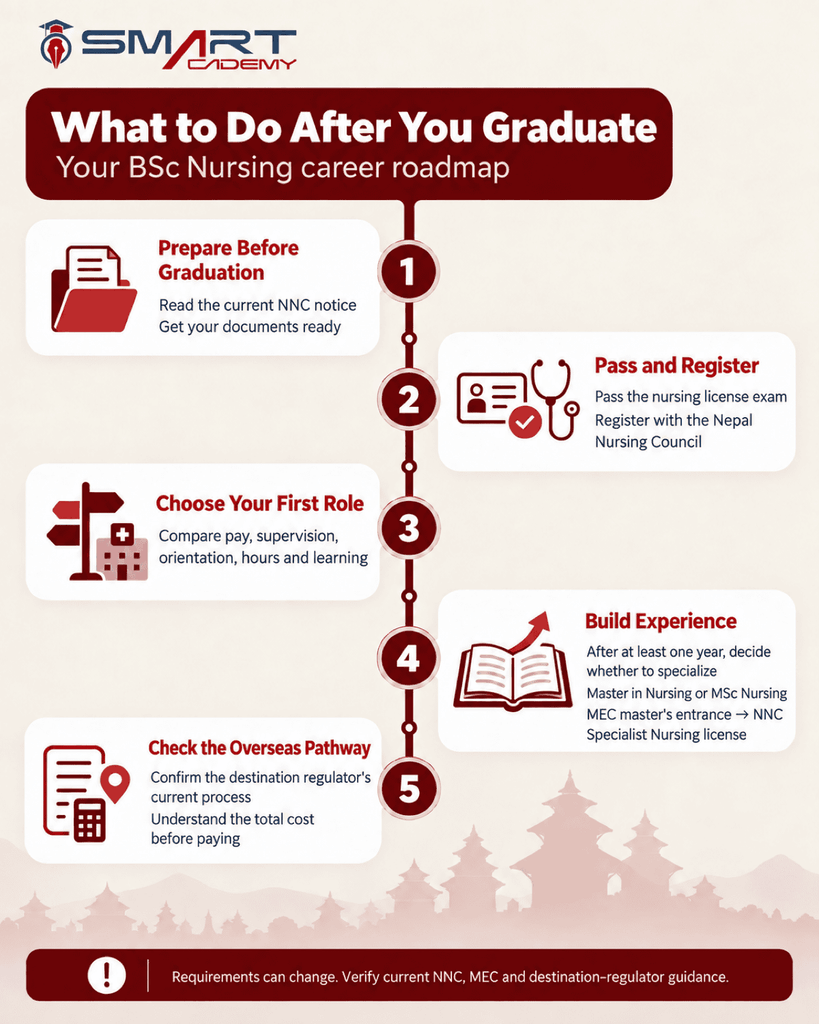
- Before graduation: Read the current NNC notice and prepare your documents.
- Pass the license exam and register with the Nepal Nursing Council.
- Choosing your first role: Compare written pay terms, supervision, orientation, hours, and what the role will teach you.
- After at least a year of experience: Decide whether to specialize. The main route is a Master in Nursing or MSc Nursing through the MEC master’s entrance, followed by the NNC Specialist Nursing license exam. A master’s is also what most teaching and senior management posts ask for.
- If considering work abroad: check the destination regulator’s current pathway and total cost before paying for any test or application.
This is a planning sequence, not a timeline or a promise of promotion. Your next step depends on your registration status, finances, and the opportunities open to you.
Can You Work Abroad After BSc Nursing in Nepal?
Possibly, later – but not on graduation alone. Nurses trained in Nepal go on to register in the UK, USA, Canada, Australia, New Zealand and Dubai, but each destination has its own regulator and its own assessment, and a job offer and a work visa are separate steps again.
| Destination | Regulator | What registration usually involves |
| UK | Nursing and Midwifery Council (NMC) | English test, then the Test of Competence: a computer-based test and a practical clinical exam |
| USA | State boards of nursing | Credential evaluation, English test and the NCLEX-RN |
| Canada | Provincial nursing regulators | Credential assessment through NNAS, then the provincial requirements, which usually include the NCLEX-RN |
| Australia | Nursing and Midwifery Board of Australia, through AHPRA | English test, then the NCLEX-RN and a practical clinical exam |
| New Zealand | Nursing Council of New Zealand | English test, then the Council’s competence assessment |
| Dubai | Dubai Health Authority (DHA | DHA licensing exam, usually after post-registration work experience |
In every case, your NNC registration and clinical experience in Nepal are what you build on, so the route starts here. Overseas salaries look far higher in rupees, but so are living costs and the upfront cost of exams, English tests, credential checks and visas. Compare take-home pay after those costs, not the headline figure.
This page provides general information based on our experience supporting students and on published requirements at the time of writing. Immigration rules change frequently and every application is assessed individually. It is not immigration advice. Always confirm current requirements with the relevant embassy or a licensed adviser before acting.
Your BSc Nursing Decision Checklist
Go through this with your parents or whoever is funding your studies. Write down what you have verified and what still needs an answer – a clear open question is easier to resolve than an assumption nobody has checked.
- I understand the everyday work of nursing and have spoken with a working nurse.
- I have checked eligibility against the current MEC notice.
- I have confirmed my chosen program and intake are approved.
- I have a written breakdown of tuition and every other charge.
- I understand the clinical placement and supervision arrangements.
- I have checked scholarship coverage and conditions, where relevant.
- My family can fund the course without relying on overseas earnings.
- I understand the NNC license exam and registration steps.
- I have read real job advertisements, including their pay terms.
- I have a practical first step after graduation.
Frequently Asked Questions Studying Bsc Nursing in Nepal
What is the average salary for a BSc nurse in Nepal?
There is no reliable published average for BSc nurses in Nepal. In government service, a Staff Nurse starts at NPR 38,203 basic a month (fifth level, from 1 Shrawan 2083), plus a 10% incentive allowance – roughly NPR 42,000 before grades and deductions. Private hospitals set their own pay, so ask each employer for a written offer.
Is BSc Nursing worth it if I want to stay in Nepal?
It can be, if you want patient-care work and your family can afford the course without future overseas income. Compare real local vacancies, their pay levels, working conditions, and take-home pay. Staying in Nepal does not make the degree pointless; it makes your budget the deciding factor.
Which is better, PCL or BSc Nursing?
Neither is better for everyone. BSc Nursing (four years, after +2 Science) gives you a bachelor’s foundation for officer-level posts, teaching, and a master’s. PCL Nursing is a shorter certificate route after SEE. Both can lead to a fifth-level Staff Nurse post, so starting pay is often the same; the difference is long-term progression.
How much does BSc Nursing cost in a government college vs a private college?
On a full-scholarship seat, about three in four places at public institutions, and about one in ten at private colleges, tuition is covered. On a paying seat, the MEC-fixed fee was NPR 1,036,000 for the full program in its most recent notice we could verify. Hostel, books, uniforms, and exam charges are usually extra in both cases.
How do I get a BSc Nursing scholarship seat in Nepal?
Scholarship seats are allocated by MECEE-BL rank, within open and reservation categories. For the 2026 cycle, there are 711 BSc Nursing scholarship seats out of 2,430. You choose your college preferences during matching. Check what the scholarship covers and whether it carries a service obligation before accepting.
How do I choose a BSc Nursing college in Nepal?
Start with the university or academy that awards the degree, then compare its colleges on facts you can verify: MEC approval for your intake, how many scholarship seats it has, where clinical placements happen and who supervises them, the full written fee, hostel costs, and what recent graduates are doing. Ask current students, not only the admissions office.
Can I do a master’s or become a specialist nurse after BSc Nursing?
Yes, but not straight away. You first register with the NNC and gain work experience – Tribhuvan University asks for at least one year for its Master in Nursing. Then you pass the MEC master’s entrance exam, complete an MN or MSc Nursing in a specialty, and pass the NNC Specialist Nursing license exam to register as a specialist nurse.
Which career paths open up after BSc Nursing?
Most graduates start in hospital staff nursing. With experience, training, or postgraduate study, routes open into department nursing (ICU, maternity, operating theater), community and project nursing, nursing education, management and research. Specialist registration with the NNC requires an MSc or MN.
How should my parents judge whether the course is affordable?
Ask for the full written budget, confirmed scholarship coverage, the payment schedule, and any loan conditions. Then plan a realistic first year of work using take-home pay and essential expenses. The savings-based check above helps, but it is not a forecast of salary, employment, or financial return.
Can I work abroad as a registered nurse after BSc Nursing?
Yes, later. The UK, USA, Canada, Australia, New Zealand, and Dubai all register nurses trained in Nepal, but each has its own regulator, English requirement, and assessment – the NCLEX-RN for the USA, for example, and the Test of Competence for the UK. Plan for it after NNC registration and some experience, not as a way to afford the fees.
The Verdict: Worth It When the Work and the Cost Both Fit
BSc Nursing is worth it when the work suits you, and the cost suits your family. The degree can lead to a registered nursing career and further study, but its value depends on what you learn, passing the NNC license exam, and the posts you go on to qualify for.
Before you choose, verify three things: your program and intake, the complete cost, and the reality of the work. With those answers in writing, you and your parents can make the decision on evidence rather than hope.
Talk it through with us on WhatsApp. Send your +2 subjects and grades, your family’s budget, and your career goal, and our counselors will help you plan your MECEE-BL preparation and the questions to settle before choosing a nursing pathway. We have taught over 10,000 students for Nepal’s license and entrance exams since 2021.
Your Next Step
Didn’t secure a seat in Nepal? Compare the BSc Nursing route in India for Nepali students.
Weighing Nepal against studying abroad? Read about studying nursing in Nepal vs. studying abroad.