
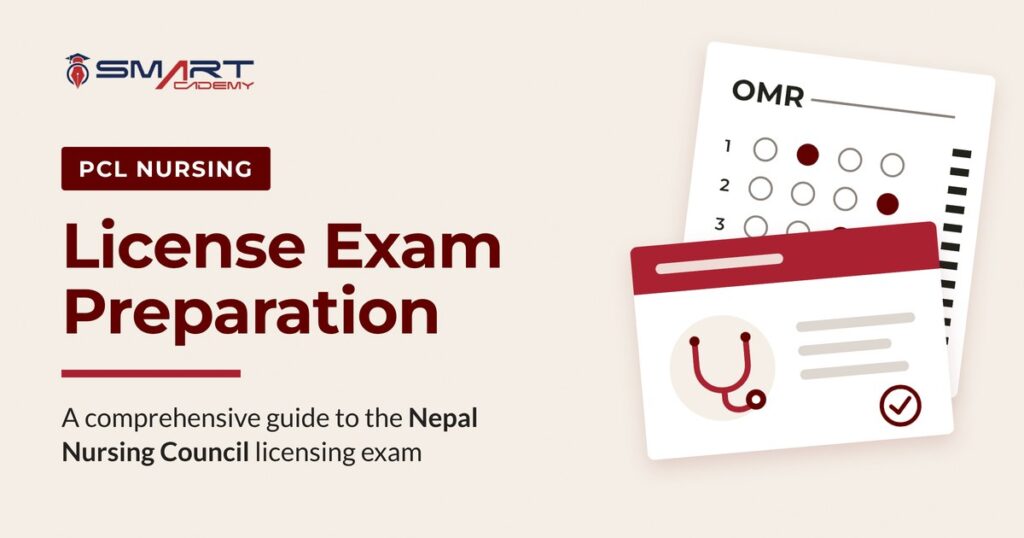
Finishing PCL Nursing is an important milestone, but graduation alone does not complete your professional registration. You must meet the Nepal Nursing Council’s eligibility and document requirements, pass the National Licensure Examination for Nurses (NLEN), and complete the registration process before receiving your nursing registration certificate.
This guide brings those steps together. It explains who can apply, which documents you may need, how the 150 questions are distributed, what happens on exam day, and how to build a practical revision plan. If you want guided classes and full-length practice, see our nursing license exam preparation in Nepal.
Important: The fees and rules below summarize the NNC PCL Nursing test guideline revised in 2025 and effective from February 2025. The application notice, online portal and admit card for your examination period are the final authorities. Check them before uploading documents or making a non-refundable payment.
What Is the PCL Nursing NLEN?
The PCL Nursing NLEN is the national licensing examination conducted by the Nepal Nursing Council (NNC) for graduates of the Proficiency Certificate Level Nursing Program. It assesses the knowledge and practice expected from an entry-level nurse and forms part of the process for registration as a nurse in Nepal.
The NNC guideline explains that PCL and B.Sc. Nursing graduates have taken separate licensure examinations since the 31st licensure examination held on December 10, 2022. This distinction matters because the subject distribution and syllabus are not the same for the two qualifications.
PCL Nursing NLEN at a Glance
| Item | Guideline information |
| Exam authority | Nepal Nursing Council |
| Qualification covered | Proficiency Certificate Level Nursing |
| Question type | Multiple-choice questions with four options |
| Total questions | 150 |
| Duration | 2 hours and 30 minutes |
| Mark per correct answer | 1 |
| Negative marking | No |
| Passing requirement | At least 50% in aggregate |
| Result format | Pass or fail; no numerical score provided |
| Usual frequency stated in the guideline | Three times per year |
| Examination fee in the 2025 guideline | NPR 3,500 |
| Registration fee after passing in the 2025 guideline | NPR 2,000 |
You have 150 minutes for 150 questions, which works out to an average of one minute per question. Your preparation should therefore develop both accuracy and pace.
Who Is Eligible for the PCL Nursing Licensure Examination?
The 2025 guideline provides eligibility routes for Nepali citizens who completed PCL Nursing either in Nepal or in another country.
Nepali citizens who graduated in Nepal
You should have completed the PCL Nursing Program and be able to provide the academic and identity documents required by the NNC.
Your application is not complete simply because you have passed your final examination. The Council must be able to verify your qualification through the uploaded documents.
Nepali citizens who graduated outside Nepal
You should have completed a PCL Nursing Program at an institution recognized by the relevant nursing council or an authorized government body in the country of study.
You must also provide the required equivalency and institutional recognition documents.
If you studied abroad, begin document preparation early. Equivalency and recognition evidence can take longer to collect than a regular transcript or character certificate.
Convictions, disciplinary action and disability-related arrangements
The guideline requires applicants to report prior convictions and disciplinary action. Failure to disclose required information may be treated as falsification and can lead to denial or cancellation of licensure.
It also states that applicants constitutionally entitled to special consideration because of a disability will be given an opportunity to sit the examination based on their limitations.
If you need an accommodation, contact the NNC early and follow the process stated in the relevant notice.
Documents Required If You Studied PCL Nursing in Nepal
According to the 2025 guideline, a Nepal-educated applicant should prepare:
- Complete personal information for the online application
- SLC/SEE marksheet and character certificate
- Citizenship certificate
- PCL Nursing academic transcript or marksheets and character certificate
- A recent passport-size photograph with a white background
- Online payment of the examination fee
The guideline states that scanned documents and the photograph should be uploaded in JPG format and should not exceed 2 MB each.
The current NNC application portal also tells candidates to use clear, readable, full-size scans taken from original documents. It may request both sides of the citizenship certificate and a scanned signature.
If you entered PCL Nursing through an ANM quota, the portal may also request your ANM marksheet. Follow the checklist displayed for your applicant category when you apply.
Documents Required If You Studied PCL Nursing Abroad
The 2025 guideline lists the following for a Nepali citizen who completed PCL Nursing outside Nepal:
- Complete personal information for the online application
- SLC/SEE marksheet and character certificate
- Citizenship certificate
- Academic transcript or marksheets and character certificate for 10+2 or I.Sc., as applicable
- PCL Nursing academic transcript or marksheets and character certificate
- Proof that the institution is recognized or accredited by the relevant nursing council or authorized government body in the country of study
- An equivalency letter from the relevant Nepali authority identified by the NNC
- A recent white-background passport-size photograph
- Online payment of the examination fee
The live portal may ask for all-year marksheets and separate equivalency documents when an earlier qualification was also completed outside Nepal.
Do not assume that one equivalency letter covers every foreign qualification. Read the latest qualification-specific list on the portal.
Document Checklist Before You Submit
Use this checklist before making payment:
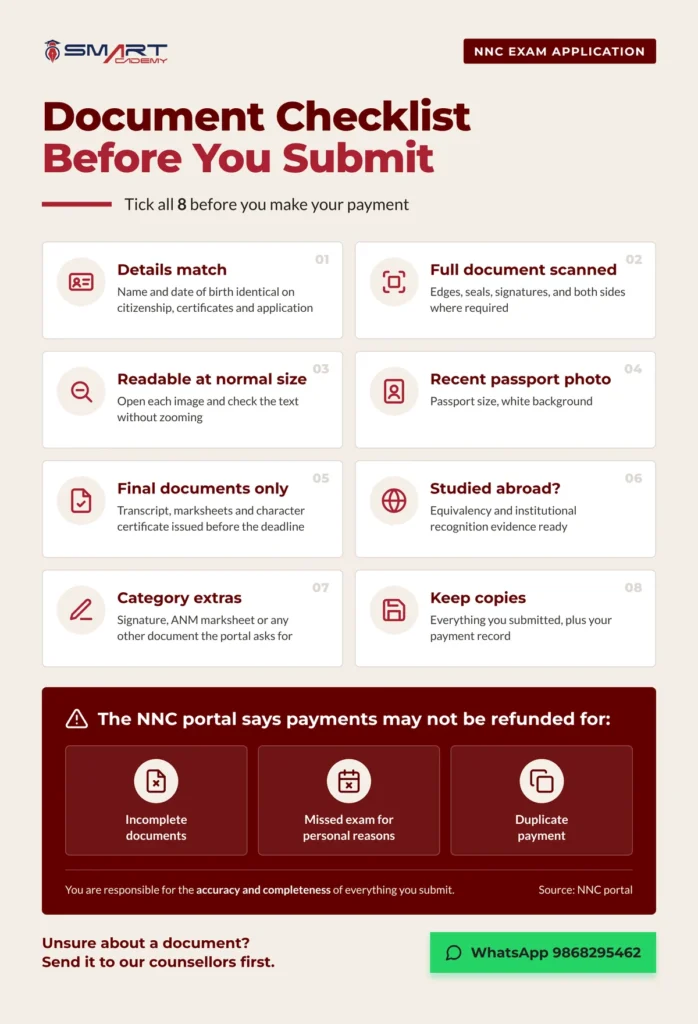
- Your name, date of birth and other personal details match across your citizenship, certificates and application.
- Every scan shows the full document, including edges, seals, signatures and both sides where required.
- The text is readable when the image is opened at normal size.
- Your photograph is recent, passport size and taken against a white background.
- Your transcript, marksheets and character certificate are final documents issued before the deadline stated in the notice.
- If you studied abroad, your equivalency and institutional recognition evidence are ready.
- You have checked whether the portal requests a signature, ANM marksheet or another category-specific document.
- You have saved a copy of everything submitted and the payment record.
The NNC portal states that applicants are responsible for the accuracy and completeness of their information.
It also states that payments may not be refunded when documents are incomplete, a candidate misses the examination for personal reasons, or duplicate payments are made.
How to Apply for the PCL Nursing NLEN Online
The general process described in the guideline is:
- Read the examination notice. Confirm the opening date, deadline, eligibility cut-off and document list for your examination period.
- Prepare the files before logging in. Rename the files clearly so you do not upload the wrong certificate.
- Complete the online form. Enter your information exactly as it appears on your official documents.
- Upload the required documents. Use the file format and size shown by the portal.
- Review the complete application. Check spelling, dates, document visibility and applicant category.
- Pay the examination fee through the approved method. The 2025 guideline lists NPR 3,500, but confirm the current amount in the notice before paying.
- Submit within the stated period. An unfinished form may not reach the verification stage.
- Download your admit card when released. It will provide your examination center, date, time and other instructions.
Apply only through the official NNC application portal.
Keep your username, password, application details and payment record secure.
What If Your Name or Address Changes?
If your name or address changes after application, the guideline says you must notify the NNC before receiving the license certificate and provide the relevant legal documents.
Your identity at the examination center must match your official photo identification.
Do not wait until exam day to deal with a spelling difference or changed surname. Ask the NNC what supporting document is required as soon as you identify the mismatch.
PCL Nursing NLEN Syllabus and Question Distribution
You do not need to reproduce every line of the syllabus to make a useful plan. Begin with the number of questions assigned to each subject.
| Subject | Possible number of questions |
| Integrated Sciences, including basic sciences, anatomy and physiology | 7 |
| Fundamentals of Nursing | 40 |
| Community Health Nursing | 20 |
| Adult and Geriatric Nursing | 30 |
| Behavioral Science and Mental Health Nursing | 5 |
| Child Health Nursing | 15 |
| Midwifery and Gynecology | 28 |
| Leadership and Management | 5 |
| Total | 150 |
The three largest areas—Fundamentals of Nursing, Adult and Geriatric Nursing, and Midwifery and Gynecology—account for 98 of the 150 questions.
They deserve a large share of your study time. However, the remaining 52 questions can still determine whether you pass, so do not leave the smaller subjects until the final evening.
What the major subject groups broadly cover
- Integrated Sciences: Anatomy and physiology, microbiology, parasitology, virology, immunology, pharmacology and related foundations.
- Fundamentals of Nursing: Nursing process, patient assessment, infection prevention, vital signs, basic procedures, safety, medication administration, first aid and everyday nursing responsibilities.
- Community Health Nursing: Primary health care, epidemiology, health education, family health, immunization, environmental health, reproductive health and community programs.
- Adult and Geriatric Nursing: Assessment and nursing management of adult and older patients across major body systems, diagnostic procedures, perioperative care, rehabilitation and emergencies.
- Behavioral Science and Mental Health Nursing: Human behavior, personality, therapeutic communication, common psychiatric conditions, treatment and psychiatric emergencies.
- Child Health Nursing: Growth and development, newborn and pediatric care, common childhood disorders, nutrition, procedures and family support.
- Midwifery and Gynecology: Antenatal, intranatal and postnatal care; newborn care; obstetric complications; reproductive health; and common gynecological conditions.
- Leadership and Management: Management principles, leadership, supervision, staffing, communication, quality, professional responsibilities and health-service organization.
Use the full NNC syllabus as your chapter checklist. The table tells you how to divide time; the detailed syllabus tells you what must be covered inside each subject.
How to Prepare for the PCL Nursing NLEN
1. Start with a diagnostic test
Take a mixed test before beginning intensive revision. Do not use the score to judge your ability. Use it to identify where you lose marks:
- Forgotten facts
- Weak concepts
- Confusion between similar conditions or procedures
- Medication errors
- Misreading of clinical scenarios
- Slow question handling
- Guessing without eliminating options
Build your study plan from this evidence rather than studying every chapter for the same number of hours.
2. Allocate time according to the official distribution
A practical order is:
- Fundamentals of Nursing
- Adult and Geriatric Nursing
- Midwifery and Gynecology
- Community Health Nursing
- Child Health Nursing
- Integrated Sciences
- Behavioral Science and Mental Health Nursing
- Leadership and Management
This order follows question volume, but your weak subjects may require adjustment.
For example, a strong midwifery graduate with poor pharmacology recall may need to bring Integrated Sciences forward.
3. Study concepts and questions together
Do not finish the entire syllabus before attempting MCQs. After revising a topic, answer related questions immediately.
For every wrong or uncertain answer, record:
- The topic
- Why your answer was wrong
- Why the correct answer is more appropriate
- The rule, concept or clinical clue you missed
- When you will review it again
This error log becomes more useful than repeatedly reading the same notes.
4. Practice clinical prioritization
Many nursing questions require the most appropriate response, not merely a true statement.
Train yourself to identify:
- Immediate threats to airway, breathing and circulation
- Patient safety risks
- Infection-prevention requirements
- Assessment that should occur before intervention
- Actions within the nurse’s responsibility
- Maternal, newborn and child danger signs
- Medication rights, contraindications and adverse effects
Read every option before choosing. An option may be clinically correct but not the first or most appropriate action in the situation described.
5. Use timed full-length mock tests
Complete 150-question tests in 150 minutes. Practice on a computer when possible because recent NNC examination notices describe the nursing licensing examination as computer-based.
After each mock, spend time reviewing wrong and guessed answers. Track performance by subject so a satisfactory total score does not hide a serious weakness in one major area.
The pass requirement is 50%, but your practice target should include a reasonable safety margin rather than treating the minimum as your goal.
6. Use a repeatable revision cycle
A flexible eight-week structure could look like this:
| Period | Main task |
| Weeks 1–2 | Fundamentals of Nursing plus daily Integrated Sciences review |
| Weeks 3–4 | Adult and Geriatric Nursing plus mixed MCQs |
| Week 5 | Midwifery and Gynecology |
| Week 6 | Community Health and Child Health Nursing |
| Week 7 | Behavioral Science, Mental Health, Leadership and accumulated weak areas |
| Week 8 | Full-length mocks, error-log revision and examination administration checks |
If you have less time, compress the phases but keep the same sequence: assess, revise, practice, test and review.
Examination Rules, Scoring and Passing Requirements
The 2025 guideline states:
- The examination lasts 2 hours and 30 minutes.
- Questions are MCQs with four options, and you select the most appropriate answer.
- Each correct answer receives one mark.
- There is no negative marking for a wrong answer.
- You need at least 50% in aggregate to pass.
- The result is reported as pass or fail; no numerical score is provided.
- Entry is not allowed more than 15 minutes after the examination starts.
- You may leave the room only after the first hour.
- The guideline says the NNC normally conducts the examination three times per year.
- If you do not pass, you may apply for the next examination.
Because there is no negative marking, leaving an answer blank generally offers no scoring advantage. Still, answer carefully and follow the instructions shown in the actual test system.
What to Carry and Check on Exam Day
Follow your admit card and current notice. At minimum, prepare:
- Your admit card
- An accepted original photo-identification document
- Any additional item specifically required in the current notice
The NNC portal currently states that an original national identity card, citizenship certificate, driving license or passport may be used for identity verification and that a photocopy is not accepted.
Confirm the accepted list for your examination period.
Arrive early enough to locate the center and complete verification. Before starting, confirm that your displayed name and examination details are correct.
During the examination, use the one-minute-per-question average as a guide, mark difficult items for review if the system allows it, and reserve time for unanswered questions.
Results and Registration After Passing
The 2025 guideline says results are expected on the day of the examination unless a technical problem occurs.
Results are published through NNC channels rather than communicated individually to every candidate. Current procedures may place results in the applicant portal or a later notice, so follow the instructions for your examination period.
After passing, the guideline says you can apply for registration and obtain your license certificate by:
- Applying through the NNC’s registration process
- Paying the registration fee—listed as NPR 2,000 in the 2025 guideline
- Presenting the admit card
- Presenting your original academic documents and citizenship certificate for verification
Keep every original certificate safe even after uploading scans. Online acceptance does not replace original-document verification.
Guidance for Parents Supporting a PCL Nursing Graduate
You can help without taking control of the candidate’s preparation.
Check the document folder together, confirm that names match, help protect regular study time, and ask about mock-test review rather than only the score.
The exam fee is only one part of the cost of an unsuccessful attempt. Another attempt can also delay registration and employment.
A realistic study timetable, complete documents and early application reduce avoidable pressure close to the examination.
For a broader comparison of nursing routes, read PCL vs. B.Sc. Nursing in Nepal.
For changing application windows and examination dates, use our NNC nursing license examination calendar together with the official NNC notice.
Frequently Asked Questions
How many questions are in the PCL Nursing NLEN?
The 2025 guideline lists 150 multiple-choice questions with four options each.
How much time do I get?
You receive 2 hours and 30 minutes, equal to an average of one minute per question.
What is the PCL Nursing NLEN pass mark?
You must score at least 50% in aggregate. With 150 one-mark questions, that corresponds to 75 correct answers if the current pattern remains unchanged.
The result is reported as pass or fail rather than as a numerical score.
Is there negative marking?
No. The 2025 guideline states that an incorrect answer does not receive a minus mark.
How much is the examination fee?
The 2025 guideline lists NPR 3,500. Confirm the amount and payment deadline in the notice for your examination period before paying.
How much is the registration fee after passing?
The 2025 guideline lists NPR 2,000 for the registration process after passing. Check the latest NNC registration notice before payment.
Can I apply if I completed PCL Nursing outside Nepal?
Yes. The guideline provides a route for Nepali citizens educated abroad.
You need the required academic documents, equivalency and evidence that the institution was recognized by the relevant nursing council or government authority.
Do I need original documents after uploading scans?
Yes. The guideline says original academic certificates, citizenship and related documents are required for verification when receiving the registration certificate.
What happens if my application name does not match my ID?
Your applicant details should match your photo identification exactly.
Contact the NNC early if a legal name change, spelling difference or other mismatch needs correction.
What happens if I do not pass?
You may apply for the next examination.
Use your next preparation period to identify weak subject areas, complete timed mocks and correct the errors recorded in your review log.
Where should I check examination dates?
Use the NNC notices page, the official application portal and your admit card.
A yearly calendar does not replace the examination-period notice.
Prepare for Your PCL Nursing License Examination With a Clear Plan
Your strongest preparation system is simple: verify your eligibility, submit complete documents, use the official subject distribution to allocate study time, practice 150-question timed tests, and review every error.
If you need structured revision, question practice and mock-test support, message Smart Academy on WhatsApp.
Tell us your target examination period, whether you studied in Nepal or abroad, and the subjects you currently find difficult. Our team can help you organize the next steps for online or in-person preparation.