
The CEE exam in Nepal is the Medical Education Commission’s (MEC) common entrance exam for bachelor-level health programs such as MBBS, BDS, BSc Nursing, BPH, and BNS. It is a three-hour, 200-question multiple-choice paper worth 200 marks. You get 1 mark for each correct answer and lose 0.25 for each wrong one. The 2026 papers run from October 31 to November 4, 2026. Which subjects you are tested on, and whether you are eligible, depends on the program group you apply for.
This guide covers the rules you need to check, then shows you how to prepare without relying on rumors or last year’s dates. If you want a study plan built around your program group, see our CEE entrance preparation classes.
-
Official name: Medical Education Common Entrance Examination for Bachelor Level (MECEE-BL), run by MEC.
-
2026 exam dates: October 31 to November 4, 2026, 11:00 a.m. to 2:00 p.m., at centers inside Kathmandu Valley. MEC calls this cycle MECEE-BL 2027, after the year of admission.
-
Format: 200 single-best-answer MCQs in 3 hours, answered on an OMR sheet. +1 for correct, −0.25 for wrong.
-
Qualifying rule: You must score at or above the 50th percentile to enter the merit list. That is not the same as scoring 100 out of 200.
-
Four program groups: Each has its own eligibility route and subject weightage.
-
Applications for this cycle have closed: The late window (double fee) ended on September 16, 2026.
What CEE means in Nepal
CEE stands for Common Entrance Examination. Here, it means the bachelor-level medical entrance exam run by Nepal’s Medical Education Commission. MEC’s formal name for it is the Medical Education Common Entrance Examination for Bachelor Level (MECEE-BL).
MEC uses this one exam for admission to bachelor-level health programs at universities, academies, and affiliated colleges across Nepal. A common exam does not mean a common paper, though. A +2 science student aiming for MBBS and a PCL nursing graduate aiming for BNS both answer 200 questions, but on very different subjects. Work out your program group before you build a timetable or buy a question bank.
Programs Covered by MECEE BL
The current MEC syllabus puts bachelor-level programs into four groups. Each year’s application notice confirms which programs are open and when each group sits the exam.
| Group | Programs | Main Entry Route |
| 1 | MBBS, BDS, BSc Nursing, BSc Midwifery, BASLP and B Perfusion Technology | +2 Science, or a specified health science diploma route |
| 2 | BAMS, BSc MLT, BSc MIT, BSc Radiotherapy Technology, BPT, B.Pharm and B Optometry | +2 Science or relevant health science diploma route |
| 3 | BPH | +2 Science or an eligible health science diploma route |
| 4 | BNS and BMS | PCL or diploma in nursing with Nepal Nursing Council registration |
Program names and availability can change. Use the current MEC application notice when deciding which form to submit.
CEE 2026 Exam Dates at a Glance
Students call it CEE 2026, but MEC labels it MECEE-BL 2027 because the name follows the year of admission. According to the MEC notice dated September 7, 2026 (Bhadra 22, 2083), every paper runs from 11:00 a.m. to 2:00 p.m. at a center inside the Kathmandu Valley.
| Program | Date (AD) | Date (BS) | Time |
| MBBS | 31 October 2026 | Kartik 14, 2083 | 11:00 am to 2:00 pm |
| BDS | 1 November 2026 | Kartik 15, 2083 | 11:00 am to 2:00 pm |
| BSc Nursing, BSc Midwifery, BASLP and B Perfusion Technology | 2 November 2026 | Kartik 16, 2083 | 11:00 am to 2:00 pm |
| BAMS, BNS or BMS, BSc MLT, BSc MIT or Radiotherapy, BPT, BPharm and B Optometry | 3 November 2026 | Kartik 17, 2083 | 11:00 am to 2:00 pm |
| BPH | 4 November 2026 | Kartik 18, 2083 | 11:00 am to 2:00 pm |
For any later changes, see our CEE exam date and schedule update. Your admit card gives your exact center and reporting time.
CEE Eligibility in Nepal
Eligibility depends on the program. The rules below come from MEC’s bachelor-level syllabus (revised August 18, 2025). Always check them against the current year’s notice, which can change document, equivalence, registration, and category requirements.
Group 1: MBBS, BDS, BSc Nursing and Related Programs
- +2 route: +2 Science or equivalent with Physics, Chemistry and Biology, with at least 50% aggregate or GPA 2.4.
- Diploma route: specified health science PCL or diploma qualifications, such as General Medicine, Medical Laboratory Technology, Ophthalmic Science, Dental Science, Pharmacy, Ayurveda, Radiography and Physiotherapy. You also need:
- Grade 12 Science equivalence from the National Examination Board
- At least 50% in both the diploma and the equivalence exam
- Registration with the relevant professional council
Group 2: BAMS, BSc MLT, B.Pharm and Related Programs
Group 2 accepts the same +2 Science route (Physics, Chemistry and Biology, 50% or GPA 2.4). It also has diploma routes, each tied to a specific program, and some of them require council registration. The diploma list and equivalence conditions are detailed. Check your exact qualification against the current notice. Not every health diploma leads to every bachelor program.
BPH
You can qualify through +2 Science with Physics, Chemistry and Biology, or through a specified health science diploma with at least 50% aggregate. Diploma applicants also need registration with the relevant council.
BNS and BMS
You need a PCL or diploma in Nursing with at least 50% aggregate and registration with the Nepal Nursing Council. This paper focuses mainly on nursing subjects, so a general +2 science prep course will not match it. Our BNS CEE mock tests follow this nursing-focused pattern.
Equivalence and Registration checks
- A Levels or another grading system: Confirm how MEC and the relevant equivalence authority read your qualification.
- Health science diploma: Check whether your target program needs Grade 12 Science equivalence.
- Council registration: Make sure it is valid and matches the diploma route you are using.
- Beyond GPA: The notice may add subject, percentage, equivalence, or registration conditions, and those count too.
CEE Exam Pattern and Marking
The MEC syllabus and the MECEE-BL 2027 notice agree on the format below. It is a written exam with an OMR sheet, not a computer-based test.
| Feature | Official format |
| Mode | Written examination using an OMR answer sheet |
| Question type | Single-best-answer MCQs(Multiple Choice Questions) |
| Options | Four (A, B, C, D) |
| Questions | 200 |
| Full Marks | 200 |
| Duration | 3 hours (180 minutes), about 54 seconds per question |
| Correct Answer | +1 mark |
| Wrong Answer | -0.25 mark |
| Qualifying Threshold | 50th percentile or above for the merit list, subject to provisions in the notice |
| Planned Cognitive Mix | 50% recall, 30% understanding, 20% application |
What the 50th percentile means: A percentile compares your score with other candidates’ scores. It is not a fixed percentage. The notice also sets a fallback for programs with few applicants: if a program has fewer than twice as many applicants as seats, a score of 50% or above qualifies.
Getting into the merit list does not give you a seat. Seats are allocated by rank, category, available seats, the preferences you submit, and the rules in the matching notice.
Subject Weightage by Program Group
Every group answers 200 questions, but the split between subjects is different. Use the row for your program.
| Program Group | Question Distribution |
| Group 1 (MBBS, BDS, BSc Nursing…) | Zoology 40, Botany 40, Chemistry 50, Physics 50, MAT 20 |
| Group 2 (BAMS, B.Pharm, BSc MLT…) | Zoology 40, Botany 40, Chemistry 40, Physics 40, program-specific PCL content 20, MAT 20 |
| Group 3 (BPH) | Zoology 40, Botany 40, Chemistry 40, Physics 40, prerequisite health knowledge 20, MAT 20 |
| Group 4 (BNS, BMS) | Core nursing subjects 150, basic and integrated health science 30, MAT 20 |
CEE Syllabus Overview
In Group 1, Biology (Zoology plus Botany) makes up 80 questions. Chemistry and Physics have 50 each, and the Mental Agility Test (MAT) has 20. The syllabus breaks these into the topics below.
Zoology
- Origin and evolution of life
- Classification from protozoa to chordates
- Plasmodium, earthworm and frog
- Human biology and human diseases
- Animal tissues
- Environmental pollution, adaptation, animal behavior, and applied zoology
Botany
- Basic components of life and biodiversity
- Ecology and environment
- Cell biology and genetics
- Anatomy and physiology
- Developmental and applied botany
Chemistry
- General and physical chemistry
- Inorganic chemistry
- Organic chemistry
Physics
- Mechanics
- Heat and thermodynamics
- Geometrical and physical optics
- Current electricity and magnetism
- Sound waves, electrostatics and capacitors
- Modern and nuclear physics
- Solid state and semiconductor devices
- Particle physics, sources of energy and the universe
Mental Agility Test (MAT)
Every group gets 20 MAT questions, five from each of these areas:
- Verbal reasoning
- Numerical reasoning
- Logical sequencing
- Spatial or abstract reasoning
Plan for MAT like any other scoring section. Don’t leave it for whatever time is left at the end.
Program-Specific Sections
- Group 2: 20 questions from the relevant PCL or diploma subject.
- BPH: 20 questions on prerequisite health knowledge: determinants of health and illness, communicable and non-communicable diseases, water and sanitation, biostatistics and epidemiology.
- BNS and BMS: a separate nursing syllabus covering community health, adult health, child health, midwifery, nursing fundamentals, leadership, behavioral science, and applied basic health sciences.
How Negative Marking Changes Your Strategy
Four wrong answers cancel out one correct answer. That should make you check your options more carefully. It does not mean you should always skip a question you’re unsure about.
Here’s the math. If your chance of being right is p, the expected score for that question is 1.25p − 0.25. You break even at p = 0.20 (20%). A pure guess among four equally likely options has a 25% chance, worth +0.0625 marks on average. That assumes the four options really are equally likely and ignores the time the guess costs you.
Treat the math as a guide, not a rule:
- First pass: answer the questions you know.
- Second pass: rule out options that contradict a fact, unit, sign, definition, or diagram.
- Decide: guess only if you still have time and you’ve actually eliminated at least one option.
- Mark carefully: a bubble in the wrong row costs you marks just as a wrong answer does.
CEE Application Process
MEC takes applications online through its entrance portal for a set period each year.
For the 2026 exam (MECEE-BL 2027): Applications opened on August 10, 2026. MEC then extended the regular deadline, and the late window at double the fee closed on September 16, 2026 (Bhadra 31, 2083). The regular fee was NPR 4,000 for Nepali applicants and NPR 8,000 for foreign applicants, not including bank or payment charges.
These dates and fees change every cycle. When you apply, follow the current MEC notice and portal, because payment deadlines can be earlier than the form deadline.
Application Steps
1. Read the current notice: Confirm your program group, eligibility, deadline, fee, and any category-specific instructions.
2. Open the MEC entrance portal: Use the official address and create or access your applicant profile.
3. Choose your program: If you’re applying to more than one, follow the notice on separate forms and payments.
4. Enter personal and academic information: Copy names, dates, grades, and identification details exactly from your documents.
5. Upload clear files: Use the specified image or PDF format, size, and background. Do not upload blurred photographs or cropped certificates.
6. Pay through an approved channel: Save the transaction reference, voucher, and confirmation page.
7. Review before final submission: Check program, category, examination center, and contact details before you lock the form.
8. Download the admit card: Use the portal when MEC releases it and read every instruction printed on it.
Documents to Prepare
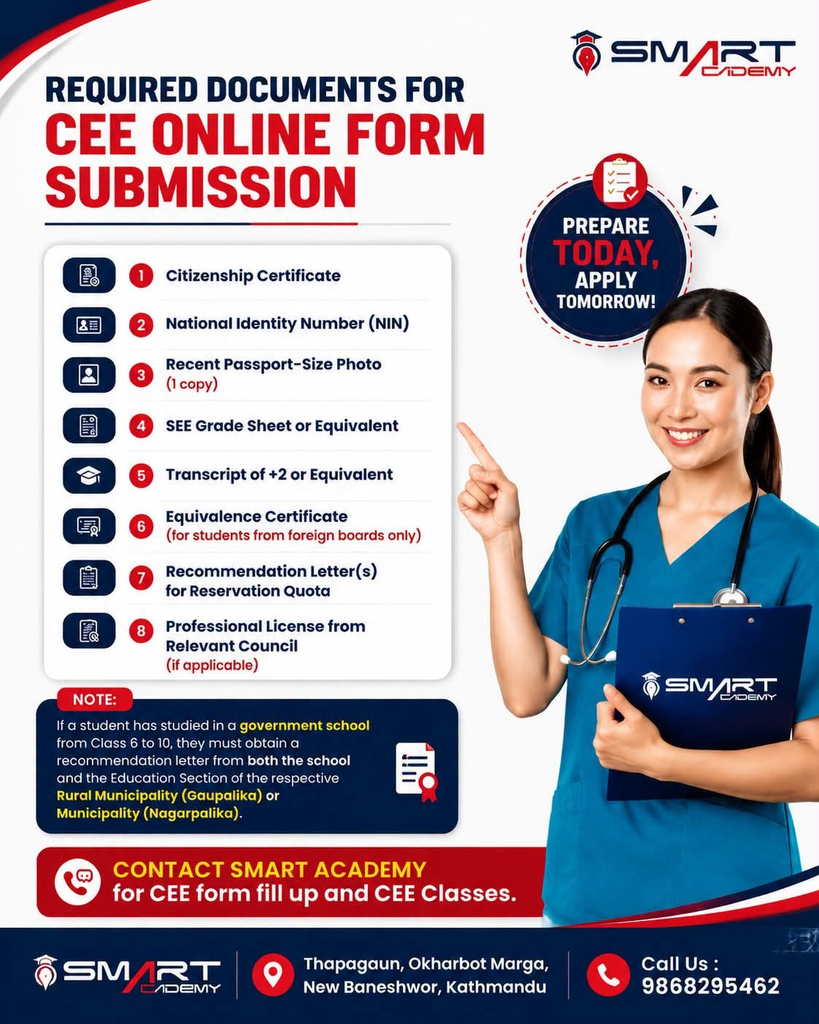
- Citizenship Certificate
- National Identity Number (NIN)
- Recent Passport-Size Photo (1 copy)
- SEE Grade Sheet or Equivalent
- Transcript of +2 or Equivalent
- Equivalence Certificate (for students from foreign boards only)
- Recommendation Letter(s) for Reservation Quota
- Professional License from relevant council (if applicable)
Note: If a student has studied in a government school from Class 6 to 10, they must obtain a recommendation letter from both the school and the Education Section of the respective Rural Municipality (Gaupalika) or Municipality (Nagarpalika).
Exam Day Checklist
Under the syllabus, you mark your answers on the OMR sheet with a black gel pen provided at the center. For 2026, all centers are inside Kathmandu Valley, and your admit card names your venue. Your admit card and the notice may add rules, so follow those, not advice from students who sat the exam in earlier years.
- Print your admit card as soon as it’s released.
- Check your name, photo, program, date, reporting time, and center on it.
- Bring the original ID document named in the notice.
- Arrive within the reporting window on your admit card.
- Follow the rules on stationery, electronic devices, jewelry, and personal items.
- Before you start, check that your question booklet and OMR details match.
- Fill each bubble cleanly and keep the question number aligned with the OMR row.
Results Merit Lists and Seat Matching
MEC publishes results and merit lists on its official website and entrance portal. Getting into the merit list puts you in the matching process, but it doesn’t give you a seat. Your rank, category, available seats, and the preferences you submit decide where you end up.
1. Check the official result: Use the MEC website or entrance portal and confirm the program and category shown.
2. Read the matching notice: Note registration, payment, document, and priority-setting deadlines.
3. Order your choices deliberately: Compare program, institution, fee category, location, and your willingness to enroll before submitting priorities.
4. Review each allocation round: Follow admission deadlines and the rules for rematching, subsequent rounds, or wrap-up matching.
5. Keep proof of every action: Save submitted priorities, payment records, allocation results, and admission documents.
The MEC academic calendar updates can help you see where application, examination, result, and matching stages sit in the wider admission cycle. Always use the dated MEC notice for the action you are taking.
To see how seats are split across open, scholarship and reserved categories at each college, check our MECEE-BL category-wise seat distribution.
12-Week CEE Preparation Plan
Start from the official weightage for your program group. Fit the hours around school, work and travel, but keep the order: diagnose, learn, recall, practice under time, then revise based on your results.
| Weeks | Main Work | Evidence to Keep |
1 to 2 | Take a diagnostic test, map the syllabus, and identify weak chapters | Baseline score by subject and a ranked weakness list |
3 to 5 | Rebuild concepts and solve short topic sets immediately after study | Daily accuracy, unanswered concepts, and formula or fact cards |
6 to 8 | Mix chapters, add MAT or program-specific content, and revise earlier work | Weekly mixed test score and error categories |
9 to 10 | Practice timed subject blocks and OMR marking | Time per question, OMR errors, and negative marks |
| 11 | Sit full 200-question mocks under 3-hour conditions | Full mock score, section timing and fatigue notes |
| 12 | Revise frequent errors, fix your sleep schedule, stop adding new material | Final checklist, short revision sheets |
A Practical Study Day
- Start with 10–15 minutes of recall without notes.
- Study one concept block and explain it in your own words.
- Do a timed question set on that block and flag every answer you weren’t sure of.
- Sort your errors by cause: knowledge gap, misread question, calculation slip, weak elimination, time pressure, or OMR handling.
- End with a quick review of older topics and a short MAT set.
Subject Priorities for Group 1
Biology carries 80 questions, so it deserves the biggest share of your time. But Chemistry and Physics together carry 100, so don’t neglect them. MAT’s 20 questions improve steadily with regular practice. Divide your time by both the weightage and your own error rate.
How to Use Mock Tests
A mock test only helps if it changes what you study next. After each one:
- Separate content errors from decision errors.
- Redo each missed question without the answer key.
- Write the shortest note that would stop you repeating that mistake.
Track correct answers, negative marks, net score, skipped questions, and time per section. You can practice with our full-length CEE mock tests by program.
Guidance for Parents
Parents often worry about two things: money spent on a form that turns out to be invalid, and the stress of the last few weeks. You don’t need to manage every study hour. You help most by removing avoidable uncertainty.
- Ask to see the current MEC notice and the submitted confirmation page.
- Keep copies of identity, academic, equivalence, council, and category documents in one secure folder.
- Budget for the application fee and payment charges, plus later costs such as travel to Kathmandu Valley for the exam and admission fees after matching.
- Judge progress by weekly accuracy and mock-test reviews, not hours at the desk.
- Protect sleep and plan travel early. Exhaustion causes reading and OMR errors that extra revision can’t fix on exam day.
- Treat qualifying and getting a seat as separate outcomes, so you can make matching choices calmly as a family.
Common Mistakes to Avoid
| Mistake | Better Action |
Using an old date or fee | Check the current MEC notice and portal before paying. |
| Preparing for the wrong group | Match your target program to the official group and weightage. |
| Treating GPA as the only condition | Check subjects, aggregate, equivalence, and council registration. |
| Calling 100/200 the pass mark | Use the 50th-percentile rule, and remember qualifying ≠ a seat. |
| Ignoring MAT or the program-specific block | Practice it every week in line with its question share. |
| Taking mocks without reviewing | Sort every error and adjust your next study plan. |
| Filling OMR bubbles in a rush | Practice transferring answers and check row alignment in timed mocks. |
| Choosing colleges after matching opens | Research colleges and costs before you set preferences. |
Frequently Asked Questions
What is the full form of CEE in Nepal?
CEE stands for Common Entrance Examination. For bachelor-level health programs, the Medical Education Commission uses the formal name Medical Education Common Entrance Examination for Bachelor Level (MECEE-BL).
When is the CEE exam in 2026?
The CEE 2026 papers run from October 31 to November 4, 2026 (Kartik 14–18, 2083), from 11:00 a.m. to 2:00 p.m. MBBS is on October 31, BDS on November 1, BSc Nursing and its group on November 2, BAMS, BNS/BMS and allied programs on November 3, and BPH on November 4.
How many questions are in the CEE exam?
There are 200 single-best-answer multiple-choice questions, each with four options, worth 200 marks in total. You have three hours, which works out to about 54 seconds per question.
Is there negative marking in CEE?
Yes. You get 1 mark for each correct answer and lose 0.25 for each wrong one. Four wrong answers cancel out one correct answer. Unanswered questions score zero.
What is the pass mark for CEE?
There is no fixed pass mark. To enter the merit list, you must score at or above the 50th percentile of candidates. That is your position relative to others, not 50% of the marks. Qualifying does not secure a seat; rank, category, preferences, and available seats decide that.
What GPA is required for CEE in Nepal?
For most +2 Science routes, you need at least 50% aggregate or GPA 2.4, with Physics, Chemistry, and Biology. Diploma routes add equivalence and council registration conditions. Check the current notice for your program.
Can a PCL or diploma student apply for CEE?
Yes, for certain programs. Specified health science diploma holders can apply if they meet the percentage, equivalence, and council registration conditions. BNS and BMS require a PCL or diploma in Nursing and registration with the Nepal Nursing Council.
Is CEE registration still open?
No. For the 2026 exam, the late application window closed on September 16, 2026. MEC announces a new application window for each cycle on its website and entrance portal.
How much does the CEE application cost?
For this cycle, the fee was NPR 4,000 for Nepali applicants and NPR 8,000 for foreign applicants, plus bank or payment charges. Late applications cost double. Fees can change each year.
Where are the CEE 2026 examination centers?
All CEE 2026 centers are inside Kathmandu Valley. Your admit card, downloaded from the MEC entrance portal, shows your exact venue and reporting time.
How long is a CEE result valid?
Use your result within the admission and matching cycle it belongs to. Don’t assume your score or rank carries over to the next year unless the current MEC rules say so.
Can I apply for more than one program?
Often yes, but each program may need a separate form and fee. Programs are tested on different days, so check the schedule for clashes before you pay for a second form.
How should I start preparing for CEE?
Start with the official syllabus for your program group and a diagnostic test. Then rebuild weak concepts, practice short timed sets, review your errors, and move on to full three-hour OMR mocks. Spend your time where the weightage is high, and your accuracy is low.
Your Next Step
A strong CEE plan starts with the correct program group, the current MEC notice, and an honest diagnostic score. Once those are clear, preparation becomes a sequence you can measure: learn the concept, answer under time, review the mistake, and return to it before it fades.
If you want help turning your syllabus and available time into a study plan, message us on WhatsApp. We’ll first confirm your target program and your eligibility route, then plan your next steps with you. If nursing is your goal, see how we can help you study nursing in Nepal.
Important Update Note
This guide was fact-checked on September 16, 2026 against MEC’s bachelor-level syllabus (revised Bhadra 2, 2082 / August 18, 2025) and the MECEE-BL 2027 notice dated September 7, 2026 (Bhadra 22, 2083). Dates, fees, centers, document rules, seat numbers, and matching procedures can change, so check the current MEC notice before you apply, pay, or travel.