
Your B.Sc. Nursing degree demonstrates that you completed professional nursing education, but it does not by itself complete registration as a nurse in Nepal.
You must satisfy the Nepal Nursing Council’s application requirements, pass the National Licensure Examination for Nurses (NLEN), and complete the post-result registration process.
This guide explains that journey from document preparation to exam-day strategy. You will find the eligibility routes for graduates from Nepal and abroad, the official 150-question subject distribution, application and registration fees stated in the 2025 guideline, examination rules, a preparation framework and answers to common questions.
For guided revision and timed practice, see our nursing license exam preparation in Nepal.
Important: This article summarizes the B.Sc. Nursing NLEN guideline revised in 2025 and effective from February 2025, together with the current NNC application portal. Requirements can change. The latest NNC notice, online checklist and your admit card take priority over this guide.
What Is the B.Sc. Nursing NLEN?
The B.Sc. Nursing NLEN is the licensure examination conducted by the Nepal Nursing Council (NNC) for graduates of the Bachelor of Science in Nursing Program.
It tests the knowledge and practice expected from a newly qualified professional nurse before registration.
It is not the same as the PCL Nursing examination. Although both versions have 150 questions in the 2025 guidelines, the B.Sc. paper includes a wider academic distribution covering pathology, biochemistry, pharmacology, management, health economics, research, biostatistics, educational science and nutrition alongside the major nursing disciplines.
B.Sc. Nursing NLEN at a Glance
| Item | Guideline information |
| Exam authority | Nepal Nursing Council |
| Qualification covered | Bachelor of Science in Nursing |
| Question type | Multiple-choice questions with four options |
| Total questions | 150 |
| Duration | 2 hours and 30 minutes |
| Mark per correct answer | 1 |
| Negative marking | No |
| Passing requirement | At least 50% in aggregate |
| Result format | Pass or fail; no numerical score provided |
| Usual frequency stated in the guideline | Three times per year |
| Examination fee in the 2025 guideline | NPR 3,500 |
| Registration fee after passing in the 2025 guideline | NPR 2,000 |
The examination allows an average of one minute per question. Knowing the material is essential, but you must also be able to read clinical scenarios, compare four options and make a decision efficiently.
Who Is Eligible for the B.Sc. Nursing Licensure Examination?
The guideline describes eligibility for Nepali citizens who completed B.Sc. Nursing in Nepal or another country.
Nepali citizens who graduated in Nepal
You should have completed a pre-service B.Sc. Nursing education program approved by the NNC and be able to submit the required academic and identity documents.
Your documents must show the qualification clearly enough for the Council to verify your eligibility.
Nepali citizens who graduated outside Nepal
You should have completed your B.Sc. Nursing education at an institution recognized by the appropriate nursing council or authorized government body in the country of study.
The guideline also requires the relevant equivalency documentation and, for applicable candidates, an Eligibility Letter from Nepal’s Medical Education Commission (MEC).
If you went abroad to study on or after October 1, 2020 (2077 Ashoj 15), the guideline lists the MEC Eligibility Letter among the required documents.
Confirm how this date applies to your case through the current NNC and MEC instructions.
Prior disciplinary action and disability-related consideration
You must report prior convictions or disciplinary action when required.
The guideline warns that failure to disclose required information can be treated as falsification and may result in denial or revocation of licensure.
Applicants entitled to disability-related consideration under constitutional provisions may be given an opportunity to sit the examination based on their limitations.
Contact the NNC before the application deadline if you need an accommodation.
Documents Required If You Completed B.Sc. Nursing in Nepal
The 2025 guideline lists:
- Complete personal information submitted through the online application
- SLC/SEE marksheet and character certificate
- Citizenship certificate
- 10+2 Science or equivalent marksheets or transcript and character certificate
- B.Sc. Nursing academic transcript or marksheets and character certificate
- A recent passport-size photograph with a white background
- Online payment of the examination fee
The guideline specifies JPG uploads not exceeding 2 MB for the scanned documents and photograph.
The current NNC portal further emphasizes clear, complete scans made from original documents. It may ask for both sides of your citizenship certificate, a scanned signature and other documents listed for the current examination period.
Use the portal’s category-specific checklist rather than relying on an old folder of application files.
Documents Required If You Completed B.Sc. Nursing Abroad
The guideline lists the following for a Nepali citizen educated outside Nepal:
- Complete personal information for the online application
- SLC/SEE marksheet and character certificate
- Citizenship certificate
- 10+2 Science or equivalent transcript or marksheets and character certificate
- B.Sc. Nursing academic transcript or marksheets and character certificate
- An MEC Eligibility Letter where applicable, including candidates covered by the October 1, 2020 date stated in the guideline
- Proof that the institution is recognized or accredited by the relevant nursing council or an authorized government body in the country of study
- An equivalency letter from the Nepali authority identified in the current NNC requirements
- A recent passport-size photograph with a white background
- Online payment of the examination fee
The current portal may request all-year B.Sc. Nursing marksheets and equivalency documents for earlier qualifications completed through foreign boards.
Make sure the exact degree title, institution name and dates are consistent across your transcript, equivalency letter and online application.
Foreign-Educated Applicant Checklist
Before the application window opens, confirm:
- Your institution was recognized for the period in which you studied.
- You have official evidence of that recognition or accreditation.
- Your B.Sc. Nursing marksheets for all years or semesters are available if requested.
- Your final transcript and character certificate have been issued.
- You have obtained the required academic equivalency.
- You have an MEC Eligibility Letter if the current rule applies to you.
- Any foreign SLC/SEE or 10+2 qualification has the separate equivalency required by the portal.
- Your citizenship and all academic records use matching personal details.
Do not wait for the application deadline to start equivalency or recognition work.
A complete nursing transcript cannot replace a missing document from another authority.
How to Prepare Your Digital Documents
The quality of the upload matters. Use this process:
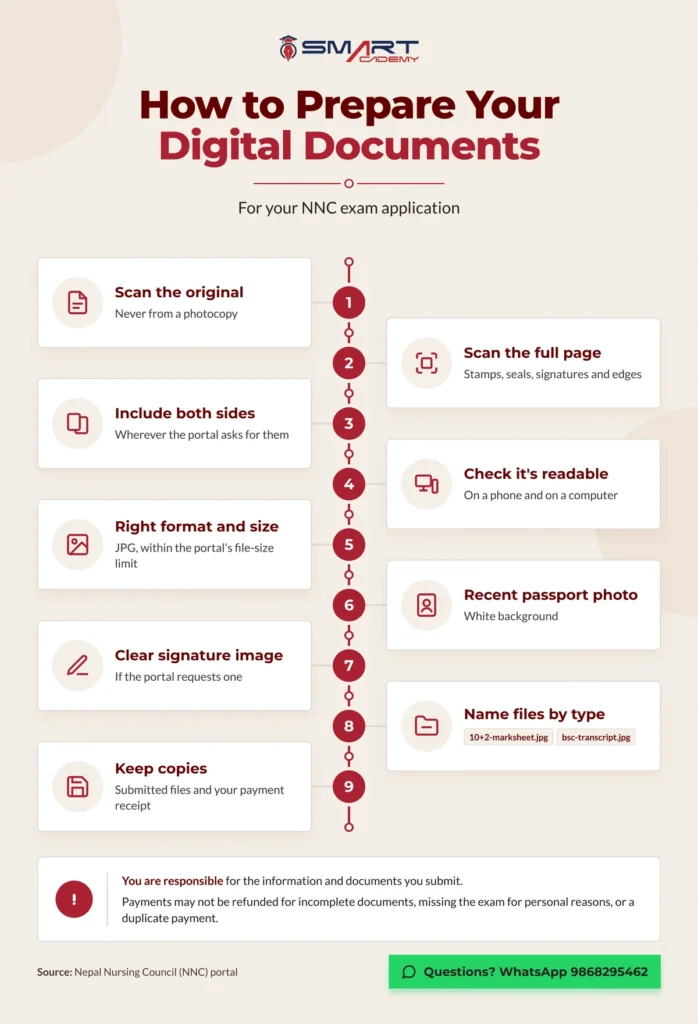
- Scan from the original document rather than from a photocopy.
- Capture the entire page, including stamps, seals, signatures and edges.
- Include both sides where the portal asks for them.
- Check readability on a phone and a computer before uploading.
- Use the specified JPG format and file-size limit.
- Use a recent white-background passport photograph.
- Prepare a clear signature image if the portal requests it.
- Name files by document type so you do not confuse the 10+2 and B.Sc. records.
- Keep copies of the submitted files and payment receipt.
The NNC portal says candidates are responsible for the information and documents they submit.
It also warns that payments may not be refundable when documents are incomplete, the candidate cannot attend for personal reasons, or a duplicate payment is made.
How to Apply for the B.Sc. Nursing NLEN
Step 1: Read the current NNC notice
Check the application dates, document-issuance cut-off, fee deadline and any category-specific rules.
The yearly examination calendar shows expected periods, but a separate examination notice opens the actual application.
Step 2: Create or access your NNC applicant account
Use the official NNC application portal.
If you are reapplying after an earlier attempt, the portal instructs candidates to use their existing username and password rather than create unnecessary duplicate records.
Step 3: Enter your details exactly
Match the spelling, date of birth and other details shown on your identity and academic documents.
A small difference can create a verification problem later.
Step 4: Upload the required files
Use the checklist for Nepal-educated or foreign-educated B.Sc. Nursing candidates.
Open every uploaded file once more before continuing.
Step 5: Review before payment
Check your applicant category, qualification, institution, graduation details and every attachment.
The 2025 guideline lists an examination fee of NPR 3,500, but the current notice controls the amount and payment deadline.
Step 6: Submit the application and monitor its status
An incomplete draft may not be available to the NNC for verification.
Save the confirmation and check the portal for a correction request, approval or admit-card update.
Step 7: Download and check the admit card
Your admit card provides the center, date, time and examination instructions.
Verify your personal details as soon as the card becomes available.
What If Your Personal Details Change?
The guideline says you must notify the NNC if your name or address changes after application and before receiving the license certificate.
- Legal supporting documents may be required.
- Your name at the examination center should match your photo identification exactly.
- If your citizenship, academic certificates and application use different spellings, raise the issue before exam day.
B.Sc. Nursing NLEN Syllabus and Question Distribution
Use the subject distribution as the structure for your study calendar.
| Subject | Possible number of questions |
| Integrated Health Sciences: Anatomy, Physiology, Microbiology, Pathology, Biochemistry and Pharmacology | 14 |
| Management and Health Economics | 7 |
| Research and Biostatistics | 5 |
| Educational Science | 4 |
| Fundamentals of Nursing and Nursing Concepts | 30 |
| Adult and Geriatric Nursing | 26 |
| Midwifery and Gynecological Nursing | 20 |
| Community Health Nursing | 20 |
| Child Health Nursing | 14 |
| Behavioral Science and Psychiatric Nursing | 6 |
| Nutrition in Health and Illness | 4 |
| Total | 150 |
Fundamentals of Nursing and Nursing Concepts, Adult and Geriatric Nursing, Midwifery and Gynecological Nursing, and Community Health Nursing together account for 96 of the 150 questions.
These four areas should anchor your plan.
Integrated Health Sciences and Child Health Nursing add another 28 questions, so a preparation plan focused only on bedside nursing would be incomplete.
What the subject groups broadly include
- Integrated Health Sciences: Anatomy, physiology, microbiology, pathology, biochemistry and pharmacology organized around major body systems.
- Management and Health Economics: Leadership, staffing, supervision, quality, resources, professional development, health-service management and basic economic concepts.
- Research and Biostatistics: Research process, designs, sampling, data collection, validity, reliability, analysis, interpretation and core statistical concepts.
- Educational Science: Learning principles, teaching plans, methods, media and evaluation.
- Fundamentals of Nursing and Nursing Concepts: Health and illness, nursing theories and process, ethics and law, assessment, basic care, infection prevention, medication and essential procedures.
- Adult and Geriatric Nursing: Medical-surgical and older-adult care across body systems, critical care, oncology, diagnostics, treatment and nursing management.
- Midwifery and Gynecological Nursing: Antenatal, labor, birth, postnatal and newborn care; obstetric complications; reproductive health; and gynecological conditions.
- Community Health Nursing: Epidemiology, primary health care, environment, maternal and child health, family planning, school and occupational health, and national programs.
- Child Health Nursing: Growth and development, family-centered care, common pediatric disorders, newborn care and pediatric procedures.
- Behavioral Science and Psychiatric Nursing: Sociology, psychology, therapeutic relationships, mental-health assessment, psychiatric disorders, treatment and rehabilitation.
- Nutrition in Health and Illness: Nutrients, food safety, nutrition assessment, life-stage requirements and therapeutic diets.
The table should guide study time, but the detailed NNC syllabus should guide chapter completion.
How to Prepare for the B.Sc. Nursing NLEN
1. Map your degree subjects to the NNC headings
B.Sc. Nursing curricula may organize content differently from the licensing syllabus.
Create one checklist using the NNC headings and place your notes, textbooks and question banks underneath them.
This prevents you from overlooking a small subject because it appeared in a different semester of your degree.
2. Take a 150-question diagnostic test
Record performance by subject, not only the total.
A candidate can reach a reasonable aggregate while still having serious gaps in pharmacology, research, child health or psychiatric nursing.
Classify each error as:
- Knowledge gap
- Misread stem or qualifier
- Confusion between similar diagnoses or interventions
- Calculation or statistics error
- Medication mechanism, contraindication or adverse-effect error
- Clinical-priority error
- Time-management error
Your revision plan should address the cause of the error, not just repeat the question.
3. Build around the four largest nursing areas
Fundamentals, Adult and Geriatric Nursing, Midwifery and Gynecological Nursing, and Community Health Nursing contribute 96 questions.
Give these subjects regular weekly blocks rather than studying each only once.
A useful pattern is to pair a large clinical subject with a smaller academic subject:
- Fundamentals with Research and Biostatistics
- Adult and Geriatric Nursing with Integrated Health Sciences
- Midwifery with Nutrition
- Community Health with Management and Health Economics
- Child Health with Educational Science
- Psychiatric Nursing with ethics, communication and nursing concepts
This approach prevents the smaller subjects from being postponed indefinitely.
4. Connect sciences to nursing decisions
Avoid revising anatomy, physiology, pathology and pharmacology as isolated facts.
Connect each concept to assessment and intervention:
- What changes in the disease process?
- Which signs and investigations support the condition?
- Which medicine is used, and what must the nurse monitor?
- Which complication needs immediate action?
- What patient education is required?
Licensure preparation becomes more efficient when one clinical case helps you revise several subjects together.
5. Give research and statistics regular short sessions
Five questions can be decisive near the pass threshold.
Practice research terminology, study designs, sampling, validity, reliability, levels of measurement, presentation of data and common calculations in short repeated sessions.
Do not leave the entire subject for one long session immediately before the examination.
6. Practice one-minute decision-making
The paper allows an average of one minute per item.
During timed practice:
- Identify what the stem is asking.
- Notice qualifiers such as first, priority, most appropriate or immediate.
- Eliminate clearly unsafe or irrelevant options.
- Choose the response that fits patient safety, nursing scope and the sequence of care.
- Move on when an item begins consuming time needed for easier questions.
7. Review full-length mocks by subject
Complete 150 questions in 150 minutes and, where possible, practice on a computer.
Recent NNC notices describe the licensing examination as computer-based.
Create a simple tracking sheet with the date, total, subject scores, guessed answers and recurring errors.
The passing requirement is 50%, but prepare for a consistent margin above the minimum so one difficult section does not decide the result.
An Adaptable Eight-Week B.Sc. Nursing NLEN Plan
| Period | Main focus |
| Week 1 | Diagnostic test, Fundamentals of Nursing and Nursing Concepts |
| Week 2 | Adult respiratory, cardiovascular, gastrointestinal and related sciences |
| Week 3 | Adult renal, neurological, endocrine, musculoskeletal and perioperative care |
| Week 4 | Midwifery and Gynecological Nursing |
| Week 5 | Community Health Nursing and Management/Health Economics |
| Week 6 | Child Health, Behavioral Science and Psychiatric Nursing |
| Week 7 | Integrated Health Sciences, Research/Biostatistics, Educational Science and Nutrition |
| Week 8 | Full-length mocks, error-log revision, documents and examination-day preparation |
Include mixed MCQs and spaced review throughout all eight weeks.
If your preparation window is shorter, combine related blocks without removing mock-test review.
Examination Rules, Scoring and Passing Requirements
The 2025 B.Sc. Nursing guideline states:
- The examination contains 150 MCQs with four options.
- The duration is 2 hours and 30 minutes.
- You must choose the most appropriate option.
- Each correct answer receives one mark.
- There is no negative marking.
- You must obtain at least 50% in aggregate to pass.
- The result is reported as pass or fail, with no numerical score.
- Entry is not allowed after 15 minutes from the start of the examination.
- You may leave the room only after one hour has passed.
- The NNC normally conducts the examination three times per year.
- A candidate who does not pass may apply for the next examination.
The guideline says results are published on the examination day unless there is a technical difficulty.
Follow the current notice and portal because the release process may change between examination periods.
Examination-Day Preparation
Check the admit card for the final requirements. Prepare:
- The admit card
- An accepted original photo-identification document
- Any other item required by the current notice
The current application portal says candidates should carry an original national identity card, citizenship certificate, driving license or passport for identity verification.
A photocopy is not accepted. Confirm the list for your examination period.
Arrive early. Once seated, verify your displayed details, read the test instructions and monitor time without rushing the first section.
Because there is no negative marking under the 2025 pattern, review unanswered items before submitting.
What Happens After You Pass?
Passing the NLEN and receiving the registration certificate are connected but separate steps.
According to the 2025 guideline, a successful candidate can apply for registration by:
- Completing the NNC registration process
- Paying the registration fee—listed as NPR 2,000 in the guideline
- Bringing the admit card
- Bringing the original academic documents and citizenship certificate for verification
The Council may publish a collection schedule or request additional items in the current registration notice.
Do not travel to collect the certificate until you have checked your assigned instructions.
Guidance for Parents Supporting a B.Sc. Nursing Graduate
The application and preparation periods can overlap with internship completion, document issuance or job planning.
You can help by checking that documents are issued before the notice deadline, supporting a quiet study routine and discussing progress through evidence such as mock analysis rather than daily pressure.
Each additional attempt involves another application process and can delay registration.
Early document preparation and a consistent revision schedule are practical ways to reduce avoidable cost and uncertainty.
If you are comparing nursing qualifications and career routes, read PCL vs. B.Sc. Nursing in Nepal and Is B.Sc. Nursing Worth It in Nepal?.
For current examination windows, follow our NNC nursing license examination calendar alongside the official NNC notice.
Frequently Asked Questions
How many questions are in the B.Sc. Nursing NLEN?
The 2025 guideline lists 150 multiple-choice questions with four options each.
How long is the B.Sc. Nursing license examination?
The examination lasts 2 hours and 30 minutes, giving an average of one minute per question.
What is the pass mark?
You need at least 50% in aggregate.
Under the 150-question, one-mark pattern, this corresponds to 75 correct answers. The NNC reports pass or fail rather than providing a numerical score.
Is there negative marking?
No. The 2025 guideline says a wrong answer does not receive a minus mark.
What is the B.Sc. Nursing NLEN examination fee?
The 2025 guideline lists NPR 3,500.
Confirm the current amount, deadline and payment method in the notice before paying.
What is the registration fee after passing?
The guideline lists NPR 2,000.
The current registration notice controls the final amount and process.
Can a B.Sc. Nursing graduate from another country apply?
The guideline provides an application route for Nepali citizens educated abroad.
You must meet the equivalency, recognition and document requirements, including an MEC Eligibility Letter where applicable.
Who needs the MEC Eligibility Letter?
The 2025 guideline includes it for applicable foreign-educated candidates and specifically refers to the October 1, 2020 (2077 Ashoj 15) date.
Confirm your individual requirement with the current NNC and MEC instructions.
Do I need every year’s B.Sc. Nursing marksheets?
The live NNC portal may request all-year marksheets from foreign-educated candidates.
Prepare them even if your final transcript summarizes the degree.
Can I enter the examination late?
The guideline says applicants are not allowed to enter more than 15 minutes after the examination starts.
Plan to arrive well before the reporting time on your admit card.
When can I leave the examination room?
The guideline says candidates can leave only after one hour from the start of the examination.
What if I do not pass?
You can apply for the next examination.
Use the interval to review your subject-level mock results and correct recurring errors rather than repeating the same study method.
Where should I check dates and application updates?
Use the NNC notices page, the official application portal and your admit card.
Do not rely only on a social-media post or an older examination calendar.
Turn the Syllabus Into a Measurable Preparation Plan
The B.Sc. Nursing NLEN covers a wide curriculum, but the preparation process becomes manageable when you use the official distribution.
Secure your documents early, build weekly subject targets, connect health sciences with clinical decisions, and practice full 150-question tests under time limits.
If you want a structured plan, guided revision and mock-test support, message Smart Academy on WhatsApp.
Share your target examination period, where you completed your degree and the subjects that need the most work. Our team can help you organize online or in-person preparation around the time available.