
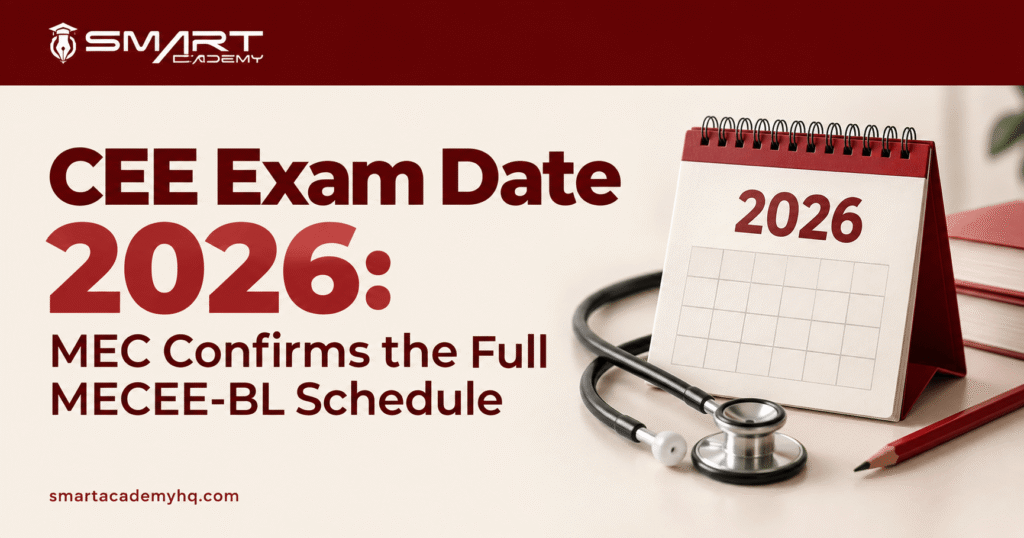
The Medical Education Commission has confirmed the CEE 2026 dates. MBBS sits on 31 October 2026 (14 Kartik 2083), with the remaining programmes running over the four days that follow and finishing with BPH on 4 November. Every paper runs from 11:00 am to 2:00 pm, and every exam centre is inside Kathmandu Valley.
MEC published the schedule on 7 September 2026. If you’ve seen an Ashoj date, that came from the earlier academic calendar and no longer applies.
“Sourced from the Medical Education Commission Examination Directorate notice dated 22 Bhadra 2083 (7 September 2026). Last verified 8 September 2026.”
CEE eligibility varies by programme: The standard entry route requires 50% aggregate marks or a 2.4 GPA in 10+2 Science with Physics, Chemistry and Biology. Diploma and nursing pathways have additional qualification and registration requirements.
Exam timing and centres: All papers run from 11:00 am to 2:00 pm at centres within Kathmandu Valley. Check your admit card for your assigned centre and reporting instructions.
CEE application fees: The application fee is NPR 4,000 for Nepali candidates and NPR 8,000 for foreign candidates, excluding bank charges. Late applications attract double fees.
Negative marking applies: Each correct answer earns 1 mark, each incorrect answer deducts 0.25 marks, and unanswered questions carry no penalty.
The qualifying threshold is percentile-based: You must reach the 50th percentile or above, which is different from scoring 50% marks. Qualifying does not automatically secure admission.
Results lead to matching and admission: Check MEC notices and your candidate account for result updates. Admission depends on your programme merit position, available seats and the matching process.
CEE Exam Date 2026: The Confirmed Schedule
| Programme | Date (BS) | Date (AD) | Time |
| MBBS | 14 Kartik 2083 | Saturday 31 October 2026 | 11:00 am – 2:00 pm |
| BDS | 15 Kartik 2083 | Sunday 1 November 2026 | 11:00 am – 2:00 pm |
| BSc Nursing, BSc Midwifery, BASLP, B Perfusion Technology | 16 Kartik 2083 | Monday 2 November 2026 | 11:00 am – 2:00 pm |
| BAMS, BNS/BMS, BSc MLT, BSc MIT/BSc Radiotherapy Technology, BPT, B Pharm, B Optometry | 17 Kartik 2083 | Tuesday 3 November 2026 | 11:00 am – 2:00 pm |
| BPH | 18 Kartik 2083 | Wednesday 4 November 2026 | 11:00 am – 2:00 pm |
Why the Notice Says MECEE-BL 2027 When You Searched for 2026
MEC names the exam after the academic year you enter, not the year you sit the paper. You take MECEE-BL 2027 in November 2026 and start classes in early 2027. Both names describe the same exam, so a search for either one should land you here.
Where Will You Sit the Exam?
The notice is specific. All exam centres fall within Kathmandu Valley, and your individual centre will be printed on your admit card rather than announced separately.
That detail matters if you live outside the Valley. You need travel and accommodation sorted well before the paper, and the exam falls just after the festival period when transport fills up fast.
Who Can Take the CEE in 2026?
You need 10+2 Science or an equivalent qualification, with Physics, Chemistry and Biology, at a minimum of 50% aggregate or a GPA of 2.4. That covers MBBS, BDS, BSc Nursing, BPH and the allied health programmes.
The PCL and Diploma route works differently. Health science diploma holders need a Certificate of Equivalence to Grade 12 Science from the National Examination Board, 50% in both the diploma and the equivalence exam, and registration with the relevant council.
BNS and BMS sit outside both routes. Entry is PCL or Diploma in Nursing with 50% aggregate plus Nepal Nursing Council registration.
How Much GPA Do You Need for the CEE?
A GPA of 2.4, or 50% aggregate marks, depending on how your board reports results. That’s the floor for sitting the exam. It is not the bar for winning a seat, and students constantly confuse the two. Clearing 2.4 gets you into the hall. Where you land on the merit list is what gets you a place.
How Much Does the CEE Exam Cost?
Nepali candidates pay NPR 4,000. Foreign candidates pay NPR 8,000 or the equivalent. Bank charges sit on top of both figures.
Applications opened on 10 August 2026 and closed at the standard fee on 31 August 2026. A late window followed at double the fee and ran to 16 September 2026. The application notice sets separate cut-offs for bank deposit and voucher submission within that window, so work from the notice on the official MEC portal rather than the headline date.
What’s Actually on the Paper
Every group sits 200 single-best-response MCQs across three hours, worth 200 marks, on an OMR sheet. What changes between programmes is the subject weightage, so check the group you applied for.
MBBS, BDS, BSc Nursing, BSc Midwifery, BASLP, B Perfusion Technology
| Subject | Questions |
| Zoology | 40 |
| Botany | 40 |
| Chemistry | 50 |
| Physics | 50 |
| Mental Agility Test | 20 |
| Total | 200 |
BAMS, BSc MLT, BSc MIT/BSc Radiotherapy Technology, BPT, B Pharm, B Optometry
| Subject | Questions |
| Zoology | 40 |
| Botany | 40 |
| Chemistry | 40 |
| Physics | 40 |
| Contents from the PCL course of the specific subject | 20 |
| Mental Agility Test | 20 |
| Total | 200 |
Chemistry and Physics each drop ten questions here to make room for 20 drawn from the PCL-level course in your specific subject. If you’re coming from 10+2 Science, that block is the part of the paper your school syllabus never covered.
BPH
| Subject | Questions |
| Zoology | 40 |
| Botany | 40 |
| Chemistry | 40 |
| Physics | 40 |
| Prerequisite Health Knowledge | 20 |
| Mental Agility Test | 20 |
| Total | 200 |
The health knowledge block covers determinants of health and illness, communicable and non-communicable diseases, WASH, and basic biostatistics and epidemiology.
BNS and BMS
| Subject | Questions |
| Nursing core subjects | 150 |
| Basic and Integrated Health Science applied to Nursing | 30 |
| Mental Agility Test | 20 |
| Total | 200 |
No physics, chemistry or biology. The core 150 splits across community health nursing, adult health nursing, child health nursing, midwifery and gynaecological nursing, fundamentals of nursing, leadership and management, and behavioural science and mental health.
Questions across all four papers are set at a 50:30:20 split for recall, understanding and application.
Does the CEE Have Negative Marking?
Yes. A correct answer earns 1 mark and an incorrect answer costs 0.25. Blank answers cost you nothing.
Four wrong guesses cancel out one correct answer. On a paper where the cut-off shifts with the cohort, that arithmetic decides places.
Exam Day: What the Notice Tells You
Your admit card carries your centre. Download it from your candidate account on entrance.mec.gov.np and print it. The admit card and the portal list the reporting time and permitted items, and those are the instructions enforced at the gate.
Papers run from 11:00 am to 2:00 pm on all five days, so plan your arrival around Kathmandu’s late-morning traffic rather than the exam time itself.
When Will the CEE 2026 Results Come Out?
MEC hasn’t published a result date for this cycle. The 2083/84 academic calendar named a window in Ashoj, but the exam itself has since moved to Kartik, so that window no longer applies.
What is known is the process. Results go to your MEC account online, and MEC publishes a separate merit list for each programme. Watch the notice page rather than any third-party countdown.
How Many Marks Do You Need to Pass the CEE?
There’s no fixed pass mark. You qualify by placing at or above the 50th percentile, which means the cut-off moves every year with how the cohort performs.
This is where 50% gets misreported as a pass mark. It isn’t one. A percentile measures your score against everyone else who sat the same paper, so a raw score that qualifies in one year can fall short in another.
After the Result: Matching and Admission
Qualified candidates go through an open house matching process, choosing a college against their merit position and the seats still open. MEC’s calendar puts classes starting from the second week of Magh 2083, which is late January 2027.
Your rank sets your options, not your preferences. Deciding which colleges you’d genuinely accept before matching opens saves you from making that call under pressure in the room.
Eight Weeks Out: How to Use the Time You Have
The MBBS paper is 53 days away at the time of writing. That’s long enough to still move your syllabus coverage, which changes what you should be doing right now.
Spend the first month closing gaps rather than revising what you already know. Most candidates revise their strong chapters because it feels productive. Pull your weakest topics out of Zoology and Chemistry and work those instead, because that’s where the marks are hiding. Whether you’re sitting MBBS entrance or BSc Nursing entrance, the weak-topic-first principle holds.
Then shift. From early October, sit full three-hour timed practice tests at 11:00 am, in the same slot as the real paper. Your concentration curve is trainable and most students never train it. Keep an error log and work it, because a question you get wrong twice teaches you more than ten you get right.
Then there’s MAT. Twenty marks, no prescribed textbook, and most candidates reach it with nine minutes left on the clock. It’s the cheapest scoring block on the paper and the one that gets neglected every single year.
One practical note. Dashain and Tihar both fall between now and the exam. Decide in advance which days you’re writing off and which you’re keeping, because drifting through the festival period is how a comfortable eight weeks becomes a panicked three.
Smart Academy runs CEE preparation classes in Kathmandu built around timed mock papers, marked error logs and small batches. If you want structure across the eight weeks, that’s what it’s for.
Learn More About Our Comprehensive Guide On:
CEE Exam in Nepal (MECEE-BL): Eligibility, Syllabus and Preparation GuideCEE 2026 FAQs
What is the date of the CEE exam?
The MECEE-BL exam runs from 31 October to 4 November 2026. MBBS is on 31 October, BDS on 1 November, BSc Nursing and allied programmes on 2 November, BAMS and the remaining allied programmes on 3 November, and BPH on 4 November. All papers run from 11:00 am to 2:00 pm.
Who is eligible to take the CEE exam in 2026?
Students who’ve passed 10+2 Science with Physics, Chemistry and Biology at 50% aggregate or 2.4 GPA. Health science diploma holders qualify at the same threshold with a Certificate of Equivalence and council registration. BNS and BMS are different, requiring PCL Nursing plus Nepal Nursing Council registration.
How much GPA is required to take the CEE exam?
A minimum GPA of 2.4, or 50% aggregate marks. That threshold only qualifies you to sit the exam. Admission depends on your position on the programme merit list.
How much does the CEE exam cost?
NPR 4,000 for Nepali candidates and NPR 8,000 for foreign candidates, before bank charges. Applications submitted in the late window were charged double.
Is there negative marking in the CEE exam?
Yes. Correct answers earn 1 mark, incorrect answers lose 0.25, and unanswered questions carry no penalty.
Where are the CEE 2026 exam centres?
All centres are within Kathmandu Valley. Your specific centre appears on your admit card, which you download from entrance.mec.gov.np.
Still weighing up programmes, or want your mock scores reviewed before the paper? Call Smart Academy on 9868295462, or come into the Thapagaun head office, Baneshwor or Putalisadak. You can also book a counselling session or visit our Kathmandu branches. We’ve guided students through medical entrance preparation in Nepal since 2021, with a team of 40+, ICEF accreditation and registration with CTEVT and the British Council.