
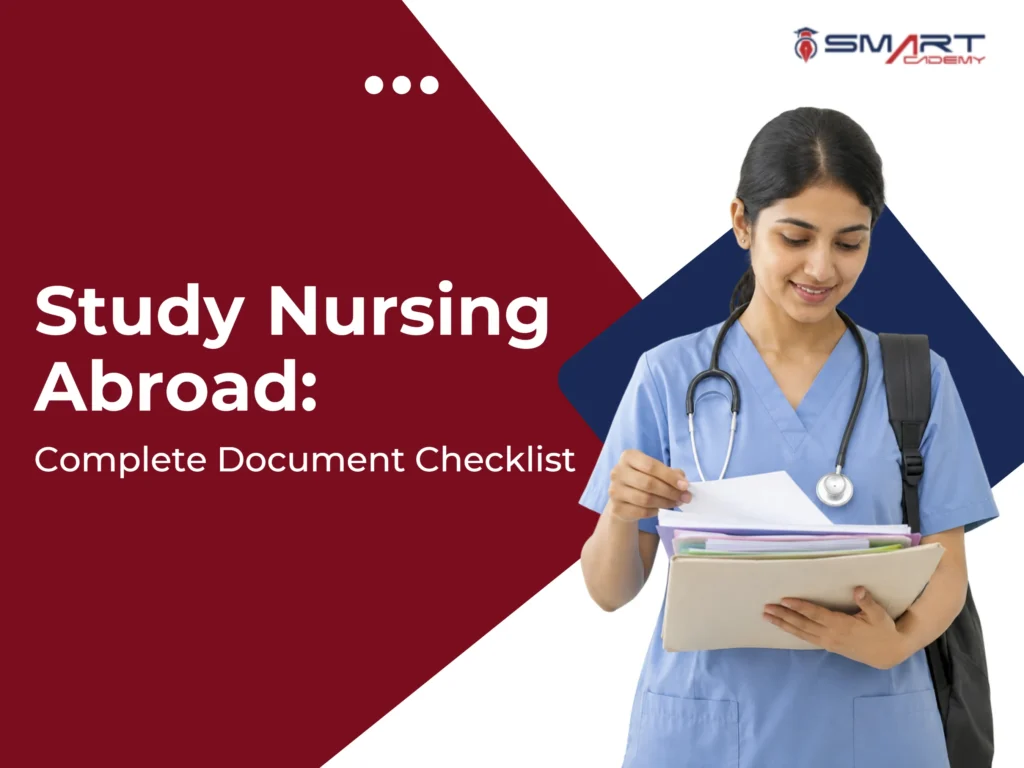
Studying nursing abroad requires careful preparation of a comprehensive set of documents that verify academic qualifications, language proficiency, financial capacity, and identity. These documents include official transcripts, degree certificates, valid passports, English test scores, and financial proofs such as bank statements or sponsorship letters. Each country and university may have specific requirements, making it necessary for applicants to understand and organize their paperwork according to their chosen destination’s standards.
From academic records like SEE and 12th mark sheets to professional nursing licenses and health clearances, assembling the correct documents supports a smooth admission and visa application process. Early preparation, thorough verification, and adherence to rules governing document validity and attestation help nursing students avoid common pitfalls and increase their chances of successful enrollment in international nursing programs.
What Documents Are Required to Study Nursing Abroad?
Documents required to study nursing abroad include academic documents (such as SEE/12 mark sheet, certificate), identity documents (e.g., valid passport, birth certificate), professional nursing documents (e.g., nursing registration certificate, council license), final documents (like bank statements, sponsorship documents), and recommendation documents (e.g., SPO and LOR). Preparing and organizing this complete document package is one of the most important stages of the nursing study-abroad application process for Nepali students, as even a minor discrepancy, a missing record, or an incomplete submission can delay university admission, complicate credential verification, or result in a student visa rejection.
Academic Documents
Academic documents required to study nursing abroad include SEE/10th and 12th mark sheets and certificates, nursing diploma or degree certificates, academic transcripts, provisional certificates, and backlog or gap certificates (if applicable). Nursing universities use these documents to verify your educational history, academic performance, and eligibility for nursing programs.
SEE/10th Mark Sheet and Certificate
The SEE (Secondary Education Examination) or 10th mark sheet and certificate are foundational academic documents required for studying nursing abroad. Nursing universities and visa authorities require these academic documents to verify your academic credentials and assess your eligibility. Preparing and submitting these documents accurately remains necessary for both the admission process and student visa applications when you plan to study nursing abroad.
The specific SEE/10th mark sheet and certificate you need to prepare include:
- 10th Mark Sheet: This official transcript shows your detailed academic performance in the SEE or equivalent examination.
- 10th Certificate: This certificate confirms that you have successfully passed the SEE (10th-grade) examination.
- Undergraduate Transcripts and Degree Certificate: If you are applying for higher studies, such as a bachelor’s or postgraduate nursing program, you must submit your undergraduate transcripts and degree certificate to prove your prior academic qualifications.
12th Mark Sheet and Certificate
Your 12th-grade (Higher Secondary) mark sheet and school-leaving certificate are important documents for undergraduate nursing study-abroad programs, including Bachelor of Science in Nursing (BSN) degrees. Nursing universities use these documents to verify secondary education completion and assess whether you meet nursing admission requirements, particularly in Biology, Chemistry, and Mathematics.
Most nursing universities review both your overall GPA/percentage and subject-specific scores in 12th grade. While requirements vary by nursing institution, many programs expect at least 50-65% marks (or equivalent GPA) in higher secondary education, with stronger scores improving admission competitiveness. Admissions committees may also evaluate credit distribution, laboratory coursework, and practical science components to ensure your academic background aligns with nursing program standards.
Nursing Diploma or Degree Certificates
To study nursing abroad, a nursing diploma or degree certificate is a mandatory document, as these certificates serve as official proof of your educational background and confirm your eligibility to enroll in international nursing programs. Nursing universities and regulatory bodies use these documents to verify that applicants meet the academic standards required for nursing admission, advanced standing, or postgraduate study pathways.
Applicants should prepare original or certified copies of all nursing qualifications and ensure the information matches their academic transcripts and identity documents. For example, applicants seeking admission to the Master of Science in Nursing (MSN), postgraduate nursing diplomas, or registered nurse bridging programs are required to submit their nursing diploma, Bachelor of Science in Nursing (BSN), Bachelor of Nursing (BN), or equivalent qualification certificates.
Academic Transcripts
To study nursing abroad, you will need an academic transcript (your graded mark sheets), which serves as an official record of a student’s academic performance, including all courses taken, grades received, and credits earned. These complete, official transcripts must be issued directly by your school or university to serve as valid proof for admissions and visa processing.
International nursing programs require you to submit official transcripts for all post-secondary education completed, such as nursing diplomas, bachelor’s degrees, or other relevant qualifications. To ensure your qualifications are accurately verified for studying nursing abroad, your transcripts must list every individual subject, a semester-by-semester breakdown, and clinical practice hours completed. If your original records are not in English, you must accompany them with certified literal English translations to meet international application standards.
Provisional Certificate
For Nepali nursing students applying abroad, a provisional certificate serves as temporary proof of graduation or academic completion when the final degree or diploma certificate has not yet been issued. Nursing universities often accept this document to verify academic eligibility and allow applicants to meet admission and visa deadlines while awaiting final certificates. To study nursing in the United States, students must eventually provide official academic records and obtain a Form I-20 to secure nonimmigrant student status.
Some advanced nursing pathways may also require a Certification of Professional Education (Form 2F) to validate foreign nursing qualifications. If your academic history includes interruptions, repeated courses, or periods of non-enrollment, a backlog or gap certificate may be required. Issued by your educational institution, it should clearly state the duration and reason for the gap, helping universities and immigration authorities assess your application without unnecessary delays.
Identity Documents
Identity documents required for Nepali students studying nursing abroad include a valid passport, national identity documents (such as a National Identity Card or citizenship certificate), a birth certificate, and passport-sized photographs. These documents help universities, immigration authorities, and visa officers verify your identity, nationality, and eligibility for international study.
Valid Passport
A valid passport is the foundational document required for any international nursing applicant, serving as your definitive global identity. Immigration authorities worldwide mandate that your passport must remain valid for at least 6 months beyond your intended stay in the destination country.
Because international nursing admissions, clinical placement clearances, and visa processing can take several months, check your expiration date well in advance. Ensure that your scanned copies are fully legible, clearly showing the biometric data page, observation pages, and signature pages, as smudged passport scans are a primary trigger for immediate processing delays.
National Identity Documents
To study nursing abroad, students are required to provide national identity documents to verify their identity, nationality, and legal status during university admissions and student visa applications. Commonly accepted documents include a national identity card, a state-issued identification card, a citizenship certificate, a certificate of naturalization, or other government-issued photo identification.
All documents must be valid, issued by an authorized government agency, and contain accurate personal information that matches your passport and academic records. Countries such as the United States, Canada, Australia, and the United Kingdom may require two forms of identification for security and verification purposes, such as a passport alongside a national ID or citizenship document. Students should review the specific identity document requirements of their destination country before applying to ensure compliance with university and immigration regulations and avoid unnecessary delays.
Birth Certificate
When applying to study nursing abroad, a birth certificate may be required as a supporting identity document during university admissions, visa processing, or credential verification. It provides official proof of birth details and helps institutions confirm a student’s identity. To avoid delays or verification issues, the spelling of the student’s name and their parents’ names should match exactly across the birth certificate, National Identity Card (NID), passport, and academic records.
While a birth certificate can support identity verification, it is not accepted as the sole document for international travel or entry into many countries. Students should verify the specific requirements of their destination country’s immigration authorities and chosen university to ensure all identity documents meet admission and travel standards.
Passport-Sized Photographs
To study nursing abroad, you will need passport-sized photographs for university applications, student visa submissions, residence permits, student identification cards, and other administrative processes. These photographs serve as official proof of identity throughout the admission and immigration process. Students should prepare multiple copies, as photo requirements may vary across countries and institutions.
In most cases, photographs must be recent, in color, show a full front-facing view with eyes open, and include the entire head within the frame. While the standard passport size is 2 inches by 2 inches (51 mm by 51 mm), applicants should verify any country-specific or university-specific requirements before submission. Providing compliant photographs helps avoid unnecessary delays or application rejections.
English Language Proficiency Documents
Nursing universities and programs require applicants to submit official score reports from recognized English-language tests, such as IELTS Academic, PTE Academic, TOEFL iBT, and OET, to demonstrate their ability to communicate effectively in academic and clinical settings. Some nursing institutions may also accept alternative proof, such as completion of secondary or higher education conducted entirely in English in countries like Canada (excluding Quebec), Great Britain, Australia, or New Zealand. Since language requirements vary by university, country, and nursing regulatory body, applicants should verify the exact criteria before applying.
- IELTS Academic: Overall 7.0 (many programs require a minimum of 7.0 in Speaking, with some requiring 8.0)
- PTE Academic: Base Tier (55 overall with no section below 50), Top Tier (65+ in each component)
- TOEFL iBT: Standard Academic Track (90+ minimum)
- OET: Score requirements vary with many nursing boards (e.g., in the UK, Australia, and Ireland) requiring at least a Grade B in reading, listening, and speaking, and a C+ in writing.
IELTS Score Report
To study nursing abroad, many universities require an IELTS Academic score report as proof of English language proficiency. Nursing programs expect an overall band score between 6.5 and 7.0, with some institutions setting higher requirements for individual components, particularly Speaking.
Nursing universities use IELTS results to assess whether applicants can participate successfully in academic coursework, clinical placements, and professional communication settings. Since score requirements differ across countries and nursing programs, students should verify the exact IELTS criteria of their chosen institution. Meeting the required band score strengthens both university admission and student visa applications.
PTE Score Report
For nursing study abroad applications, a PTE Academic score report is widely accepted as a secure digital alternative to IELTS for demonstrating English language proficiency. Universities and nursing authorities use PTE results to assess the communication skills required for academic coursework, clinical training, and professional nursing practice. A cumulative score of 55, with no communicative skill score below 50, is a common minimum requirement for many nursing programs and registration pathways.
However, competitive nursing programs and certain regulatory bodies may require scores of 65 or higher in each component, including Listening, Reading, Writing, and Speaking. To ensure authenticity and compliance with institutional requirements, official PTE scores are transmitted electronically through Pearson directly to the receiving university or authority. Students should verify the exact score requirements of their chosen program before applying.
TOEFL Score Report
To study nursing abroad, a TOEFL iBT score report is widely accepted as an alternative to IELTS or PTE for demonstrating English language proficiency. International nursing schools use TOEFL results to assess whether applicants possess the language skills needed for advanced clinical coursework, fast-paced lectures, and effective patient communication during clinical placements.
A minimum TOEFL iBT score of 90 or higher is required by many nursing programs, although specific score requirements vary by institution. When registering for the exam, applicants should enter their target nursing university’s institution code so that the Educational Testing Service (ETS) can send official electronic score reports directly to the university. Nursing students should verify the TOEFL requirements of their chosen nursing program and ensure their scores remain valid throughout the admission process.
Other Accepted English Test Results
Depending on your chosen study destination and nursing regulatory requirements, alternative English proficiency tests, such as the Occupational English Test (OET) and Cambridge English qualifications (C1 Advanced or C2 Proficiency), may also be accepted for nursing study-abroad applications. These examinations provide additional pathways for applicants who do not plan to take IELTS, PTE, or TOEFL.
Nursing councils and healthcare employers particularly value the OET because it assesses Listening, Reading, Writing, and Speaking skills through realistic clinical and healthcare scenarios rather than general academic situations. Since acceptance policies vary across universities and nursing registration bodies, applicants should confirm the approved examinations and minimum score requirements before booking a test to ensure the results meet both university admission and professional registration standards.
Professional Nursing Documents
Professional nursing documents required for Nepali students studying nursing abroad include nursing registration certificates, nursing council licenses, work experience certificates, and internship or clinical placement records. Preparing complete and valid professional nursing records supports smoother admission, credential review, and future registration processes abroad.
Nursing Registration Certificate
For nursing professionals pursuing education abroad, a Nursing Registration Certificate serves as official proof that you have met the professional requirements to be recognized as a qualified nurse in your home country. Issued by a recognized authority such as the Nepal Nursing Council (NNC), this document confirms your registration status and standing within the profession.
Universities, nursing boards, and credential evaluation agencies require a valid registration certificate when assessing applicants for post-registration bachelor’s degrees, master’s programs, bridging courses, or professional registration pathways. Any suspension, restriction, or lapse in registration may affect both admission eligibility and clinical placement approval.
Nursing Council License
Distinct from your registration certificate, a valid Nursing Council License demonstrates your current legal authorization to practice nursing and is often required when applying for nursing study abroad programs. Unlike a registration certificate, which confirms professional recognition, a nursing license verifies that your practice authorization remains active during a specific period.
Many international universities and regulatory authorities require license verification or a Letter of Good Standing to be sent directly from your home country’s nursing council to the destination country’s registration body. Maintaining an active, unrestricted license throughout the application process supports credential recognition and future licensing opportunities abroad.
Work Experience Certificates
Work Experience Certificates provide verified evidence of your professional nursing employment and clinical expertise after graduation. These documents are particularly valuable for postgraduate nursing programs, specialized nursing pathways, and assessments of internationally educated nurses.
Ideally issued on official institutional letterhead, they should include your job title, employment dates, department, clinical setting, key responsibilities, and any specialized skills or certifications acquired during employment. Experience gained in areas such as intensive care, emergency nursing, medical-surgical units, or community health can strengthen your application by demonstrating readiness for advanced coursework, research, and clinical training abroad.
Internship or Clinical Placement Records
Internship or Clinical Placement Records document the supervised practical training completed during your nursing education and are often required by universities evaluating international nursing applicants. These records help institutions assess whether your clinical experience aligns with local nursing education standards and licensing requirements.
A complete record should include details of clinical rotations, healthcare facilities, placement duration, supervising instructors, and the number of clinical hours completed in areas such as Medical-Surgical Nursing, Pediatrics, Obstetrics, and Mental Health Nursing. Accurate clinical placement documentation can play a crucial role in admission decisions, advanced standing evaluations, and future nursing registration processes.
Financial Documents
Financial documents required for Nepali students studying nursing abroad include bank statements, sponsorship documents, income verification documents, affidavits of support, and scholarship documents. These records help universities and visa authorities assess your financial capacity to cover tuition fees, living expenses, accommodation, health insurance, and other study-related costs.
Bank Statements
When applying to study nursing abroad, bank statements serve as the primary proof of your financial capacity to cover tuition fees, living expenses, accommodation, and other education-related costs. Most universities and immigration authorities require official bank statements covering the previous three to six consecutive months to evaluate both the availability and stability of funds.
The account balance must meet the minimum financial requirements set by the destination country, including first-year tuition and a prescribed living-expense threshold. Statements should be issued on official bank letterhead and include authorized stamps, signatures, and complete transaction histories. Sudden or unexplained deposits shortly before submission may trigger additional scrutiny or raise source-of-fund concerns during visa assessment.
Sponsorship Documents
Students pursuing nursing education abroad with financial assistance from a parent, guardian, spouse, or other sponsor must provide sponsorship documents that establish both the relationship and the sponsor’s commitment to funding their studies. A complete sponsorship package includes government-issued identification, proof of relationship, financial records, and a formal sponsorship letter confirming responsibility for tuition, living expenses, and related costs. Universities and visa authorities carefully review these documents to assess whether the sponsor possesses sufficient and sustainable financial resources to support the student throughout the nursing program without creating financial hardship.
Income Verification Documents
For nursing study-abroad applications, income verification documents demonstrate that the funds shown on bank statements originate from legitimate, sustainable sources. These records help immigration authorities assess the long-term financial stability of both the applicant and sponsor. Salaried sponsors are required to provide recent payslips, employment verification letters, and income tax records. At the same time, business owners may need to submit company registration documents, tax clearance certificates, audited financial statements, and business bank records. Strong income verification documentation demonstrates that the financial resources available for nursing education can be maintained throughout the program.
Affidavit of Support
An Affidavit of Support is often required when a nursing student abroad relies on sponsor-funded finances. This legally binding declaration confirms that another individual accepts financial responsibility for the student’s education. The document is sworn before a notary public or authorized legal authority. It outlines the sponsor’s commitment to covering tuition fees, accommodation, medical insurance, and living expenses for the duration of the nursing program.
To avoid delays during admission or visa processing, the affidavit should clearly identify the student, sponsor, educational institution, and scope of financial support. A detailed and unambiguous affidavit strengthens the credibility of the overall financial documentation package.
Scholarship Documents
Students planning to study nursing abroad with scholarship assistance must submit official scholarship documents as proof of financial support. These records confirm that a university, government agency, healthcare organization, or private foundation has agreed to fund part or all of the educational expenses. The scholarship award letter should clearly state the amount awarded, the funding duration, the issuing authority, and the expenses covered, such as tuition fees, accommodation, living expenses, or healthcare coverage.
Because scholarship funding directly reduces the financial burden, as demonstrated by personal or sponsor funds, visa authorities use these documents when assessing financial capacity. Any remaining costs not covered by the scholarship should be supported through additional financial evidence, such as bank statements or sponsorship records.
Statement and Recommendation Documents
Statement and recommendation documents required to study nursing abroad for Nepali students are a Statement of Purpose (SOP), Letters of Recommendation (LOR), and a Curriculum Vitae (CV) or Resume. These documents help admission committees evaluate an applicant’s academic goals, nursing motivation, professional achievements, and overall suitability for the program beyond grades and test scores.
Statement of Purpose (SOP)
When applying to study nursing abroad, a Statement of Purpose (SOP) allows you to explain your academic background, professional experiences, career goals, and motivation for pursuing nursing education in a specific country and institution. Admission committees use the SOP to assess whether your objectives align with the program’s curriculum, values, and career outcomes.
A strong SOP should clearly describe your nursing journey, relevant achievements, reasons for choosing the university, and plans after graduation. Because it presents your story beyond grades and certificates, a well-structured SOP can significantly strengthen your overall application.
Letters of Recommendation (LOR)
Letters of Recommendation (LOR) provide objective, third-party validation of your clinical skills, work ethic, and academic performance, acting as proof of qualification for studying nursing abroad. For nursing study abroad applications, you need two to three letters from academic professors, clinical instructors, or senior nursing supervisors who have directly overseen your work.
These letters must be printed on official institutional letterhead, include the recommender’s contact information, and feature their physical signature. Rather than just listing positive traits, a strong LOR gives concrete examples of your critical thinking under pressure, empathy in patient care, and collaborative skills within a healthcare team.
Curriculum Vitae (CV) or Resume
A Curriculum Vitae (CV) or Resume provides a structured summary of your educational qualifications, clinical experience, professional employment, certifications, research activities, volunteer work, and relevant achievements. Nursing universities use this document to obtain a comprehensive overview of your academic and professional background before making admission decisions.
A strong nursing CV should highlight clinical placements, nursing licenses, work experience, specialized training, certifications such as BLS or ACLS, research involvement, and community healthcare activities. Presenting a clear and well-organized CV helps admission committees quickly evaluate your readiness for international nursing education.
How Do Document Requirements Differ by Study Destination?
Document requirements for studying nursing abroad vary by country due to differences in academic admission standards, nursing regulations, immigration policies, and visa procedures. While most applicants must provide academic records, identity documents, English-language proficiency scores, financial evidence, and visa paperwork, specific requirements and evaluation criteria vary. Variations may include academic qualifications, accepted language tests, nursing registration documents, health clearances, credential assessments, and immigration requirements.
Documents Required to Study Nursing in India
To study nursing in India as an international student, you must submit academic, identity, financial, and admission-related documents that demonstrate your eligibility for the chosen nursing program. Requirements may vary by institution and study level, but most universities expect applicants to provide the following:
- Association of Indian Universities (AIU) Equivalence Certificate: International applicants must submit their school-leaving records (10+2 or an equivalent science track with Physics, Chemistry, Biology, and English) to the AIU to obtain a mandatory certificate confirming that their academic eligibility meets Indian high school benchmarks.
- INC No Objection Certificate (NOC): Post-basic or post-graduate international nursing candidates must secure an official NOC from the Indian Nursing Council before enrollment.
- State Nursing Council Provisional Registration: For clinical tracking or advanced coursework, a temporary or provisional registration token from the State Nursing Council in the college’s state is often required.
- Student Visa & Association Marksheets: In addition to a dedicated Student Visa, candidates must upload year-by-year consolidated high school science sheets showing absolute aggregate grade thresholds.
Documents Required to Study Nursing in Australia
Documents required to study nursing in Australia include academic qualification documents, English language proficiency test scores, financial evidence, health insurance records, identity documents, and, in some cases, nursing registration-related documents. Australian universities and immigration authorities assess these records to verify academic eligibility, language competency, financial capacity, and compliance with student visa requirements.
- Academic Prerequisites: Must submit a high school certificate or equivalent qualification with strong grades in science subjects such as Biology and Chemistry. Most universities expect a minimum GPA of 5.5 or 50-60%, although requirements vary by institution.
- Proof of English Language Proficiency: Most nursing programs require evidence of English proficiency, an IELTS score of 7.0 with no band below 6.5. Equivalent scores from other approved tests may also be accepted.
- Financial Documentation: Applicants must provide financial evidence, such as bank statements or financial guarantee letters, showing sufficient funds to cover tuition fees and living expenses during their studies.
- International Student Health Insurance: International students must hold Overseas Student Health Cover (OSHC) and submit proof of valid health insurance for the entire duration of their nursing program.
- Registration with the Nursing and Midwifery Board of Australia (NMBA): Depending on the program and future registration pathway, applicants may need to meet NMBA requirements for clinical placements, professional registration, or nursing practice in Australia.
Documents Required to Study Nursing in the UK
For international students applying to study nursing in the UK, required documents include academic qualification records, English language proficiency test scores, financial evidence, immigration documents, and nursing-specific registration records where applicable. UK universities, the UK Visas and Immigration (UKVI) department, and professional nursing regulators use these documents to assess academic suitability, language competency, financial preparedness, and eligibility for nursing education pathways.
Typical document requirements to study nursing in the UK include:
- Confirmation of Acceptance for Studies (CAS): An official, electronic document issued by your UK university after verifying your qualifications. The CAS number is mandatory for your Student Visa application.
- NMC Overseas Registration Portal Profile: If entering an advanced or top-up nursing program, you must provide proof of an active online application on the MyNMC portal, which acts as the precursor to completing the Test of Competence (CBT and clinical OSCE).
- NMC-Compliant English Test Scores: You must supply an official report sheet matching the UK’s precise healthcare standards: an IELTS Academic overall score of 7.0 (with a minimum of 7.0 in all bands) or an Occupational English Test (OET) with a minimum of a Grade B across all sub-tests.
- Tuberculosis (TB) Certificate: For students originating from specified countries, an official TB clearance certificate from a UK Home Office-approved diagnostic clinic is a mandatory visa requirement.
Documents Required to Study Nursing in the USA
Nursing applicants seeking admission to universities in the USA must provide academic, financial, and immigration-related documents that support both university admission and student visa approval. Nursing schools often place significant emphasis on academic credential evaluation and prerequisite coursework.
- CGFNS Credentials Evaluation Service (CES) Report: Most US nursing programs require international applicants to have their foreign nursing education audited by the Commission on Graduates of Foreign Nursing Schools (CGFNS). This official report converts your domestic curriculum into a US-equivalent credit standard.
- SEVIS Form I-20: Issued directly by your university’s designated school official (DSO) upon receipt of financial proof, this document certifies your legal enrollment status and is mandatory for securing an F-1 student visa.
- State Board of Nursing (BON) Authorization to Test (ATT): If entering an advanced placement program that triggers direct eligibility for the NCLEX-RN exam, an official ATT document issued by a state-level BON is required.
- TOEFL iBT Official Institutional Score Report: US programs overwhelmingly favor the TOEFL iBT, requiring a score of 90 or above, with specific sub-score requirements transmitted securely via ETS.
Documents Required to Study Nursing in Canada
For admission to nursing programs in Canada, international students must submit documents that satisfy academic admission requirements, language proficiency standards, financial regulations, and provincial nursing expectations. Additional credential assessments may be required depending on the institution and province.
- NNAS Advisory Report Application: For post-graduate or bridging programs, your files must first pass through the National Nursing Assessment Service (NNAS). This report demonstrates how your training aligns with Canadian nursing competencies.
- Provincial Regulatory Board Letter of Eligibility: Depending on your study location (e.g., British Columbia, Ontario), you must often show correspondence or an open portal profile with the local provincial regulatory body.
- Provincial Attestation Letter (PAL): Under current Canadian student visa frameworks, international applicants must obtain an official PAL from the provincial government, in addition to their university Letter of Acceptance (LOA), to apply for a Study Permit.
- GIC (Guaranteed Investment Certificate): To meet student visa financial compliance requirements, Canadian immigration requires a formal GIC document confirming a locked deposit (around CA$20,635) with a participating Canadian financial institution to cover initial living expenses.
Documents Required to Study Nursing in Denmark
For admission to nursing programs in Canada, international students must submit documents that satisfy academic admission requirements, language proficiency standards, financial regulations, and provincial nursing expectations. Additional credential assessments may be required depending on the institution and province.
- Danish Patient Safety Authority (Styrelsen for Patientsikkerhed) Evaluation: If you possess prior clinical training, you must submit your diploma, complete academic transcripts, and clinical hours directly to the authority to obtain a formal assessment of your curriculum’s eligibility for a Danish authorization path.
- Danish Language Proficiency Documentation (Prøve i Dansk 3): Because patient interactions are conducted in Danish, many clinical tracks require official certification of Danish language fluency at a high tier (Prøve i Dansk 3) before you are permitted to clear hospital-based clinical rotations.Schengen-Compliant
- Travel and Medical Insurance: To secure a Danish residence permit for studies, you must hold a comprehensive medical insurance policy with a minimum coverage of €30,000 that is valid throughout the Schengen area.
- Biometric Data and EU Declaration Forms: Visas require a formal digital biometric receipt, along with specific institutional declarations confirming that your academic program includes mandatory, accredited clinical traineeships within the Danish healthcare network.
What Documents Are Required for a Student Visa After Nursing Admission?
Documents required for a student visa after nursing admission include confirmation of enrollment, financial evidence, health and medical records, police clearance certificates, and visa application forms with supporting documents. After securing admission to a nursing program abroad, students must submit these documents to immigration authorities to verify their enrollment status, financial capacity, health compliance, character requirements, and overall eligibility for a student visa.
Here is a list of documents required for a student visa after nursing admission:
- Confirmation of Enrollment Documents
- Financial Evidence Documents
- Health and Medical Documents
- Police Clearance Documents
- Visa Application Forms and Supporting Documents
Confirmation of Enrollment Documents
Before a government embassy or immigration department will process a student visa application, you must provide official, legally binding digital receipts generated directly by your hosting institution. These documents prove you have been allocated an accredited clinical seat and have paid your initial tuition deposits.
- United States: You must present Form I-20 (Certificate of Eligibility for Nonimmigrant Student Status), issued securely by the university’s Designated School Official (DSO) via the federal SEVIS system.
- United Kingdom: You require a valid Confirmation of Acceptance for Studies (CAS) electronic reference number issued by your Tier 4 university sponsor.
- Australia: You must upload an official Confirmation of Enrolment (CoE) token generated through the Department of Home Affairs PRISMS database.
- Canada: You must present a formal Letter of Acceptance (LOA) paired with an official Provincial Attestation Letter (PAL) issued by the territorial government.
Financial Evidence Documents
Financial evidence documents demonstrate a nursing student’s ability to cover tuition fees, living expenses, accommodation, and other study-related costs while studying abroad. Universities and visa authorities use these records to verify financial capacity and ensure applicants can support themselves throughout their education. All documents should be original or certified copies and comply with the financial verification requirements of the destination country.
- Recent Bank Statements: Official bank statements issued within the last 6 months that show sufficient funds to meet tuition and living expense requirements. Statements should include the bank’s details, account holder information, transaction history, and a consistent financial record.
- Scholarship Letters: Official award letters confirming scholarship funding, including the amount awarded, duration of support, and expenses covered. These documents help demonstrate external financial assistance.
- Education Loan Approvals: Loan sanction letters issued by recognized financial institutions that confirm approved education funding, including the loan amount, approval date, and key terms.
- Affidavits of Support: Legally sworn declarations from sponsors confirming their commitment to support the student financially. The document should clearly identify the sponsor, relationship to the student, and supporting financial capacity.
Health and Medical Documents
Health and medical documents, such as immunization records, health examinations, medical clearance forms, vaccine records, and prescription documents, are required of nursing students to meet university admission standards, visa requirements, and clinical placement regulations. Universities and nursing regulators use these records to verify that students are medically fit to participate in academic training and patient-facing clinical environments.
- Proof of Immunizations: Official records confirming required vaccinations such as Hepatitis B, MMR, Varicella, and Tuberculosis screening.
- Health Checks: Medical examination reports completed by an authorized healthcare provider confirming fitness for study and clinical placements.
- Health History and Clearance Forms: Institution-specific forms signed by a medical professional documenting health history, medical conditions, and clinical clearance status.
- Health Information Forms: Additional forms detailing emergency contacts, health insurance information, ongoing treatments, or special medical requirements.
- Vaccine Records: Comprehensive vaccination records showing the dates and status of all required immunizations.
- Health Prescriptions: Copies of current prescriptions and supporting medical letters for students requiring ongoing medication during their studies abroad.
Police Clearance Documents
For Nepalese nursing students preparing to study abroad, a Police Clearance Certificate (PCC) or Police Report is a mandatory document required by universities worldwide, nursing boards, and immigration departments to verify a clean criminal record. In Nepal, the entire system is digitized, allowing you to rapidly obtain an authenticated, QR-coded certificate if your details are structured correctly.
To obtain a PCC for studying nursing abroad for Nepali students, follow the steps below:
- Create an account on the official Nepal Police Online Police Clearance Registration portal (opcr.nepalpolice.gov.np) or via the Nagarik App.
- Fill out the application form with your full name, date of birth, and parents’ names, which must match the exact spelling listed on your Nepali Citizenship Certificate and your e-Passport. Select “Study/Visa” as your explicit purpose.
- Upload clean, uncropped digital scans of your Nepali Citizenship Certificate (both sides), valid e-Passport (bio-data and signature pages), a recent passport-sized color photo with a white background, and your university Letter of Acceptance.
- Submit your digital application for background verification by the Nepal Police Headquarters Character Verification Branch. Once approved, your QR-coded report will be ready for digital download within 48 to 72 hours.
- Log in to the Department of Consular Services attestation portal (att.nepalconsular.gov.np). Input your report’s Dispatch Number, upload the digital copy, and pay the NPR 500 government revenue fee online to download your officially stamped MoFA certificate.
Visa Application Forms and Supporting Documents
Visa application forms and supporting documents are required to verify a nursing student’s identity, academic qualifications, financial capacity, and eligibility to enter the destination country. A complete visa application package includes a valid passport, passport-sized photographs, a university acceptance letter, academic transcripts and certificates, English language proficiency scores, and financial evidence such as bank statements or scholarship letters.
Many countries also require destination-specific documents. For example, the United States requires Form I-20 and DS-160, Canada may require a Guaranteed Investment Certificate (GIC) and study permit documentation, while the United Kingdom requires a Confirmation of Acceptance for Studies (CAS) and proof of funds. Preparing accurate and complete visa documents helps minimize processing delays and reduces the risk of visa refusal.
How Should Students Prepare and Organize Their Nursing Study Abroad Documents?
Students should prepare and organize their nursing study-abroad documents by verifying their accuracy, completing required certifications, creating digital backups, monitoring validity dates, and maintaining secure records. Taking these steps early helps streamline university applications, credential evaluations, and visa processing while reducing the risk of delays or missing documentation.
Document Verification and Attestation
Before applying to study nursing abroad, verify that all academic certificates, transcripts, licenses, and identity documents are authentic and up to date. All Nepalese academic transcripts (SEE, +2, and Bachelor’s) must be verified by the National Examination Board (NEB) or your issuing university, and then legalized by the Ministry of Education, Science and Technology (MoEST). Following this, you must secure an official attestation stamp from the Department of Consular Services (MoFA) in Tripureshwor, Kathmandu.
Document Translation Requirements
Any official document originally issued in Nepali, such as your birth certificate, citizenship card, marriage certificate, or local relationship proofs, must be translated into English. This translation must be executed by a licensed, certified notary public or an authorized translator recognized by the embassy. The final document must include the translator’s official seal, signature, date, and a formal statement certifying that the English text accurately reflects the original.
Document Scanning and Digital Copies
High-quality digital scans prevent immediate application rejections, so scan every original document using a flatbed scanner or a high-resolution mobile scanning app at a minimum baseline of 300 DPI. Ensure all edges are perfectly visible, the text is completely legible, and there are no glares, dark shadows, or finger obstructions covering the data fields. Crop the files cleanly and export them as clean PDFs or JPGs under 1 MB.
Document Validity and Expiry Checks
Track document expiration timelines strictly to avoid processing gaps. Your e-Passport must remain valid for at least 6 months beyond your intended arrival date abroad. Police Clearance Certificates (PCC) and medical clearance reports expire exactly 6 months after their date of issue. Financial documents, including bank balance certificates and transaction statements, are highly time-sensitive and should be pulled no more than 30 days before visa submission.
Document Storage and Backup Practices
Maintain a dual-layered storage system to safeguard your high-stakes records. Organize your physical documents chronologically inside a labeled, waterproof accordion file. For your digital backup, create a structured folder hierarchy (e.g., Academic, Financial, Identity) within a secure cloud platform like Google Drive or Dropbox. Share access links with your sponsors, and keep offline copies stored securely on an encrypted USB flash drive or hard drive.
What Common Document Mistakes Get Applications Rejected?
Common document mistakes that can get applications for studying nursing abroad rejected include missing academic records, expired passports, incomplete financial evidence, incorrect personal information, and last-minute document collection. Identifying and correcting these issues before submission helps ensure that universities and visa authorities receive complete, accurate, and compliant documentation.
8 common document mistakes that get applications rejected for studying nursing abroad are:
- Missing or Incomplete Documents: Failing to submit all required documents, such as academic transcripts, certificates, proof of language proficiency, or financial statements, often leads to immediate rejection. Students should use a document checklist to ensure every item is included and complete.
- Outdated or Unofficial Documents: Submitting expired, unofficial, or uncertified copies of documents, such as old transcripts or non-certified bank statements, can result in the application being rejected. Always provide current, official, and certified copies as required by the university or embassy.
- Incorrectly Filled Forms: Errors in application forms, such as incorrect personal details, missing signatures, or incomplete sections, may cause processing delays or outright refusal. Double-check all entries and follow the instructions for each form carefully.
- Insufficient Proof of Funds: Providing financial documentation that does not meet the required amount or format may result in a visa or admission refusal. Ensure that bank statements, financial aid letters, or loan documents clearly show the necessary funds and are in the correct format.
- Weak or Generic Statements of Purpose: A poorly written statement of purpose (SOP) that lacks clarity or fails to address the program’s requirements can weaken an application. Tailor the SOP to the nursing program and highlight relevant academic and professional goals.
- Ignoring Language Proficiency Requirements: Not submitting valid English test scores (such as IELTS, PTE, or OET) or misjudging language ability can result in rejection. Confirm the program’s minimum score requirement and submit official test results.
- Failure to Meet Document Recognition Standards: Some countries require documents to be recognized or validated (Anerkennung-Ready) for nursing qualifications. Submitting unrecognized credentials may prevent admission or licensing. Check the destination country’s requirements and obtain necessary validation or attestation.
- Missing Deadlines: Late submissions of documents or applications often result in automatic rejection. Track all deadlines and submit materials well in advance to avoid last-minute issues.
When Should Students Start Preparing Documents to Study Nursing Abroad?
Students should start preparing their documents 8 to 12 months before their targeted intake deadline. Early preparation provides sufficient time to obtain academic records, renew passports, complete English language tests, arrange financial documents, secure police clearance certificates, and fulfill any translation or attestation requirements. Nursing programs have some of the most rigorous and lengthy document screening processes of any academic field because they involve both university admissions and national healthcare licensing boards.
To navigate this lengthy process without missing critical deadlines, you should break your preparation down into distinct, manageable phases:
- 8 to 12 Months Out (The Foundation): Prioritize long-lead requirements. Sit for your English proficiency exam (IELTS, PTE, or TOEFL) and request official academic transcripts and syllabus descriptors from your previous institution. Check your passport expiration date; if it expires within 18 months, renew it now to avoid visa processing hold-ups.
- 5 to 7 Months Out (Verification & Evaluation): Start institutional legalizations. In Nepal, route your academic files through the NEB or your university registrar, followed by verification stamps from MoEST and MoFA. If targeting the US or Canada, launch your CGFNS or NNAS credential evaluations immediately, as international nursing audits take months.
- 3 to 4 Months Out (Applications & Narratives): Finalize your application portfolio. Draft a nursing-specific Statement of Purpose (SOP) that highlights your clinical exposure and hospital rotations. Secure academic and professional Letters of Recommendation (LOR) from clinical supervisors or nursing professors, then submit your complete university applications.
- 1 to 2 Months Out (Visa & Compliance): Gather time-sensitive documents once you have an admission offer. Secure your bank balance certificates and source-of-income tax records. Apply for your digitized Police Clearance Certificate (PCC) online and schedule your mandatory student visa medical exams, chest X-rays, and immunization checks at embassy-approved clinics.
How Can Students Avoid Document Problems Before Applying to Study Nursing Abroad?
Students can avoid document problems before applying to study nursing abroad by reviewing their documents early, carefully matching application requirements, verifying country-specific rules, and conducting multiple checks before submission. Taking these preventive steps and relying on a trusted advisor helps reduce the risk of delays, missing paperwork, and visa or admission rejections.
Here is how students can avoid document problems before applying to study nursing abroad:
- Document Readiness Review: Check that all academic, identity, professional, financial, and visa documents are complete, accurate, and up to date before starting your application.
- Application Requirement Matching: Compare every document against your university’s admission requirements to ensure nothing is missing or incorrectly formatted.
- Country-Specific Document Check: Verify destination-specific requirements such as translations, attestations, health records, police clearances, or nursing registration documents.
- Financial Document Review: Confirm that bank statements, sponsorship documents, scholarship letters, and income records meet the financial requirements of both the university and the visa authority.
- Visa Document Preparation Check: Review all visa-related documents, including your passport, enrollment confirmation, financial evidence, and health records, before submitting your visa application.
- Final Application File Review: Conduct one final review of your complete application package to verify that all documents are present, properly organized, and ready for submission.