
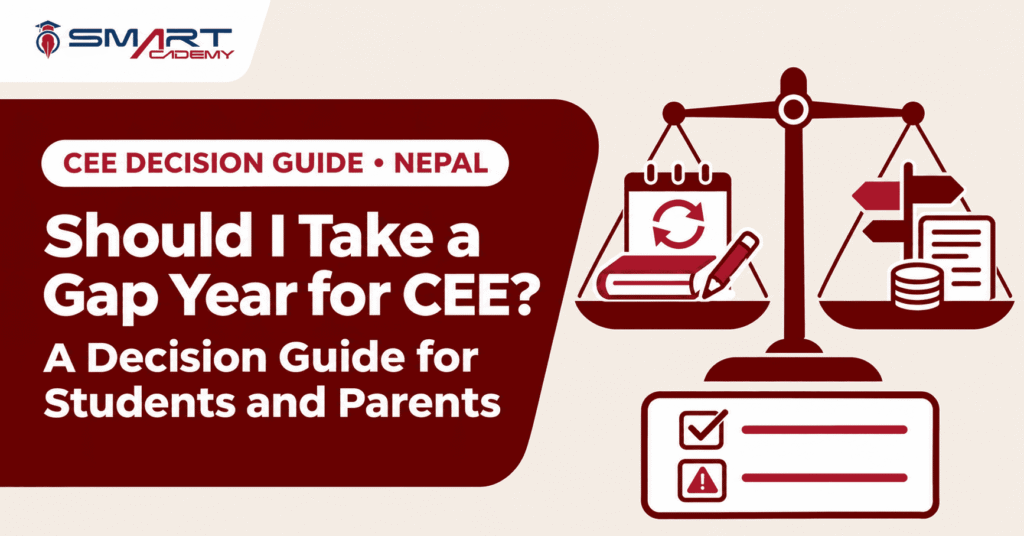
A gap year for Nepal’s Common Entrance Examination (CEE), formally MECEE-BL, gives you time—but time alone does not improve a result. It works only when you diagnose the previous attempt, change your preparation system, and have financial and emotional support.
Review your result, career goal, and family situation before deciding. Structured CEE preparation support in Nepal can provide planning, tests, and feedback, but the decision should remain yours and your family’s—not a reaction to pressure.
First, Identify the Result You Are Responding To
“I did not get admission” can mean that you fell below the 50th-percentile qualifying threshold or qualified without securing an available seat. MEC explains that matching also considers merit position, applicable group rules, submitted priorities, and seats.
If you qualified, follow matching, rematching, and wrap-up stages before deciding the cycle is over. See what to do if you passed CEE but did not get a seat. If you did not qualify, review your options after an unsuccessful CEE result.
The Five-Part Gap-Year Decision Test
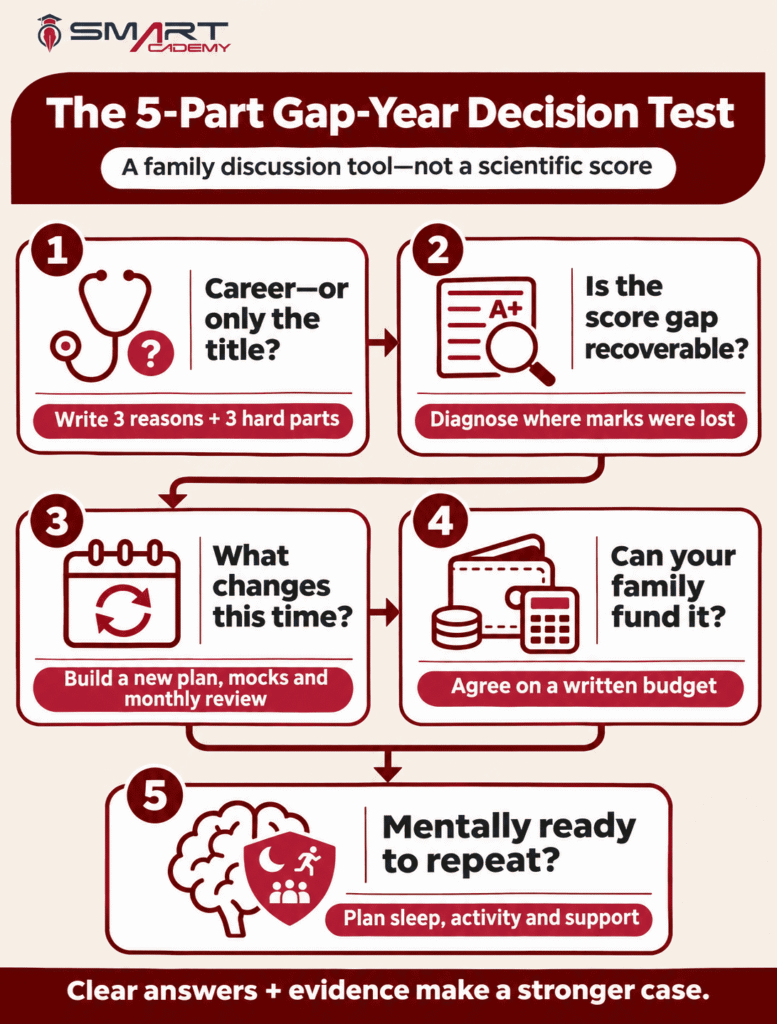
Use the following questions as a family discussion tool, not as a scientific score. A gap year is more reasonable when most answers are clear and supported by evidence.
1. Do You Still Want the Career—or Only the Title?
Ask what attracts you to the work: patient contact, long training, clinical responsibility, science, or service. If prestige, comparison, or fear is the main reason, another year may deepen the conflict.
Write three reasons you want the profession and three difficult parts you accept. If you cannot, explore your interests before committing.
2. Is Your Score Gap Understandable and Recoverable?
Compare your score and program-specific rank with the outcome you wanted. Take a timed diagnostic paper and classify lost marks: concept gaps, recall, calculations, question selection, negative marking, or time pressure.
A clearly diagnosed gap makes a stronger case for repeating than a large gap with no explanation. Previous cutoffs cannot promise a future seat because performance, seats, and matching outcomes change.
3. What Will Be Different This Time?
Repeating the same notes and last-minute revision is not a new strategy. Specify:
- Which subjects and chapters require rebuilding
- How often you will use timed MCQs and full-length mocks
- Who will review your errors and explain difficult concepts
- How you will revise older topics throughout the year
- How progress will be measured every month
Research on effective learning techniques supports practice testing and distributed practice—revisiting material over time—over relying mainly on rereading or cramming. Track accuracy, error types, and retention, not only hours.
4. Can Your Family Support the Full Cost?
A gap year can include classes, mock tests, books, travel, internet, and accommodation. It also delays starting another degree by one admission cycle.
Agree on a written budget and maximum spending amount before enrollment. Financial strain can turn an academic plan into daily conflict, so do not hide costs or rely on an unconfirmed scholarship.
5. Are You Mentally Ready for a Structured Repeat Year?
A repeat year can bring isolation, comparison, and fear of another disappointing result. The World Health Organization’s adolescent mental-health guidance emphasizes sleep, physical activity, coping skills, and supportive environments.
Use a sustainable routine and stay connected to supportive people. If persistent anxiety, hopelessness, sleep disruption, or another concern affects daily functioning, speak with a qualified health professional before increasing the pressure.
Try a 30-Day Decision Period Before Committing
If uncertain, run a four-week trial before making a one-year promise.
- Week 1: Diagnose. Take a timed baseline test and build a chapter-level error log.
- Week 2: Test the routine. Follow a realistic study schedule that includes sleep, exercise, breaks, and family responsibilities.
- Week 3: Add retrieval practice. Complete mixed MCQs, revise errors, and retest weak chapters after several days.
- Week 4: Measure. Take another comparable test and review accuracy, pacing, knowledge retention, and consistency.
Look for consistency, learning from errors, and improvement in weak areas—not a dramatic one-month score jump. Parents should review the evidence rather than count desk hours.
What a Responsible CEE Gap-Year Plan Includes
Your plan should contain monthly syllabus targets, weekly timed practice, full mocks, an error log, spaced revision, and fixed mentor reviews. Use the CEE exam schedule guide and MEC academic calendar to work backward from official milestones.
Create a backup plan before starting. List other programs, a decision deadline, and the evidence that would make you change direction. A Plan B reduces all-or-nothing pressure.
Guidance for Parents: Support Without Controlling
Parents can provide a stable environment, agree on costs, and hold a calm weekly or monthly review. Ask about mock accuracy, topics, and errors—not only study hours.
Avoid comparisons. Recognize consistency and honest reporting, including setbacks. If the plan is not working, revise it together instead of using shame.
So, Should You Take a Gap Year for CEE?
Take a gap year when the career fits you, the score gap is explainable, your preparation will change, and your family can support the plan. Reconsider when pressure drives the decision or the costs are too high.
For an objective discussion, message our CEE counselors on WhatsApp. Share your scorecard, target program, previous method, and main concern. We will help you test the plan—not pressure you toward one choice.
Frequently Asked Questions
Is One Gap Year Enough to Improve My CEE Result?
It can be enough to make meaningful progress, but the outcome depends on your starting point, diagnosis, consistency, feedback, and preparation system. The year itself does not create improvement.
How Many Hours Should I Study During a CEE Drop Year?
There is no responsible number that fits everyone. Build a sustainable schedule around focused study blocks, practice tests, revision, sleep, movement, and recovery. Measure learning through accuracy and retention rather than desk time.
Will a Gap Year Affect My CEE Eligibility?
MEC eligibility is based on the requirements in the current application notice and program rules. Check the latest MEC entrance information before applying instead of relying on a previous cycle.