
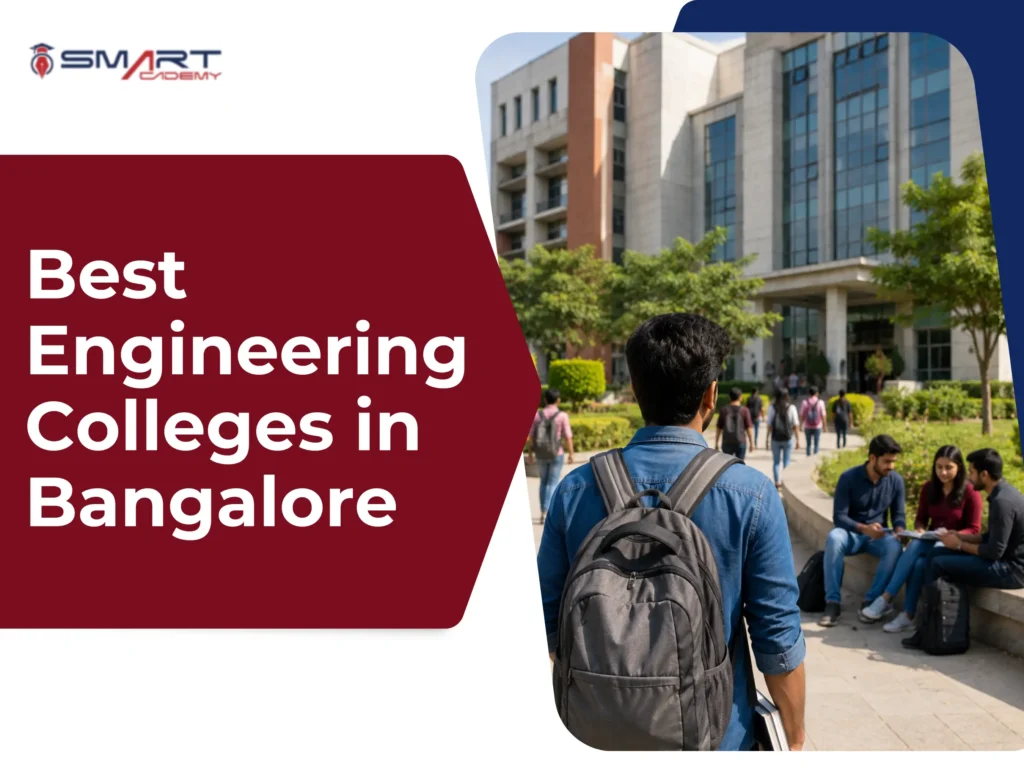
The best engineering colleges in Bangalore include R.V. College of Engineering (RVCE), Indian Institute of Science (IISc), International Institute of Information Technology Bangalore (IIIT-B), M.S. Ramaiah Institute of Technology (MSRIT), BMS College of Engineering (BMSCE), PES University, RNS Institute of Technology (RNSIT), Christ University, Bangalore Institute of Technology (BIT), and the National Institute of Engineering (NIE). These engineering institutions offer B.E./B.Tech., M.Tech., MCA, and Ph.D. programs across Computer Science, Artificial Intelligence, Mechanical, Civil, Electronics, Electrical, Chemical, and other engineering disciplines.
As India’s technology hub, Bangalore provides engineering students with direct access to multinational companies, startups, research institutions, Global Capability Centers (GCCs), and advanced manufacturing industries. Colleges such as IISc, IIIT-B, RVCE, PES University, and BMSCE are known for research, innovation, and strong industry collaborations, while MSRIT, RNSIT, BIT, Christ University, and NIE emphasize practical learning and career-focused technical education. Students should compare accreditation, faculty quality, placements, industry exposure, infrastructure, and engineering specializations to identify the institution that best supports their academic interests and long-term career goals.
Top 10 Engineering Colleges in Bangalore
RNS Institute of Technology (RNSIT)
RNS Institute of Technology (RNSIT) is a well-established private autonomous engineering college in Bangalore, founded in 2001 and affiliated with Visvesvaraya Technological University (VTU). Accredited by the National Board of Accreditation (NBA), the institute offers undergraduate and postgraduate programs in Computer Science, Electronics and Communication, Mechanical, Civil, and several other engineering disciplines. Its academic approach combines modern laboratories, practical training, research opportunities, and industry-oriented learning to prepare graduates for competitive engineering careers.
Admission is primarily based on KCET and COMEDK UGET scores, ensuring a competitive selection process. RNSIT maintains a strong placement record, with graduates recruited by leading technology and engineering companies through campus placements. According to verified statistics from the institutional placement cell, during the 2025 placement cycle, the institution recorded a 71% overall placement rate, maintained an average package of ₹8.0 LPA, a highest package of ₹50.0 LPA, and saw active corporate participation from over 200 companies. Its autonomous curriculum, NBA-accredited programs, and placement-focused education make RNSIT a preferred choice for students seeking quality engineering education in Bangalore.
R.V. College of Engineering (RVCE)
R.V. College of Engineering (RVCE) is a leading autonomous private engineering college in Bangalore, established in 1963 and affiliated with VTU. The institute offers 13 NBA Tier 1-accredited undergraduate B.E. programs, including Computer Science, Aerospace, Mechanical, and Biotechnology, as well as postgraduate tracks, an MCA, and doctoral research. More than 20 Centers of Excellence, backed by industry and defense collaborations, promote advanced research, innovation, and hands-on technical training. Admission is offered through KCET, COMEDK UGET, and the management quota, requiring a minimum of 45% aggregate marks in Class 12 Physics, Mathematics, and an optional science subject.
According to Careers360 and Shiksha RVCE Placement Portals, the campus drive secured an overall placement rate of 82.3% for the engineering batch. The recruitment cycle achieved an average package of ₹16.86 LPA, a peak highest package of ₹67.0 LPA, and active corporate participation from over 192 major companies, including Microsoft, Cisco, and Amazon. RVCE’s academic reputation, research ecosystem, and stellar placement outcomes make it one of Bangalore’s premier engineering institutions.
Indian Institute of Science (IISc)
Established in 1909, the Indian Institute of Science (IISc) is India’s premier research university and one of the country’s most prestigious institutions for engineering education. Unlike conventional engineering colleges, IISc emphasizes research-led learning, scientific innovation, and interdisciplinary education. Its Faculty of Engineering offers a research-focused B.Tech. in Mathematics and Computing, as well as specialized programs in Aerospace Engineering, Materials Science and Engineering, and Mechanics and Computing, all supported by world-class laboratories and internationally recognized faculty.
IISc also offers M.Tech., M.Engg., Ph.D., and Master of Science (Engineering) programs in disciplines including Computer Science and Automation, Electronic Systems Engineering, Civil Engineering, Aerospace Engineering, and Semiconductor Technology. Undergraduate admission is primarily based on JEE Advanced, while most postgraduate programs require a valid GATE score. Its rigorous admission process, advanced research ecosystem, and strong industry collaborations consistently place IISc among the top engineering institutions in India, making it the preferred destination for students seeking research-oriented engineering education and advanced technical specialization.
International Institute of Information Technology, Bangalore (IIIT-B)
The International Institute of Information Technology, Bangalore (IIIT-B) is a leading private deemed university specializing in Information Technology and Computer Science. Located in Electronics City, the institute offers B.Tech and Integrated M.Tech programs designed to combine strong academic foundations with industry-oriented learning and research. Its curriculum emphasizes software engineering, artificial intelligence, data science, and emerging technologies, making IIIT-B a preferred destination for students pursuing technology-focused engineering education.
Admission to IIIT-B is based on national-level entrance examinations, including JEE Main, as well as other accepted admission channels. The institute consistently records strong placement outcomes, securing a 98.2% overall placement rate in its latest cycle with a total of 656 corporate offers. Graduates secured an average package of ₹36.75 LPA for the Integrated CSE track and ₹38 LPA for ECE, with top-tier packages peaking at ₹1.45 Crore per annum. Its research-driven environment, modern infrastructure, industry collaborations, and specialized IT programs have established IIIT-B as one of Bangalore’s top institutions for Computer Science and Information Technology education.
National Institute of Engineering (NIE)
Established in 1946, the National Institute of Engineering (NIE) is one of Karnataka’s oldest private engineering institutions, recognized for its academic excellence across Computer Science, Mechanical, Electrical, Civil, and Electronics engineering. Affiliated with Visvesvaraya Technological University (VTU) and accredited by the National Board of Accreditation (NBA), the institute combines rigorous academics with research, laboratory-based learning, and industry-oriented projects. Its specialized programs, experienced faculty, and emphasis on practical engineering skills make it a preferred choice for students compared to the best computer science engineering colleges in Bangalore and nearby regions.
NIE admits students through KCET, COMEDK UGET, and JEE Main, maintaining a competitive admission process for undergraduate programs. During the 2025-26 placement cycle, the institute achieved a 71.75% placement rate, down from 74% in 2024-25. Graduates secured an average package of ₹9 LPA, while the highest Super Dream offer reached ₹56 LPA. Strong industry collaborations, campus recruitment drives, and branch-specific training help students build technical expertise and transition successfully into careers across IT, manufacturing, consulting, and core engineering sectors.
MS Ramaiah Institute of Technology (MSRIT)
Established in 1962, M.S. Ramaiah Institute of Technology (MSRIT) is one of the leading engineering colleges in Bangalore, recognized for its strong academic foundation and industry-oriented education. Located near Yelahanka in North Bangalore, the institute offers excellent connectivity to major technology parks, research organizations, Kempegowda International Airport, and key transportation routes. Its autonomous status, affiliation with Visvesvaraya Technological University (VTU), and NBA-accredited engineering programs contribute to its reputation among engineering aspirants.
The institute offers undergraduate, postgraduate, and doctoral programs across multiple engineering disciplines, supported by modern laboratories, research facilities, and industry collaborations. Students benefit from its proximity to Bangalore’s technology ecosystem through internships, technical events, and professional networking opportunities. MSRIT is well-suited for students seeking an established engineering college with strong academic infrastructure and convenient access to the city’s engineering and innovation hubs.
BMS College of Engineering (BMSCE)
Established in 1946, BMS College of Engineering (BMSCE) is a premier engineering college in Bangalore, recognized for its robust academic foundation and industry-driven focus. Located in Basavanagudi in South Bangalore, the campus ensures convenient connectivity to major commercial zones and key tech corridors. Its autonomous framework, VTU affiliation, and NAAC A++ rating secure its national standing, placing it within the 151-200 rank band in the NIRF 2025 Engineering Rankings and ranking 25 in India Today’s 2025 Engineering list.
The institute delivers comprehensive undergraduate, postgraduate, and doctoral tracks supported by advanced research centers. Students benefit from direct alignment with Bangalore’s tech ecosystem through internships and competitive recruitment drives. For the 2025 graduating batch, the placement cell secured an average package of ₹11.4 LPA, with top-tier domestic offers peaking at ₹51.5 LPA across 383 participating companies. BMSCE remains a top choice for students seeking premium engineering education and deep innovation networks.
Christ University (Engineering)
Christ University (Engineering), established in 2009 at its Kengeri Campus, is an autonomous institution offering AICTE-approved B.Tech., M.Tech., and Ph.D. programs. Its engineering ecosystem ranks 76th in the NIRF 2025 Engineering Rankings and 65th in India Today’s 2025 B.Tech list. The academic framework integrates a strict 85% mandatory attendance policy alongside interdisciplinary minors in Artificial Intelligence and Automation, backed by specialized Centers of Excellence in E-Mobility and Digital Forensics.
Admission follows a merit-driven pipeline. Eligible candidates with a minimum 50% aggregate in PCM (10+2) must clear the Christ University Entrance Test (CUET), followed by a Skill Assessment, a Micro Presentation, and a Personal Interview. Scorecards for top competitive exams, such as COMEDK UGET, are also evaluated. This high accountability yields robust career outcomes, securing a verified average package of ₹6 LPA and domestic offers peaking at a highest package of ₹20 LPA across premium corporate recruiters like Dell, TCS, and Goldman Sachs.
PES University
Established in 1972, PES University (formerly PESIT) is one of Bangalore’s premier autonomous institutions, recognized for its cutting-edge technological focus and academic agility. Strategically located on the Outer Ring Road, the main campus provides seamless connectivity to major tech corridors and innovation hubs. Its independent university status enables real-time curriculum updates, securing a stable position within the 101-150 rank band in the NIRF 2025 Engineering Rankings.
The university offers comprehensive undergraduate, postgraduate, and doctoral programs across high-demand disciplines such as Computer Science, AI, and Data Science. Admission follows a selective, merit-driven pathway that requires top competitive scores in KCET, JEE Main, or the institutional PESSAT exam. This rigorous framework ensures premium career outcomes, yielding a stellar average package of ₹13.21 LPA and elite domestic placements peaking at ₹68 LPA at corporate giants such as Google, Amazon, and Microsoft. With its heavy focus on practical engineering design and experiential internships, PESU remains a top choice for students seeking a modern, industry-aligned technical education.
Bangalore Institute of Technology (BIT)
Bangalore Institute of Technology (BIT), established in 1979, is a well-known autonomous engineering college in Bangalore, affiliated with Visvesvaraya Technological University (VTU). The institute offers undergraduate, postgraduate, and doctoral programs across Computer Science, Electronics and Communication, Mechanical, Civil, Information Science, and other engineering disciplines. Its autonomous status enables BIT to design industry-relevant curricula, introduce emerging technologies, and conduct independent examinations, giving students greater academic flexibility than many affiliated colleges.
BIT combines experienced faculty, modern laboratories, research facilities, and innovation-driven learning to strengthen students’ technical and practical skills. Admission is primarily based on KCET and COMEDK UGET, making it accessible to both Karnataka and all-India applicants. While BIT focuses on regular full-time engineering education, students seeking flexible schedules may also explore evening engineering colleges available in Bangalore. Its academic reputation, autonomous curriculum, and emphasis on practical engineering education make BIT a strong benchmark among Bangalore’s autonomous engineering colleges.
Government vs. Private Engineering Colleges in Bangalore
Government engineering colleges in Bangalore offer a stronger academic legacy, research opportunities, and competitive entrance-based admissions, while private engineering colleges emphasize modern infrastructure, industry-oriented curricula, specialized programs, and corporate collaborations. Both pathways provide quality engineering education, but the right choice depends on factors such as academic priorities, preferred engineering branch, learning environment, and long-term career aspirations.
Below is the table highlighting the major differences between government and private engineering colleges in Bangalore:
| Comparison Factor | Government Engineering Colleges | Private Engineering Colleges |
| Academic Reputation | Strong research legacy and established institutions | Industry-focused with specialized engineering programs |
| Faculty Quality | Experienced academicians and researchers | A blend of academic experts and industry professionals |
| Infrastructure | Well-established laboratories and campus facilities | Modern campuses, advanced labs, and innovation centers |
| Curriculum | University-regulated with limited flexibility | Autonomous, industry-aligned, and regularly updated |
| Placement & Industry Exposure | Strong placements in leading institutions and PSU opportunities | Extensive corporate partnerships, internships, and campus recruitment |
| Entrance Exams | KCET, JEE Main, JEE Advanced (institution-specific) | KCET, COMEDK UGET, JEE Main, and institute-level admissions |
| Best Suited For | Students seeking a research-oriented and academically rigorous education | Students prioritizing industry exposure, practical learning, and career-focused training |
Top Government Engineering Colleges
Government engineering colleges in Bangalore include the Indian Institute of Science (IISc), University Visvesvaraya College of Engineering (UVCE), Dr. Ambedkar Institute of Technology (AIT), and other government-supported institutions in Karnataka. These government engineering colleges are known for competitive entrance-based admissions, recognized engineering programs, experienced faculty, research-driven learning, and consistent placement outcomes.
Below are some of the best government engineering colleges in Bangalore:
| College Name | Type | Programs Offered | Entrance Exams |
| Indian Institute of Science (IISc) | Government Deemed University | B.Tech., M.Tech., M.Engg., Ph.D. | JEE Advanced, GATE |
| University Visvesvaraya College of Engineering (UVCE) | Government Autonomous | B.E., B.Tech., M.Tech. | KCET |
| Dr. Ambedkar Institute of Technology (AIT) | Government-Aided | B.E., M.Tech., Ph.D. | KCET, COMEDK UGET |
| University BDT College of Engineering (UBDTCE) | Government University College | B.E., M.Tech., Ph.D. | KCET |
Top Private Engineering Colleges
Private engineering colleges in Bangalore include RV College of Engineering, IIIT Bangalore, PES University, M.S. Ramaiah Institute of Technology, BMS College of Engineering, National Institute of Engineering, RNS Institute of Technology, Christ University (Kengeri Campus), and REVA University’s School of Engineering. These private engineering institutions offer diverse engineering programs supported by industry-oriented curricula, modern laboratories, research opportunities, and strong corporate collaborations.
Private Engineering Colleges in Bangalore
| College Name | Programs Offered | Entrance Exams | Average / Highest Package |
| R.V. College of Engineering (RVCE) | B.E., M.Tech., MCA | KCET, COMEDK UGET | ₹16.86 LPA / ₹67.0 LPA |
| IIIT Bangalore (IIIT-B) | B.Tech., Integrated M.Tech., M.Tech., Ph.D. | JEE Main | ₹36.75 LPA (iMTech) / ₹1.45 Cr |
| PES University (PESU) | B.Tech., M.Tech., Ph.D. | PESSAT, KCET, JEE Main | ₹13.21 LPA / ₹68.0 LPA |
| BMS College of Engineering (BMSCE) | B.E., M.Tech., MBA, MCA, Ph.D. | KCET, COMEDK UGET | ₹11.40 LPA / ₹51.50 LPA |
| M.S. Ramaiah Institute of Technology (MSRIT) | B.E., M.Tech., Ph.D. | KCET, COMEDK UGET | ₹7.60 LPA / ₹50.0+ LPA |
| National Institute of Engineering (NIE) | B.E., M.Tech., Ph.D. | KCET, COMEDK UGET, JEE Main | ₹9.0 LPA / ₹56.0 LPA |
| RNS Institute of Technology (RNSIT) | B.E., M.Tech., MBA, MCA | KCET, COMEDK UGET | ₹8.0-10.0 LPA / ₹56.0+ LPA |
| Christ University (Kengeri Campus) | B.Tech., M.Tech., Ph.D. | CUET, COMEDK UGET, KCET | ₹6.0 LPA / ₹20.0 LPA |
| REVA University (School of Engineering) | B.Tech., M.Tech., Ph.D. | REVA CET, KCET, COMEDK UGET | ₹6.0-8.0 LPA / ₹30.0+ LPA |
How do Tier 1, Tier 2, and Tier 3 Colleges Compare?
Tier 1 engineering colleges in Bangalore offer the highest academic reputation, research ecosystem, and global placement opportunities, while Tier 2 colleges balance strong industry partnerships, competitive placements, and practical learning. In comparison, Tier 3 colleges provide more accessible admissions but require students to strengthen their employability through certifications, internships, and off-campus networking. Understanding these differences helps students choose a college that aligns with their academic profile, career aspirations, and long-term professional goals.
| Tier 1 Colleges | Tier 2 Colleges | Tier 3 Colleges |
| Examples: IISc, IITs | Examples: RV College of Engineering (RVCE), PES University | Examples: Regional and mass-employability engineering colleges |
| Highly selective admissions through top national entrance exam ranks | Moderately competitive admissions through KCET, COMEDK UGET, and JEE Main | Comparatively less competitive admission process |
| Strong national and global brand reputation | Established regional and national reputation | Recognition varies by institution |
| Highest average placement packages with multinational and global recruiters | Competitive placement packages with leading regional and national companies | Placement outcomes vary across institutions and branches |
| Extensive research ecosystem, innovation, and international collaborations | Strong industry partnerships, internships, and practical learning | Greater reliance on certifications, internships, and off-campus networking to improve employability |
| Best suited for research, higher studies, leadership roles, and global careers | Ideal for students seeking industry-ready education and corporate careers | Suitable for students willing to build additional skills and practical experience alongside their degree |
Engineering Courses Available in Bangalore
The engineering courses available in Bangalore include Computer Science and Engineering, Information Science and Engineering, Electronics and Communication Engineering, and Mechanical Engineering. Other major specializations include Civil Engineering, Electrical and Electronics Engineering, Chemical Engineering, and Data Science and Artificial Intelligence. Together, these courses cover computing, electronics, manufacturing, infrastructure, energy systems, chemical processing, and emerging digital technologies, enabling students to choose a specialization that aligns with their interests, technical strengths, and long-term career goals.
Here are some of the engineering courses available in Bangalore:
- Computer Science and Engineering
Computer Science and Engineering (CSE) develops expertise in programming, algorithms, software engineering, databases, AI, and cloud computing. Students build strong problem-solving and technical skills for careers in software development, cybersecurity, data science, and emerging technologies. With Bangalore’s thriving IT ecosystem, CSE graduates enjoy excellent internship opportunities and strong career prospects.
- Information Science and Engineering
Designed around data and information systems, Information Science and Engineering (ISE) focuses on software development, databases, cybersecurity, cloud computing, and data analytics. Students learn to design technology solutions that support modern businesses and digital transformation. Graduates build careers in IT services, enterprise solutions, consulting, and analytics, with strong demand across Bangalore’s technology industry.
- Electronics and Communication Engineering
Electronics and Communication Engineering (ECE) covers electronic circuits, signal processing, embedded systems, telecommunications, and microprocessors. Students develop skills for designing communication networks and intelligent electronic devices. Career opportunities include semiconductors, IoT, 5G, consumer electronics, and telecommunications, supported by Bangalore’s expanding electronics and semiconductor sectors.
- Mechanical Engineering
Mechanical Engineering combines mechanics, thermodynamics, machine design, materials science, and automation to develop modern machines and manufacturing systems. Graduates find opportunities in automotive, aerospace, robotics, energy, and Industry 4.0. Bangalore’s strong industrial and aerospace ecosystem continues to create excellent career prospects.
- Civil Engineering
From highways to high-rise buildings, Civil Engineering shapes the infrastructure that supports modern cities. The discipline covers structural, transportation, geotechnical, environmental, and construction engineering, preparing students to design, build, and maintain essential infrastructure. Graduates find opportunities in construction companies, consulting firms, government departments, and smart infrastructure projects across Bangalore.
- Electrical and Electronics Engineering
Powering modern industries, Electrical and Electronics Engineering (EEE) combines electrical systems, electronic circuits, automation, power generation, and control engineering. Students develop expertise in renewable energy, industrial automation, electric vehicles, and electronics manufacturing. Graduates pursue careers in utilities, automation, electronics, and research, supported by Bangalore’s growing technology and manufacturing ecosystem.
- Chemical Engineering
Chemical Engineering combines chemistry, physics, mathematics, and engineering to optimize industrial manufacturing processes. Students study reaction engineering, thermodynamics, process control, and sustainable manufacturing. Graduates pursue careers in pharmaceuticals, energy, biotechnology, food processing, and advanced manufacturing, with growing opportunities in Bangalore.
- Data Science and Artificial Intelligence
Data Science and Artificial Intelligence focus on machine learning, data analytics, statistical modeling, programming, natural language processing, and computer vision. Graduates build careers as AI engineers, data scientists, and analytics professionals across IT, finance, healthcare, and research. Bangalore’s thriving startup and technology ecosystem fuels strong demand.
Admission Process for Engineering Colleges in Bangalore
The admission process for engineering colleges in Bangalore includes eligibility criteria, required entrance exams, application form and deadlines, and required documents. Together, these steps help colleges verify academic qualifications, entrance exam performance, application completeness, and student identity before seat allocation.
The following are the admission processes for engineering colleges in Bangalore:
- Eligibility Criteria
To become eligible for undergraduate engineering admission in Bangalore, candidates must complete 10+2 with Physics and Mathematics as compulsory subjects along with Chemistry, Biology, or Computer Science and English. General category students require a minimum of 45% aggregate, while SC, ST, and OBC candidates need 40%. Many top-tier colleges also expect 60% in Physics and Mathematics. A valid rank in KCET, COMEDK UGET, or JEE Main is essential, although specific eligibility requirements may differ across institutions.
- Entrance Exams Required (KCET, COMEDK UGET, JEE Main)
Engineering admissions in Bangalore are primarily based on KCET, COMEDK UGET, and JEE Main. KCET is mainly intended for Karnataka domicile students seeking admission to government and participating private colleges, whereas COMEDK UGET allows all-India applicants to compete for seats in private engineering institutions. JEE Main is accepted by several private, deemed, and nationally recognized colleges. Students should always verify which entrance examinations are accepted by their preferred institutions before applying.
- Application Form and Deadlines
The engineering admission cycle in Bangalore generally begins between January and March, when colleges release application forms and open entrance exam registrations. KCET applications are submitted through the KEA portal, usually until late February, with a late-fee extension, while COMEDK UGET follows a separate registration schedule. Counselling and seat allotment commonly take place in June and July, although institutions such as RVCE, BMSCE, PES University, and Ramaiah may announce additional admission timelines.
- Documents Needed
Applicants must submit academic transcripts, entrance exam scorecards, government-issued identity proof, and recent passport-size photographs to complete the admission process. Candidates applying under reserved categories should also provide valid caste or category certificates, while some colleges may request domicile, migration, or transfer certificates depending on admission policies. International applicants are required to submit a valid passport and a student visa. Since documentation requirements vary by institution, students should confirm the latest checklist on their chosen college’s official admissions website.
How do Engineering Colleges in Bangalore Compare on Placements?
Engineering colleges in Bangalore are highly competitive, with premier institutions delivering placement rates between 85% and 95%. Leading institutes benefit from strong industry partnerships, established recruiter networks, and Bangalore’s thriving technology ecosystem. While specialized institutions like IIIT Bangalore secure exceptional salary packages through focused technology programs, established colleges such as RVCE, PES University, and BMS College of Engineering consistently achieve strong placement outcomes across a wider range of engineering disciplines and larger student intakes.
| College Name | Placement Cycle Year | Overall Placement Rate | Average Salary Package | Highest Salary Package |
| IIIT Bangalore (IIIT-B) | 2025 | 95.0% | ₹36.75 LPA (iMTech) | ₹1.45 Crores |
| R.V. College of Engineering (RVCE) | 2026 | 82.3% | ₹16.86 LPA | ₹67.00 LPA |
| PES University (PESU) | 2025 | 85.5% | ₹17.99 LPA | ₹68.00 LPA |
| BMS College of Engineering (BMSCE) | 2025 | 80.2% | ₹11.40 LPA | ₹51.50 LPA |
Engineer Salary in Bangalore
Engineer salaries in Bangalore range from ₹3.5 LPA to ₹25+ LPA, depending on experience, engineering branch, industry, and employer. Fresh graduates generally earn ₹5.0 LPA to ₹15.0 LPA, while graduates from top engineering colleges and high-demand fields such as Computer Science, Artificial Intelligence, Machine Learning, and Data Science can secure packages exceeding ₹20 LPA. Bangalore’s thriving technology ecosystem, along with multinational companies, startups, and Global Capability Centers (GCCs), makes it one of India’s highest-paying cities for engineering careers.
- Entry-level salary:
According to Glassdoor, the entry-level salary for fresh engineering graduates and software developers in Bangalore spans from ₹5.0 LPA to ₹15.0 LPA. While the citywide base average sits around ₹8.9 LPA across general tech services, highly competitive tracks like Artificial Intelligence and Data Science routinely push starting brackets from ₹12.0 LPA up to ₹22.0 LPA at major multinational product firms.
- Salary by branch:
- Computer Science, AI, Machine Learning & Data Science: ₹12 LPA – ₹25+ LPA
- Electronics & Communication (ECE) & Electrical Engineering (EEE): ₹6 LPA – ₹12 LPA
- Mechanical, Civil & Chemical Engineering: ₹3.5 LPA – ₹7.5 LPA
- Salary by sector:
- IT & Software: ₹3.5 LPA – ₹6.5 LPA
- Mechanical & Production Engineering: ₹3 LPA – ₹8 LPA
- Electronics & Communication Engineering: ₹5 LPA – ₹10 LPA
- Civil Engineering: ₹2.5 LPA – ₹6 LPA
- Consulting, Analytics, Data Science & AI: ₹6 LPA – ₹20+ LPA
Career Prospects After Engineering in Bangalore
The career prospects after engineering in Bangalore include Software and IT roles, Core engineering roles, Higher education and research, and Government and public sector opportunities. Together, these pathways offer careers across technology, manufacturing, research, and public services. Choosing the right engineering specialization and college helps students maximize placement opportunities, career growth, and long-term professional success.
- Software and IT Roles:
- Software Developer: Designs, develops, and maintains software applications and enterprise systems.
- Data Analyst: Interprets business data to support strategic and operational decisions.
- QA Engineer: Tests software applications to ensure product quality and performance.
- System Administrator: Manages IT infrastructure, servers, networks, and enterprise systems.
- Core Engineering Roles:
- Design Engineer: Develops engineering designs for products, machines, and industrial systems.
- Project Engineer: Plans, coordinates, and executes engineering projects across multiple industries.
- Site Engineer: Supervises the execution of construction, infrastructure, and industrial projects.
- Production Engineer: Manages manufacturing operations, production efficiency, and quality control.
- Higher Education and Research
Higher education and research create opportunities for technical specialization and academic advancement. Graduates can pursue M.Tech., MS by Research, or Ph.D. programs at institutions such as IISc, IIIT Bangalore, RVCE, and PES University. Advanced laboratories, funded research projects, faculty mentorship, and industry collaborations help students build expertise for careers in research organizations, academia, product innovation, and advanced technology development.
- Government and Public Sector Opportunities
Government and public-sector careers offer engineers stable employment and opportunities to contribute to national development. Organizations such as ISRO, DRDO, HAL, BEL, BHEL, and state engineering services recruit graduates through GATE, competitive examinations, and PSU recruitment drives. Typical roles include Technical Officer, Scientist, Design Engineer, and Project Engineer across defense, aerospace, infrastructure, energy, and public sector projects.
What Makes an Engineering College in Bangalore Worth Considering?
Factors that make an engineering college in Bangalore worth considering include AICTE approval and NBA accreditation, university affiliation and autonomous status, faculty quality, infrastructure, fee structure, scholarship availability, campus facilities, placement records, and industry partnerships. Evaluating these factors before admission helps students identify institutions that offer recognized qualifications, practical learning, strong industry exposure, and better career opportunities after graduation.
7 factors that make an engineering college in Bangalore worth considering are:
- AICTE Approval and NBA Accreditation:
AICTE approval confirms that an engineering college meets national standards for technical education, while NBA accreditation assesses the quality of individual engineering programs. Choosing institutions with both recognitions ensures valid degrees, outcome-based education, stronger academic standards, and improved employability across industries.
- University Affiliation and Autonomous Status:
Understanding whether a college is affiliated or autonomous helps assess its academic flexibility. Autonomous institutions can revise curricula, introduce emerging technologies, and conduct independent assessments, whereas affiliated colleges follow university-prescribed syllabi and examinations, ensuring standardized academic quality and degree recognition.
- Faculty Quality and Infrastructure:
Experienced faculty with research backgrounds, modern laboratories, digital libraries, innovation centres, and industry-sponsored facilities significantly improve the learning experience. Colleges such as IISc, RVCE, PES University, and BMSCE combine academic expertise with practical training, enabling students to build stronger technical and problem-solving skills.
- Fees and Scholarship Availability:
Comparing the overall cost of education, including tuition, hostel, laboratory, and examination fees, provides a realistic financial picture. Students should also evaluate merit scholarships, government financial aid, and institutional fee waivers to identify colleges that balance academic quality with affordability.
- Location and Campus Facilities:
Colleges located near Bangalore’s technology corridors and industrial hubs provide easier access to internships, live projects, and networking opportunities. Well-developed campuses with advanced laboratories, libraries, hostels, sports facilities, and innovation spaces further enhance academic learning and overall student development.
- Placement and Internship Record:
Verified placement statistics, internship opportunities, recruiter diversity, and average salary packages provide reliable indicators of graduate outcomes. Strong engineering colleges maintain consistent campus recruitment by partnering with leading technology and core engineering companies, helping students transition successfully into professional careers.
- Industry Partnerships and Exposure:
Collaborations with multinational companies, research organizations, and technology firms strengthen practical learning through internships, live projects, industry-sponsored laboratories, guest lectures, hackathons, and certification programs. These partnerships bridge classroom learning and real-world engineering practice, improving graduates’ career readiness.
How to Choose the Right Engineering College in Bangalore?
To choose the right engineering college in Bangalore, match the college to your branch priority, weigh placements against the fee structure, visit shortlisted campuses before you commit, and consult an admissions expert. Following these steps helps students compare academic quality, career outcomes, affordability, campus environment, and admission guidance, making it easier to shortlist colleges that align with their engineering specialization, career goals, and long-term aspirations.
Follow the steps below to choose the right engineering college in Bangalore:
- Match the College to Your Branch Priority
Choose an engineering college that demonstrates proven strength in your preferred branch. Compare faculty expertise, specialized laboratories, and branch-specific placement records before applying. For example, Computer Science should offer AI-focused research, Mechanical should provide advanced workshops, Electronics should benefit from embedded systems labs, and Civil should provide modern construction and structural engineering facilities.
- Weigh Placements Against Fee Structure
Compare placement performance with the total cost of education to evaluate long-term value. Review placement rates, average and highest salary packages, and tuition and other academic expenses. Colleges that consistently deliver strong placement outcomes relative to their fee structure generally provide a better return on investment.
- Visit Before You Commit
Visit shortlisted colleges to experience the campus beyond brochures and rankings. Assess classrooms, laboratories, libraries, hostels, student life, and support services while interacting with faculty and current students. A campus visit offers practical insights that help confirm whether the institution matches your academic expectations and learning preferences.
- Consult an Admissions Expert
Consulting an admissions expert helps simplify college selection and the application process. Experts provide guidance on eligibility, documentation, application timelines, and college shortlisting and offer personalized recommendations based on academic goals. Their updated knowledge of admissions and dedicated support for Nepali applicants can improve the chances of securing admission to leading engineering colleges in Bangalore.