
If you have studied abroad or even at a different university within Nepal, you already know the headache of getting an equivalency certificate from Tribhuvan University (TU). Long queues, unclear timelines, and inconsistent decisions have frustrated thousands of returning students for decades. That is about to change today.
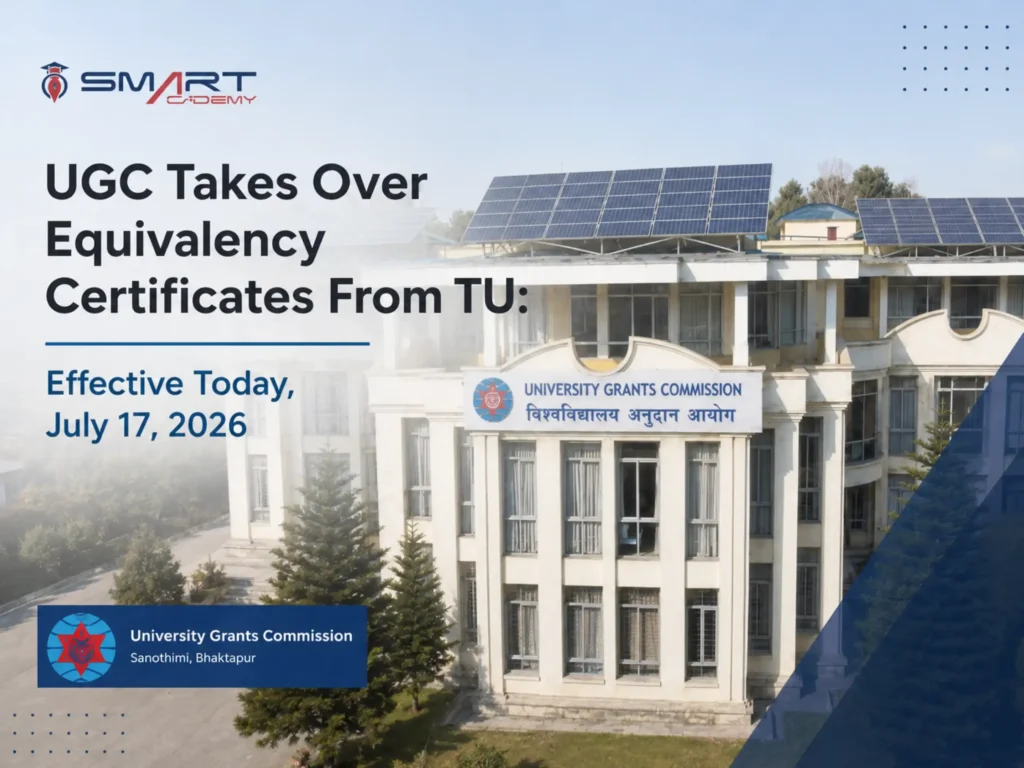
As of July 17, 2026 (1st Shrawan, 2083), the University Grants Commission (UGC), headquartered in Sanothimi, Bhaktapur, has officially assumed responsibility for issuing equivalency certificates for TU. This is one of the biggest shifts in Nepal’s higher education administration in recent years, and it directly affects anyone returning home after graduating abroad or applying for jobs and licensing exams in Nepal.
What’s Changing?
For nearly three decades, TU’s Curriculum Development Center (CDC), established in 2030 BS (1973 AD) and operating under the Office of the Rector, was the sole authority deciding whether a degree earned in Nepal or abroad was equivalent to Nepali academic standards. Students needed this certificate for government jobs, professional licensing, further studies, and more.
Parliament has now amended the University Grants Commission Act, 2050, specifically Section 6, through the Some Nepal Acts Amendment Act, 2082, transferring this authority to the UGC. The amendment has been authenticated by President Ramchandra Paudel and published in the Nepal Gazette. In a notice issued on July 16, TU’s Curriculum Development Center confirmed it will no longer accept new applications for degree equivalency from today onward.
Under the new law, UGC will:
- Issue equivalency certificates for degrees earned at foreign universities
- Take over credit transfer processes between universities
- Handle Quality Assurance and Accreditation (QAA) of institutions and colleges
- Publish updated lists of recognized degrees and institutions every 6 months
Do You Need to Reapply?
No. If you already hold an equivalency certificate issued by TU before July 17, 2026, it remains valid. You will not need to reapply through UGC.
Also worth noting: UGC Deputy Director and member-secretary of the equivalency committee, Dularaj Chimariya, has confirmed that students graduating from domestic Nepali universities will no longer need an equivalency certificate, since these institutions are already established and regulated under government law. However, equivalency will still be required for degrees earned from foreign universities.
Why the Change?
TU’s process had long been criticized for delays that left some students waiting months, inconsistent decisions in similar cases, and a lack of transparency in how subject committees evaluated degrees. Over 50 students were visiting the CDC daily solely for equivalency-related work, diverting the center’s focus from its core mandate of curriculum development and revision, which is the very purpose for which it was established.
A 2018 High-Level Education Commission report had already recommended shifting this responsibility to UGC. The UGC itself proposed the amendment to Parliament, which passed it into law.
Why Credit Transfer Matters Now More Than Ever
The credit transfer dimension of this change also gained urgency following the tragic death of Nepali student Prakriti Lamsal at Kalinga Institute of Industrial Technology (KIIT), Odisha, India, and reports of mistreatment of Nepali students there.
Several Nepali universities, including TU, Kathmandu University, and Purbanchal University, encouraged returning students to apply for credit transfers, but the absence of a national standard and legal clarity has created significant challenges in accommodating them.
Under the amended Act, UGC now has formal authority over inter-university credit transfers, and a separate committee led by Professor Govinda Nepal is developing a national standard for this process, something Nepal has never formally had. A Credit Bank system is also being designed to record academic attendance and allow students who are unable to complete their studies on time to resume within a defined period.
What UGC Is Planning
UGC Chairperson Prof. Dr. Devraj Adhikari has confirmed that the Commission is drafting clear guidelines and standards for the new process. Key changes expected include:
- A dedicated equivalency section within UGC, with 23 additional staff requested from the government to handle the increased workload
- A seven-member equivalency policy committee led by Prof. Dr. Yogendra Bahadur Gurung, tasked with drafting procedures
- A fully paperless, online process from application submission to certificate issuance
- A publicly updated list of recognized degrees and institutions, published every six months
Quality Assurance and Accreditation: Where Nepal Stands
The amended Act also mandates that the UGC actively enforce Quality Assurance and Accreditation (QAA) across higher education institutions, an area where it previously lacked formal legal backing. Clearer QAA standards covering faculty-student ratios, lab and library facilities, land ownership, and building infrastructure are expected as part of the new framework.
The scale of the gap is significant. Of approximately 1,400 campuses in Nepal, only 137 have received QAA certification to date. TU’s current policy already requires QAA certification for campuses seeking new program affiliations, and TU is affiliated with around 1,000 campuses.
In December last year, the Ministry of Education issued a directive requiring all foreign-affiliated colleges in Nepal to obtain mandatory QAA certification from the UGC. However, a study committee found the directive had not been enforced. Of the 59 foreign-affiliated colleges operating in Nepal, only 10 have obtained QAA certification, and those 10 are the only ones affiliated with universities ranked within the global top 1,000. The committee concluded that weak regulation and oversight by the Ministry of Education have allowed many foreign colleges to operate well outside established standards.
What This Means for You
If you are a student who has completed or is planning to complete a degree abroad, here is what to keep in mind:
- Already have a TU equivalency certificate? You are set. No reapplication needed.
- Graduating or returning after July 17, 2026? Your equivalency application goes through UGC, not TU. TU’s CDC stopped accepting new applications today.
- Studying at a domestic Nepali university? You may no longer need an equivalency certificate at all once UGC’s guidelines are finalized.
- Planning to study abroad? It is worth choosing a university and program likely to meet UGC’s upcoming recognition standards and one affiliated with a globally top-ranked institution, given how QAA certification is shaping up, so the equivalency process is smoother when you return.
- Need to contact UGC? The Commission’s office is at Sanothimi, Bhaktapur (P.O. Box 10796, Kathmandu). Phone: 01-6638548 / 01-6638549 / 01-6638550. Email: [email protected]. Website: www.ugcnepal.edu.np. Since guidelines for the new equivalency process are still being finalized, check the website regularly for updates.
Get the Right Guidance Before You Apply Abroad
Where you choose to study does not just affect your admissions and visa process, it also determines how smoothly your degree is recognized when you return to Nepal. With UGC’s recognition standards and QAA requirements still taking shape, making an informed choice now can save you months of delays later.
At Smart Educational Academy, our academic counselors track exactly these kinds of regulatory shifts so you do not have to. Whether you are shortlisting universities, evaluating program recognition, or planning your return, we can help you make decisions that hold up long after graduation.