
Quick College Facts
| Field | Value |
|---|---|
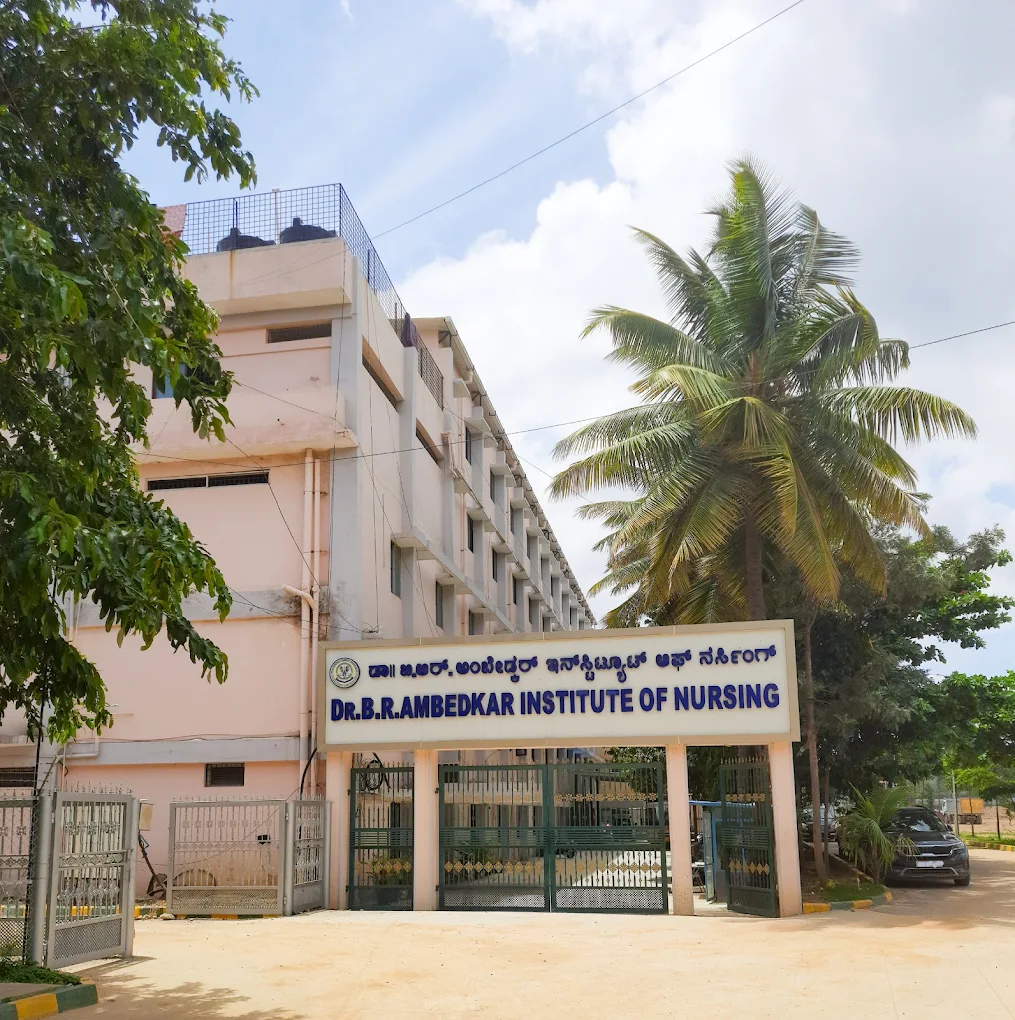
| College name | Dr. B.R. Ambedkar Institute of Nursing |
| Established | 1988, as Mathrushri Bheemabai Ambedkar Institute of Nursing |
| Managed by | Ananda Social and Educational Trust (founded 1980; also runs Dr. B.R. Ambedkar Medical College) |
| Institute type | Private |
| Affiliating university | Rajiv Gandhi University of Health Sciences (RGUHS), Bangalore |
| Approvals | Indian Nursing Council (per published listings) |
| Location | #24, Dr. B.R. Ambedkar Medical College campus, Kadugondanahalli, Bangalore 560045, Karnataka |
| Courses | GNM · BSc Nursing · Post Basic BSc Nursing · MSc Nursing |
| Teaching hospital | Dr. B.R. Ambedkar Medical College and Hospital (750 beds) |
| Other clinical sites | NIMHANS · Sri Jayadeva Institute of Cardiology · Kidwai Memorial Institute of Oncology · Indira Gandhi Institute of Child Health · Narayana Nethralaya · rural health training centre at Sathnur, Kanakapura |
| Hostel | Separate boys’ and girls’ hostels on campus, with a full-time warden and 24-hour security |
About Dr. B.R. Ambedkar Institute of Nursing
The institute sits on the campus of Dr. B.R. Ambedkar Medical College in Kadugondanahalli (often called KG Halli), a built-up, residential part of north-east Bangalore. The medical college was set up in 1981 by the Ananda Social and Educational Trust. It is recognised by the National Medical Commission for its medical courses and affiliated to Rajiv Gandhi University of Health Sciences. The same campus also runs a dental college and an allied health sciences institute.
For you, the medical college’s hospital matters most. It is a 750-bed teaching hospital with MRI and CT scanners, a 24-hour pharmacy and a blood bank, and the nursing institute calls it “the core centre” of your training. From there, your postings spread across some of Bangalore’s specialist public institutions for mental health, cardiology, cancer and child health.
The nursing institute itself opened in 1988 as Mathrushri Bheemabai Ambedkar Institute of Nursing and was later renamed. It teaches every level from the GNM diploma to MSc Nursing. It also runs skill training courses certified by the American Heart Association.
It suits you if you want to live in the city itself and train across several specialist hospitals, not just one.
Is Dr. B.R. Ambedkar Institute of Nursing recognised in Nepal?
Your qualification needs to be recognised in India and then in Nepal. For nursing, Nepal’s side has one step you must take before you leave.
In India. Rajiv Gandhi University of Health Sciences (RGUHS) awards your degree or diploma. Nursing colleges also need approval from the Indian Nursing Council (INC). Published listings show this institute as INC-approved, but its own website doesn’t state its approvals. You or your parents can check its current status on the INC’s list of recognised institutions at indiannursingcouncil.org, and it’s worth doing before you pay any fee.
In Nepal. You can’t practise as a nurse on a foreign qualification alone. You must register with the Nepal Nursing Council (NNC) and pass its licensing examination. The NNC asks anyone who studied outside Nepal on or after 01/10/2020 to submit an eligibility letter from Nepal’s Medical Education Commission (MEC) with their licensing exam application. Get this letter sorted before you pay fees or travel.
Beyond Nepal. An INC-recognised BSc Nursing is the usual starting point for the UK, Gulf and US routes. Each route has its own registration exam and English test.
Why choose Dr. B.R. Ambedkar Institute of Nursing — and who it suits
Reasons you can check yourself:
- Your clinical training reaches well beyond one hospital. Besides the 750-bed teaching hospital, the institute lists postings at NIMHANS for mental health, Sri Jayadeva Institute of Cardiology, Kidwai Memorial Institute of Oncology, Indira Gandhi Institute of Child Health and Narayana Nethralaya for eye care.
- You also see rural practice. The medical college runs a rural health training centre at Sathnur in Kanakapura, so community health isn’t taught only in a classroom.
- The hostel is on campus and staffed. There are separate boys’ and girls’ hostels, a full-time warden, security around the clock, and a fenced women’s hostel.
- College buses take you to your clinical postings, so you aren’t finding your own way across the city.
- You can move up without changing college. GNM, Post Basic BSc and MSc Nursing are all taught here.
It may not suit you if:
- Your marks are close to the national minimum. The institute sets 50% in Physics, Chemistry, Biology and English for BSc Nursing, which is higher than the INC’s 45%.
- You’re nervous about an interview. Selection is on merit and an interview.
- You’re nervous about the local language. Teaching is in English, but many patients speak Kannada, and you’ll also hear Tamil, Telugu and Hindi on the wards. You’ll need working phrases in your first clinical year.

Courses and academics at Dr. B.R. Ambedkar Institute of Nursing
| Course | Duration | Eligibility (as the institute lists it) |
|---|---|---|
| BSc Nursing | 4 years | Two-year PU or equivalent recognised by RGUHS, with science · 50% aggregate in Physics, Chemistry, Biology and English · age 17 by 31 December |
| GNM | 3 years, including a six-month internship period | +2 or equivalent in science, humanities or commerce |
| Post Basic BSc Nursing | 2 years | GNM, registered as a nurse and midwife (INC norm) |
| MSc Nursing | 2 years | BSc, BSc Hons or Post Basic BSc Nursing, 55% aggregate · registered nurse and midwife · one year of experience · medically fit |
MSc clinical specialities: Medical-Surgical, Community Health, Paediatric, and Obstetrics and Gynaecological Nursing.
English is the medium for teaching and exams, and RGUHS sets your university exams. The BSc covers subjects such as anatomy, physiology, nutrition, biochemistry, nursing foundations, psychology, microbiology, pharmacology, pathology, medical-surgical nursing, community health nursing, midwifery, and nursing research and statistics.
Dr. B.R. Ambedkar Institute of Nursing fees for Nepali students — the full cost
The institute doesn’t publish its fees, and we haven’t found a reliable published figure. We won’t estimate one.
Before you commit, we’ll give you the college’s written fee schedule, covering:
- tuition for each year
- hostel rent and mess charges for each year, plus the hostel deposit
- one-time charges: admission fee, uniform, books, and RGUHS exam and registration fees
- the full-programme total, converted to NPR at the fixed Nepal Rastra Bank rate of INR 1 = NPR 1.60
What is not included, even once fees are confirmed:
- Travel home, especially at Dashain and Tihar, when fares are highest
- Personal spending: phone, local transport, toiletries and clothes. City life in Bangalore costs more day to day than a smaller town.
- Medical insurance, unless the college includes it
- Nepal-side paperwork, such as the MEC letter, document attestation and translations
Scholarships: the institute doesn’t publish any scholarship or fee concession for international students.
Refunds depend on the case and the stage of admission. Ask our counsellors before you pay anything.
Clinical training, internship and where this degree takes you
Most of your ward hours are at Dr. B.R. Ambedkar Medical College and Hospital, a 750-bed teaching hospital on your own campus. Its departments include emergency medicine, general medicine and surgery, cardiology, nephrology and dialysis, neurology, psychiatry, respiratory medicine, ENT, ophthalmology, dermatology and anaesthesiology, along with a blood centre and a central lab.
Specialist postings run at:
- National Institute of Mental Health and Neuro Sciences (NIMHANS)
- Sri Jayadeva Institute of Cardiology
- Kidwai Memorial Institute of Oncology
- Indira Gandhi Institute of Child Health
- Narayana Nethralaya
- Cadabam’s psychiatric rehabilitation centre
- The rural health training centre at Sathnur, Kanakapura
The BSc ends with a supervised internship, as required for every INC-recognised BSc Nursing.
Where the degree takes you. The institute doesn’t publish placement data, so we don’t quote a placement rate. These are the routes:
- Nepal: register with the Nepal Nursing Council after passing its licensing exam. See the recognition section above.
- India: Indian Nursing Council guidance says foreign nationals, including Nepali citizens, are not registered with Indian State Nursing Councils for employment, so plan on using your degree in Nepal or abroad.
- Abroad: the UK, Gulf and US routes start from an INC-recognised degree, plus that country’s own exam and English test.
Hostel, safety and campus facilities
Your parents will want to know who is responsible for you after classes. Here is the arrangement the institute describes:
- Separate boys’ and girls’ hostels on campus.
- A full-time warden, and a hostel committee for each hostel.
- Security staff around the clock, and the women’s hostel is fenced and secured.
- Ventilated rooms, lounges and a recreation room with television.
- A hostel mess serving meals to every resident, run by the students themselves under the warden’s supervision. That usually means you have a say in the menu.
- Drinking water, and a generator for power cuts.
- An anti-ragging commitment: the institute describes its campus as ragging-free.
You pay a hostel deposit, plus rent and other charges. Before you pay, we confirm room sharing, gate timings and the hostel fees in writing.
Campus facilities
- College buses to clinical postings in the city
- Wi-Fi across the college building, OPD block, hospital, library and classrooms
- Library and laboratories
- Classrooms and seminar halls
- Canteen and coffee shop
- ATM on campus
- Playground
Admission for Nepali students — eligibility, documents and steps
Eligibility
For BSc Nursing, the institute asks for:
- Two-year PU (+2) or equivalent recognised by RGUHS, with science
- At least 50% aggregate in Physics, Chemistry, Biology and English. This is higher than the INC national minimum of 45%.
- Aged at least 17 on 31 December of your joining year
For GNM, the institute accepts +2 in science, humanities or commerce. Under INC rules, you must be aged 17 to 35. For Post Basic BSc, you need a GNM qualification and registration as a nurse and midwife.
Selection: on merit, after the institute reviews your academic record and interviews you.
IELTS or PTE: not required. English is the medium of teaching and exams, and neither the institute nor the INC lists an English test for admission.
Documents you will need
- SEE marksheet and certificate
- NEB +2 transcript, marksheet, provisional certificate and migration certificate
- Character certificate from your +2 school
- Passport and citizenship certificate
- Recent passport-size photographs
- Medical fitness certificate
- An RGUHS eligibility certificate. RGUHS lets foreign nationals apply to its private colleges. The application needs a letter of introduction from your embassy, and your NEB +2 must be checked for equivalence with the Association of Indian Universities (AIU).
- An MEC eligibility letter from Nepal (see the recognition section)
Our counsellors check every document before anything is submitted.
How to apply from Nepal
- Send us your NEB marksheet on WhatsApp. We check it against the 50% rule for PCB and English.
- Nepal-side check. We confirm your MEC eligibility letter route before you commit money.
- Document review. Our counsellors review every document.
- Application. We apply directly to the institute for you.
- Interview. We help you prepare for the institute’s interview.
- Offer and fee payment. The institute confirms your seat, and you pay the first instalment.
- RGUHS eligibility and AIU equivalence are processed.
- Travel and reporting. You travel, move into the hostel and register with the university.
Note: This page provides general information based on our experience supporting students and on published requirements at the time of writing. Immigration rules change frequently and every application is assessed individually. It is not immigration advice. Always confirm current requirements with the relevant embassy or a licensed adviser before acting.
How Smart Academy guides you to Dr. B.R. Ambedkar Institute of Nursing
The interview and the 50% rule mean this admission needs more preparation than most, and your parents will want to know who is handling each step.
- Before you apply: we check your NEB marks against the 50% rule and your Nepal-side eligibility, and tell you plainly if something stands in the way.
- Interview: we prepare you for the institute’s interview.
- Documents: our counsellors review everything before submission.
- Application: we apply directly to the institute and follow it through to your offer.
- Fees: you get the institute’s written fee schedule, not a verbal estimate.
- Travel: we plan the journey and make sure you know where and when you report.
- Once you’re there: we have an office in India as well as in Nepal.
Before you plan around these figures
Indian colleges may revise their fees, hostel charges and admission rules for international students every year, and some make changes after the intake has opened. Everything on this page reflects the college’s published information at the time we last checked it. Use it to plan, not as a quote. The only figures your family should budget around are the ones the college gives you in writing.
Fees may be revised every year. Tuition, admission, university and exam fees are set for each academic year and can change after they are published.
Your fee may differ from the published fee. Some colleges charge international students a different amount from Indian applicants. Ask which fee applies to a Nepali citizen, in writing.
Tuition is not the total cost. Hostel, mess, uniform, books, laboratory charges, caution deposits and travel are usually billed separately.
Scholarships are not awarded automatically. Many are limited to Indian nationals or state residents. Verify this from the official source.
Rupee amounts are estimates. Nepali rupee figures are converted from Indian rupees. What you actually pay depends on the day’s exchange rate and bank charges.
Courses, seats and dates can change. Seats for international students, deadlines, eligibility rules, hostel arrangements and clinical postings are set each year.
Recognition needs checking on both sides. Confirm the college’s current approval in India, such as from the Indian Nursing Council or the National Medical Commission, and your eligibility to register in Nepal before you pay.
Refunds follow the college’s rules. Any refund is decided by the college under its own policy, so read the terms in your admission letter before you pay.
Before your family pays anything
- Get the college’s current fee structure and admission letter in writing, including hostel, mess and one-time charges.
- Confirm the college’s approval status in India and your eligibility to register in Nepal when you return.
- Pay only against an official fee demand from the college, and keep every receipt.
When you apply through us, we request the college’s current fee letter for you and go through every line with you and your parents in Nepali rupees before any payment is made.
We are an independent education consultancy, not part of this college. The college and its affiliating university set fees, admission criteria and policies, and make every admission decision. This notice is general information, not a fee quote, an offer of admission or immigration advice. Where anything here differs from what the college confirms to you in writing, the college’s written information applies.
Frequently asked questions
Is the BSc Nursing from Dr. B.R. Ambedkar Institute of Nursing valid in Nepal?
Rajiv Gandhi University of Health Sciences awards the degree, and published listings show the institute as approved by the Indian Nursing Council. To work in Nepal, you register with the Nepal Nursing Council after passing its licensing exam. You’ll also need an eligibility letter from Nepal’s Medical Education Commission, so arrange it before you leave.
What NEB marks do I need for BSc Nursing here?
The institute asks for at least 50% aggregate in Physics, Chemistry, Biology and English. That’s higher than the INC national minimum of 45%. You must also be 17 by 31 December of your joining year. Send us your marksheet on WhatsApp and we’ll check it.
Is there an interview?
Yes. The institute selects students on merit, after reviewing your academic record and interviewing you. We’re confirming how the interview works for applicants in Nepal, and we’ll help you prepare for it before you apply.
Do I need IELTS or PTE?
No. English is the medium of teaching and exams, and the institute doesn’t ask for an English test. You’ll only need IELTS, OET or a similar test later if you register as a nurse in the UK, the Gulf or another English-speaking country.
How much does it cost, including hostel?
The institute doesn’t publish its fees, so we don’t quote a figure. Before you pay, we get the written fee schedule, which will cover tuition, hostel rent, mess, the hostel deposit and one-time charges, converted to NPR at INR 1 = NPR 1.60. Ask us on WhatsApp for the confirmed total.
Where will I do my clinical training?
Mostly at Dr. B.R. Ambedkar Medical College and Hospital, a 750-bed teaching hospital on campus. The institute also lists postings at NIMHANS, Sri Jayadeva Institute of Cardiology, Kidwai Memorial Institute of Oncology, Indira Gandhi Institute of Child Health, Narayana Nethralaya and a rural health centre in Kanakapura.
How do I get to clinical postings across the city?
The institute runs its own buses to take students to clinical postings at hospitals and community centres around Bangalore, so you won’t be arranging your own transport to each site.
Is the hostel safe for girls?
There are separate hostels for boys and girls on campus, with a full-time warden and security staff around the clock. The women’s hostel is fenced and secured. Before you pay, we’ll confirm the room sharing, gate timings and what the mess serves.
Will I need to speak Kannada?
Teaching is in English, but many patients in Bangalore speak Kannada, and you’ll also hear Tamil, Telugu and Hindi. You’ll need working phrases for patient care in your first clinical year. It’s the hardest adjustment for most students, so start early.
Do I need a visa to study in India from Nepal?
No. Nepali citizens don’t need a visa to study in India. Travel on your passport. The Embassy of Nepal also lists the citizenship certificate for air travel, but some airlines accept only a passport or voter ID from adults.
Can I study Post Basic BSc or MSc here later?
Yes. The institute teaches GNM, Post Basic BSc and MSc Nursing. For the MSc, you need a BSc or Post Basic BSc Nursing with 55%, registration as a nurse and midwife, and one year of work experience.